 Fantasy
 Children's Books
 Young Adult


📝 First Impressions
Harry Potter and the Half-Blood Prince feels noticeably darker from the very beginning. By this point in the series, the sense of wonder that defined the earlier books is still there, but it is constantly overshadowed by the knowledge that the wizarding world is changing and becoming more dangerous.
What struck me most this time was how much the book lives in that uncomfortable space between school life and war. Hogwarts is still Hogwarts: there are classes, Quidditch, friendships, crushes, arguments and all the familiar details that make the castle feel almost like home. But outside that bubble, Voldemort’s return is no longer something that can be denied or pushed aside. People are disappearing, families are afraid, and the threat has become part of everyday life.
That contrast is one of the most interesting things about the novel. Harry and his friends are growing up, but they are not being given the luxury of doing so slowly. Their personal problems may still feel enormous to them — jealousy, relationships, friendships changing — while at the same time they are surrounded by events that are genuinely life-threatening.
The title itself also creates a strong mystery from quite early on. Harry’s discovery of the old Potions textbook belonging to the mysterious Half-Blood Prince gives him something that feels almost private, something separate from the larger conflict. At first, the annotations seem useful and even clever, but there is always an uncomfortable feeling underneath: Harry is trusting someone he knows absolutely nothing about.
That tension between curiosity and danger runs through much of the book.
💜 What I Loved
One of the strongest aspects of Harry Potter and the Half-Blood Prince is the exploration of Voldemort’s past.
The memories Dumbledore shares with Harry give us far more than a simple explanation of how Voldemort became who he is. They show us Tom Riddle at different stages of his life, and that makes him much more interesting as a villain. He was not simply born as the fully formed monster we know from the present. We see his intelligence, manipulation, arrogance and fascination with power developing over time.
I particularly liked the way these memories are presented in fragments. Harry — and the reader — has to slowly put the pieces together. Dumbledore is teaching Harry how to understand Voldemort, not simply how to fight him. That makes the lessons feel much more important than ordinary magical training.
The concept of Horcruxes is also one of the most memorable additions to the series. It gives Voldemort’s obsession with immortality a concrete form and makes the final conflict feel much more complicated. Killing Voldemort is no longer enough. Harry first has to understand what Voldemort has done, why he has done it, and where the pieces of his soul might be hidden.
I also enjoyed the relationship between Harry and Dumbledore here. In earlier books, Dumbledore often feels distant, appearing mainly when Harry needs guidance or answers. In this book, they spend much more meaningful time together. Dumbledore begins to treat Harry less like a child who needs protection and more like someone who must be prepared for what is coming.
Those scenes are among the best in the book.
Draco Malfoy’s storyline is another element I found genuinely interesting. For the first time, Draco is not simply the arrogant school bully who exists to antagonise Harry. He is frightened, isolated and under enormous pressure. His behaviour remains difficult to sympathise with, but we begin to see that he has become trapped by the world and beliefs he grew up with.
The scenes involving Draco work particularly well because Harry is right about him while everyone around him assumes he is simply obsessed. That creates an unusual frustration: we know Harry’s suspicions are justified, but he cannot convince the people he needs to convince.
And, of course, Hogwarts itself still has that familiar charm. Even in one of the darkest books in the series, there are small moments of humour and normality that keep the story from becoming relentlessly bleak. Slughorn is an entertaining addition, and his habit of collecting talented or well-connected students gives us another glimpse of the social hierarchies within the wizarding world.
🤔 What Didn’t Quite Work for Me
The main reason this book did not work quite as well for me as some of the others is that the balance between the larger story and the romantic drama often feels uneven.
There is so much important material here: Voldemort’s past, Horcruxes, Draco’s mission, the growing war, Dumbledore’s plans. Against all of that, a significant amount of time is spent on teenage relationships and jealousy.
I understand why those elements are included. Harry, Ron and Hermione are teenagers, and it would feel unrealistic if they suddenly stopped caring about relationships simply because the world around them was becoming dangerous. But some of the romantic storylines feel repetitive or forced compared with the much stronger material surrounding them.
Ron and Lavender in particular take up more space than I would have liked. The storyline does show Hermione’s feelings and the emotional awkwardness between the characters, but after a while it begins to feel stretched out.
Harry’s feelings for Ginny also develop in a way that never completely convinced me. I understand where the relationship is going, but the transition from Ginny being Ron’s younger sister to Harry suddenly becoming intensely aware of her feels quite abrupt. I would have preferred more gradual development.
Another issue for me is Harry’s dependence on the Half-Blood Prince’s textbook. He trusts the notes extremely quickly because they help him succeed in Potions, even though he has no idea who wrote them or what some of the spells actually do.
That is believable in the sense that Harry can be impulsive, but it also becomes frustrating. The book repeatedly signals that the Prince’s annotations may be dangerous, yet Harry continues to use them because they are useful.
The consequences of that trust are powerful when they finally arrive, but I sometimes wanted Harry to question the book more seriously much earlier.
I also found parts of the pacing slightly uneven. The memories involving Voldemort are fascinating and feel central to the entire series, while some of the school-based sections between them feel slower by comparison. Every time Dumbledore calls Harry into his office, the novel suddenly becomes much more compelling.
That difference is noticeable.
👥 Who Would Enjoy
At this stage, this is obviously not a book to read independently from the rest of the series. So much of its emotional weight comes from knowing the characters, understanding what has already happened and recognising how much the wizarding world has changed since the first book.
Readers who enjoy the darker side of the Harry Potter series will probably appreciate this one. It moves much further into the history of Voldemort and begins to reveal the structure of the conflict that will dominate the final book.
It is also a good choice for readers who enjoy villains with complicated backgrounds. The sections involving Tom Riddle are some of the most interesting in the series because they show how personality, choices and ambition gradually shaped him.
Readers who mainly love Hogwarts for the school atmosphere will still find plenty of that here, but it is different now. The castle no longer feels completely safe, and that change is essential to the mood of the book.
If teenage romance is one of your favourite parts of the series, this volume gives it much more attention than many of the earlier books. If, like me, you are more interested in Voldemort, Dumbledore, Draco and the larger conflict, some of those sections may feel like distractions from the strongest parts of the story.
💭 Final Thoughts
Harry Potter and the Half-Blood Prince is one of the most important books in the series because it finally begins to explain the enemy Harry will eventually have to face.
The information about Voldemort, his childhood and the Horcruxes changes the entire shape of the story. Until now, Voldemort has often seemed almost impossibly powerful. Here, for the first time, Harry begins to understand that his immortality has a structure — and therefore a weakness.
I also think this is the book where the idea of childhood ending becomes impossible to ignore. Harry, Ron and Hermione are still students, but the world around them is no longer allowing them to remain simply students. Hogwarts is no longer completely separate from what is happening outside its walls, and the adults who once seemed capable of protecting everyone are becoming increasingly vulnerable themselves.
That is why the relationship between Harry and Dumbledore matters so much here. Dumbledore is not only giving Harry information. He is preparing him to continue without him.
The final part of the book changes the emotional landscape of the entire series. The loss is devastating not only because of who dies, but because of what that person represented: knowledge, protection, stability and the belief that someone else always had a plan.
After this, that safety is gone.
There are parts of Half-Blood Prince that I enjoyed far less than others, particularly some of the romantic drama, and I think the pacing can feel uneven. But the strongest parts are genuinely powerful. The exploration of Voldemort’s past, Draco’s growing desperation, the discovery of the Horcruxes and Harry’s changing relationship with Dumbledore all push the series towards its final stage.
By the end, Hogwarts no longer feels like a place where the characters can hide from the war.
And Harry no longer has the option of waiting for someone else to tell him what to do.
✨ The BookFairy Verdict
Harry Potter and the Half-Blood Prince
📖 Book Details
- Title: Harry Potter and the Half-Blood Prince
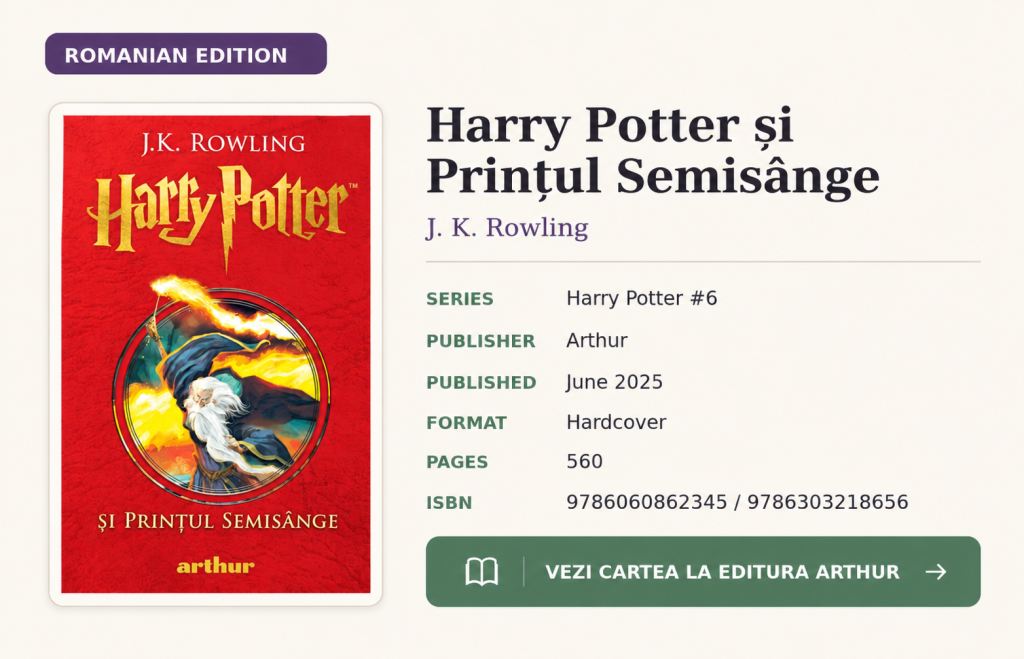
- Romanian Title: Harry Potter și Prințul Semipur
- Author: J. K. Rowling
- Series: Harry Potter #6
- Genre: Fantasy, Children’s Books, Young Adult
- Publisher (EN): Bloomsbury
- Publisher (RO): Egmont
- Published (EN): 2005
- Format Experienced: Physical book
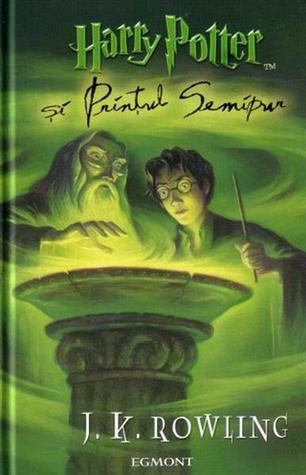
- Edition Owned: Romanian edition, Egmont
📚 Reading Order
- Harry Potter and the Philosopher’s Stone
- Harry Potter and the Chamber of Secrets
- Harry Potter and the Prisoner of Azkaban
- Harry Potter and the Goblet of Fire
- Harry Potter and the Order of the Phoenix
- Harry Potter and the Half-Blood Prince
- Harry Potter and the Deathly Hallows
🛒 Buy the Book
If Harry Potter and the Half-Blood Prince sounds like your kind of read, you can support BookFairy by purchasing the book through the links below. It won’t cost you anything extra, and using these links helps support the site while allowing me to continue creating honest, independent book reviews.