 Fantasy
 Horror
📝 First Impressions
The Ocean at the End of the Lane feels, from its very first pages, like a story remembered rather than a story simply told. Neil Gaiman takes an adult narrator back to the place where he grew up, to a childhood that at first seems ordinary and almost comforting, but where memory quickly begins to bend into something darker, stranger and far more unsettling.
What I loved immediately was that sense of looking back at childhood through adult eyes while still allowing the child’s perspective to remain completely real. When you are a child, the things you do not understand can become enormous. A tense conversation between adults, a frightening person, a rule you cannot explain, a sudden change in the atmosphere of your own home — all of these can feel as threatening as any monster. Gaiman takes that feeling and makes it literal.
There is something deceptively simple about the beginning. A man returns to the area where he grew up and finds himself drawn towards the Hempstock farm, where memories begin to surface. From there, the story slips almost effortlessly into the past. The transition is so smooth that the strange events never feel like they arrive out of nowhere. They seem to grow naturally from the landscape, from loneliness, from fear and from the imagination of a child trying to make sense of a world controlled by adults.
And then there is the ocean itself — a small pond that Lettie Hempstock insists is an ocean. That idea alone says so much about the book. Childhood is full of things that are simultaneously tiny and enormous. A pond can be an ocean. A house can be an entire universe. A few frightening days can shape the person you become decades later.
💜 What I Loved
The strongest part of the novel for me is the way Gaiman captures childhood vulnerability without romanticising childhood itself.
There is nostalgia here, certainly, but this is not a cosy story about returning to happier times. Childhood in The Ocean at the End of the Lane can be lonely, confusing and terrifying. Children have very little control over their lives. Adults decide where they go, what happens in their homes and which explanations they are expected to accept. When something is wrong, a child may recognise the danger perfectly well while still having no power to change it.
That powerlessness becomes particularly effective once Ursula Monkton enters the story. She is frightening not simply because of what she is, but because she occupies an adult role and therefore gains authority over the narrator. His fear is dismissed, his choices become restricted, and the place that should be safest — his own home — becomes hostile. For me, that is far more disturbing than a conventional monster.
I also loved the Hempstock women. Lettie, her mother and her grandmother feel as though they belong to a mythology much older than the story itself. Gaiman never over-explains them, and that makes them more interesting. They are comforting without ever becoming ordinary, powerful without needing elaborate displays of magic, and somehow both completely at home in the English countryside and completely outside normal time.
Lettie in particular is wonderful. She treats extraordinary things with such matter-of-fact confidence that the narrator, and therefore the reader, begins to trust her almost immediately. Their friendship gives the book its emotional centre. She never talks down to him and never dismisses his fear. In a story where adults repeatedly fail to understand or protect a child, Lettie believes him.
The atmosphere is another major strength. The book moves between cosy domestic details and genuine horror with almost no warning. Food, farms, bedrooms, gardens and country lanes exist alongside creatures that should not exist at all. That contrast makes the unsettling moments much stronger because the supernatural is not confined to some distant fantasy world. It enters the familiar.
I also appreciated the way the novel explores memory. The narrator’s recollections are not presented as a perfectly preserved record. They are fragmented, resurfacing gradually as he returns to a place associated with them. That feels right. Childhood memories often work exactly like that: one place, smell or object suddenly unlocks something that seemed completely forgotten.
And beneath all the fantasy and horror is something much more human. The things we fear, the people who protect us, the moments in which we feel abandoned or believed — these experiences stay with us. We may forget the details, but they still become part of the adult we eventually turn into.
🤔 What Didn’t Quite Work for Me
As much as I enjoyed the novel, there were moments when its dreamlike quality worked slightly against it.
Gaiman deliberately leaves many things unexplained, particularly when it comes to the Hempstocks and the deeper rules of the supernatural world. Most of the time I liked this because too much explanation would have destroyed some of the mystery. But occasionally I wanted just a little more structure. Certain events happen according to rules that feel intuitive rather than clearly established, and although that suits the fairy-tale atmosphere, it can also make parts of the story feel slightly elusive.
The pacing is also unusual. This is a short novel, and once the central conflict begins, events move quickly. Because the book is so atmospheric and emotionally rich, I sometimes wanted it to slow down and spend more time in particular moments. Some ideas are fascinating enough to support much more exploration, especially the nature of the Hempstocks and the world they seem to understand so easily.
At the same time, I can see why the novel works at this length. It has the shape of a memory: intense, selective and incomplete. Expanding everything might have made the world clearer, but it might also have weakened that strange feeling of remembering something enormous through the limited perspective of childhood.
There were also moments when the symbolism felt more important than the literal mechanics of what was happening. That is not necessarily a flaw, but it does mean this may not work equally well for readers who prefer fantasy with clearly defined systems and explanations. This is much closer to myth, fairy tale and nightmare logic.
👥 Who Would Enjoy
This is a book I would recommend to readers who enjoy fantasy that feels intimate rather than epic. There are supernatural forces, ancient beings and genuine danger, but the story is ultimately very small in scale: one child, one house, one family and a handful of memories that refuse to disappear completely.
Readers who enjoy dark fairy tales, magical realism, folklore and stories where childhood and horror overlap will probably find a lot to love here. It is also a good choice for anyone who appreciates books where atmosphere matters as much as plot.
I think it will particularly appeal to readers who like stories about memory, growing up and the strange way childhood experiences remain inside us long after we stop thinking about them consciously. The horror is effective, but this is not really a horror novel in the traditional sense. Its most disturbing moments often come from helplessness, betrayal and the knowledge that a child can understand that something is wrong while the adults around him refuse to listen.
Readers looking for a detailed magical system, a large fantasy world or a heavily plot-driven adventure may find it too ambiguous. But if you are happy to accept that some things are more powerful when they remain unexplained, this is exactly the kind of book that lingers.
💭 Final Thoughts
The Ocean at the End of the Lane is a strange, beautiful and deeply unsettling story about childhood, memory and the things we carry with us into adulthood.
For me, its greatest strength is the way it understands that childhood fear does not have to be rational to be real. When we are young, the things we cannot understand — or cannot accept — can become monsters. And sometimes the adults around us, intentionally or not, make those monsters even larger.
But the book is not only about fear. It is also about friendship, protection and the people who enter our lives at exactly the moment we need them. Lettie Hempstock becomes part of the narrator’s childhood in a way that continues to shape him even when the memory itself fades.
I also loved the idea that memory is not necessarily lost simply because we cannot consciously access it. Something can disappear from the surface and still remain part of us. Returning to a place, hearing a name or seeing something familiar can suddenly open a door we did not even realise was there.
The novel captures that strange territory between reality and imagination that belongs so completely to childhood. A pond can be an ocean. A familiar road can lead somewhere impossible. A nightmare can be real. And years later, we may no longer be certain exactly what happened — only that it mattered.
That is what stayed with me most after finishing the book: the idea that childhood does not simply end. It becomes part of the foundation beneath everything that comes afterwards, including the fears, friendships and experiences that helped create the adult we eventually became.
✨ The BookFairy Verdict
The Ocean at the End of the Lane
📖 Book Details
- Title: The Ocean at the End of the Lane
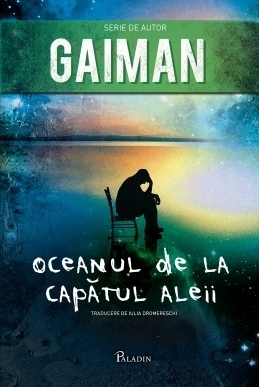
- Romanian Title: Oceanul de la capătul aleii
- Author: Neil Gaiman
- Series: Standalone
- Genre: Fantasy, Horror
- Publisher (EN): William Morrow
- Publisher (RO): Paladin
- Published (EN): 2013
- Published (RO): June 2013
- Pages (EN): 181 pages
- Pages (RO): 200 pages
- Format Experienced: Physical book
- Edition Owned: Romanian hardcover edition, Paladin
- Translator: Iulia Dromereschi
- ISBN (RO): 9789731249001