 Fantasy
 Children's Books
 Young Adult

📝 First Impressions
Harry Potter and the Order of the Phoenix feels like a major turning point in the series. Hogwarts is still full of familiar corridors, lessons, friendships, magical creatures, and school traditions, but the atmosphere has changed. The sense of wonder is now accompanied by frustration, fear, political interference, and the growing awareness that the adults in charge cannot always be trusted to do what is right.
Harry returns to Hogwarts after a summer marked by isolation and uncertainty. The wizarding world is refusing to accept that Voldemort has returned, and Harry is treated as an attention-seeking troublemaker rather than someone who has witnessed something terrifying. That refusal to believe him creates an immediate sense of injustice. The danger is real, but the people with the power to respond choose denial instead.
This is one of the darkest emotional shifts in the series. In earlier books, Hogwarts often felt like a refuge from the outside world. Here, the outside world begins to enter the school through official decrees, propaganda, surveillance, and political control. The castle is still magical, but it no longer feels entirely safe.
The book is also much more interested in the emotional cost of everything Harry has experienced. He is angry, exhausted, frightened, and increasingly isolated. He is not presented as a perfectly calm hero who always knows what to do. He reacts badly, loses patience, pushes people away, and struggles to explain what is happening inside him.
That makes the story more uncomfortable, but also more honest. Harry is growing up in the middle of a crisis, and growing up does not make him less vulnerable. It simply makes him more aware of how much he has to lose.
💜 What I Loved
What I enjoyed most was the book’s exploration of resistance. When the official authorities refuse to teach students how to defend themselves, Harry, Ron, Hermione, and their friends decide to create their own secret group. Dumbledore’s Army becomes one of the most satisfying parts of the novel because it gives the students a sense of purpose and solidarity.
The group is not simply about learning spells. It is about reclaiming control. These young people are constantly told that they are too young, too inexperienced, or too troublesome to understand what is happening. Instead of accepting that judgment, they choose to prepare themselves.
The training scenes also show how much the characters have grown. They are no longer children discovering magic for the first time. They are becoming capable, determined, and willing to take responsibility for one another. The friendships feel more mature because they are tested by fear, secrecy, disagreement, and real danger.
Dolores Umbridge is another element that works extremely well. She is frightening precisely because she does not behave like a traditional villain. She smiles, speaks politely, wears carefully chosen colours, and presents herself as respectable. Yet beneath that appearance is cruelty, control, and a complete lack of empathy.
Her authority is based on humiliation and punishment rather than competence. She does not need to shout in order to make people afraid. She uses rules, paperwork, inspections, detentions, and institutional power to create an environment where everyone feels watched. Her presence turns Hogwarts into a place of quiet oppression.
The political dimension of the story is also compelling. The Ministry of Magic attempts to control the narrative by attacking Harry’s credibility and limiting the information available to the public. The Daily Prophet becomes a tool of propaganda, while inconvenient truths are dismissed as dangerous rumours.
This makes the wizarding world feel larger and more realistic. Evil does not always arrive wearing a black cloak. Sometimes it appears as bureaucracy, denial, censorship, and the deliberate protection of a comfortable lie.
I also appreciated the role of Sirius Black. His relationship with Harry is complicated, affectionate, and deeply imperfect. Sirius wants to protect Harry, but he also sees him through the shadow of James and struggles with the limitations placed on him. Their connection carries a painful sense of missed time. They care about each other, but neither of them always knows how to express that care safely.
The book’s treatment of grief is powerful as well. Harry is carrying trauma that many people around him do not fully understand. He is expected to continue functioning while adults debate whether his experience is politically convenient. His anger is not always easy to read, but it reflects how isolated he feels.
The novel also gives Hermione some of her strongest moments. She remains intelligent and principled, but she is not merely the person who explains the rules or solves academic problems. She understands the importance of organisation, communication, journalism, solidarity, and practical resistance. Her ideas often provide the structure that allows the others to act.
🤔 What Didn’t Quite Work for Me
The biggest difficulty is the pacing. This is a very long book, and parts of it feel repetitive. Harry’s anger, headaches, nightmares, arguments, and emotional frustration are understandable, but the same conflicts sometimes return without developing as quickly as they could.
The story spends a great deal of time showing Harry feeling isolated, misunderstood, and furious. That is central to the book, but it can also make the reading experience emotionally heavy. There were moments when I wanted the plot to move forward rather than remain inside the same cycle of anger and misunderstanding.
Harry’s relationship with Dumbledore is particularly frustrating. Dumbledore’s silence has narrative consequences, and the reader can understand why he makes certain choices, but the lack of communication creates unnecessary suffering. Harry is already struggling with fear and uncertainty, and being excluded from important information makes his situation even more difficult.
Some characters also receive less attention than they deserve. Ron, Ginny, Neville, Luna, and other members of Dumbledore’s Army become important to the resistance, but the enormous size of the novel means that not every relationship can be explored with equal depth.
The book can also feel divided between two different stories. One is a school-based resistance narrative focused on Umbridge and the Ministry. The other is a darker exploration of prophecy, trauma, the Order of the Phoenix, and Voldemort’s connection to Harry. Both elements are important, but the movement between them is not always smooth.
There are also moments when the exposition becomes heavy. The wizarding world contains a great deal of history, political detail, and hidden information, and the novel sometimes pauses to explain rather than allowing the discoveries to unfold more naturally.
Still, these weaknesses are connected to the ambition of the book. Rowling is trying to show a world under political pressure, a teenager dealing with trauma, a school facing institutional control, and a war beginning to move into the open. The result is not always balanced, but it is undeniably significant.
👥 Who Would Enjoy This Book?
This book would be a strong choice for readers who enjoy:
- fantasy stories that become darker and more political;
- school settings shaped by conflict and resistance;
- friendships tested by fear and disagreement;
- stories about propaganda, censorship, and abuse of authority;
- emotionally complicated protagonists;
- coming-of-age narratives;
- magical worlds with increasingly serious consequences.
Readers who have followed Harry, Ron, and Hermione from the beginning will find many emotional rewards here. The novel assumes an investment in the characters and in the history of the wizarding world. It is not the lightest or most accessible entry point into the series, but it is an important continuation of everything that came before.
It may especially appeal to readers who enjoy fantasy with institutional conflict. The struggle against Voldemort is no longer happening only through dramatic confrontations. It is also happening through newspapers, classrooms, official statements, secret meetings, and the courage to keep telling the truth.
Readers who prefer faster pacing or a more cheerful Hogwarts atmosphere may find this instalment difficult. The story is deliberately frustrating, and much of its emotional power comes from showing how exhausting it can be to resist people who control the rules.
💭 Final Thoughts
Harry Potter and the Order of the Phoenix is a story about resistance in a world that would prefer silence.
The students are told not to ask questions. Harry is told not to speak. The truth is treated as an inconvenience, and authority is used to protect appearances rather than people. Against that pressure, the characters create their own community. They teach one another, defend one another, and refuse to accept that obedience is the same thing as safety.
The book is not always easy to enjoy. It is long, emotionally tense, and at times repetitive. Harry’s anger can be exhausting, even when it is completely understandable. Yet the novel’s discomfort is also part of its purpose. It shows what happens when a young person is forced to carry fear, grief, responsibility, and public disbelief all at once.
What stays with me most is the idea that courage does not always look dramatic. Sometimes courage means continuing to speak when nobody wants to listen. Sometimes it means learning beside your friends in secret. Sometimes it means refusing to let an institution decide what is true.
This is a darker and more complicated chapter of the series. It may not be the most effortless instalment, but it adds important emotional and political layers to the story. Hogwarts is no longer simply a place where Harry learns magic. It becomes a place where he learns what it means to resist, to grieve, and to keep going when the adults have failed.
✨ The BookFairy Verdict
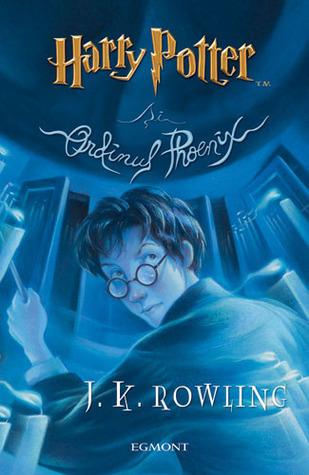
Harry Potter and the Order of the Phoenix
📖 Book Details
- Edition Owned: Egmont
- Title: Harry Potter and the Order of the Phoenix
- Romanian Title: Harry Potter și Ordinul Phoenix
- Author: J. K. Rowling
- Series: Harry Potter (#5)
- Original Title: Harry Potter and the Order of the Phoenix
- Translator: Tatiana Dragomir
- Publisher (RO): Arthur GOLD
- Published (RO): September 2024
- Pages: 992
- Format: Hardcover
- Age Recommendation: 12+
- ISBN: 9786067887723 / 9786303214832
📚 Reading Order
- Harry Potter and the Philosopher’s Stone
- Harry Potter and the Chamber of Secrets
- Harry Potter and the Prisoner of Azkaban
- Harry Potter and the Goblet of Fire
- Harry Potter and the Order of the Phoenix
- Harry Potter and the Half-Blood Prince
- Harry Potter and the Deathly Hallows

🛒 Buy the Book
If Harry Potter and the Order of the Phoenix sounds like your kind of read, you can support BookFairy by purchasing the book through the links below. It won’t cost you anything extra, and using these links helps support the site while allowing me to continue creating honest, independent book reviews.