 Fantasy
 Children's Books
 Young Adult


📝 First Impressions
Harry Potter and the Deathly Hallows feels different from every previous book in the series almost immediately. Hogwarts is no longer the centre of the story, the familiar rhythm of school terms is gone, and Harry, Ron and Hermione are finally forced into the world they have spent years preparing to face.
That change gives the book a very different atmosphere. There is far less comfort here. The trio are constantly moving, constantly hiding and constantly trying to work out what to do next without the protection of teachers, routines or the castle itself. For the first time, they are truly on their own.
I liked that sense of uncertainty. The mission Dumbledore left behind is important, but frustratingly incomplete. Harry knows that the Horcruxes must be found and destroyed, but he does not know exactly where they are, how to find them or what else Dumbledore may have been hiding from him. That lack of certainty makes the story feel much more vulnerable than the previous books.
At the same time, the book immediately feels heavier. There is a constant awareness that people are dying, that the Ministry has fallen and that Voldemort’s influence is spreading everywhere. The wizarding world is no longer threatened from the outside. It has already been infiltrated.
And that gives the final book a very different kind of tension.
💜 What I Loved
One of the strongest things about Deathly Hallows is the way it finally forces Harry to question Dumbledore.
For most of the series, Dumbledore has been presented as the person who understands more than everyone else. Harry trusts him almost completely. In this book, that certainty begins to crack. Harry learns that Dumbledore had secrets, ambitions and mistakes of his own, and that is important because it makes him feel much more human.
I liked that Harry’s grief becomes mixed with anger and disappointment. He still loves and respects Dumbledore, but he is no longer able to see him as infallible. That feels like a natural part of Harry growing up. Eventually, children discover that the adults they admired were complicated people too.
The Horcrux hunt is also one of the most important parts of the book. It gives the final conflict a clear purpose and connects directly to everything Harry learned in Half-Blood Prince. The idea that pieces of Voldemort’s soul have been hidden inside significant objects makes the task personal, dangerous and symbolic at the same time.
The introduction of the Deathly Hallows adds another layer to the story. The Elder Wand, the Resurrection Stone and the Invisibility Cloak create a second mystery running alongside the Horcrux hunt. I especially liked the story of the Three Brothers and the way it feels like an old fairy tale that has somehow survived inside the wizarding world for generations.
Hermione is particularly strong in this book. She is often the one holding everything together, both practically and emotionally. Her planning saves them repeatedly, and the sacrifices she makes before leaving home show just how serious the situation has become.
Ron’s departure is painful, but I think it is also believable. The Horcrux amplifies all the insecurities that were already there: his fear that he is less important than Harry, his jealousy and his worry about his family. His return works because he has to confront those feelings rather than simply pretending they never existed.
I also loved several of the quieter emotional moments. The visit to Godric’s Hollow, Harry seeing his parents’ graves, the appearance of the doe Patronus, Dobby’s rescue and sacrifice — these scenes work because the series has spent so many books building the relationships behind them.
The Battle of Hogwarts is another obvious highlight. Returning to the castle after spending so much of the book away from it gives the final confrontation real emotional weight. Hogwarts has always represented safety, friendship and belonging, so seeing it become a battlefield is genuinely painful.
🤔 What Didn’t Quite Work for Me
The biggest problem for me is the pacing in the middle section.
The camping and travelling chapters are important because they show how isolated the trio has become, but they can also feel repetitive. They move from place to place, argue, worry about supplies and struggle to find the next Horcrux, and although that frustration is clearly intentional, I sometimes felt it too strongly as a reader.
The story slows down considerably during these sections, especially compared with the urgency of what is happening elsewhere in the wizarding world.
I also have mixed feelings about the Deathly Hallows themselves. I like the mythology around them, and the Tale of the Three Brothers is one of the most memorable pieces of world-building in the entire series. But introducing another major magical mystery in the final book sometimes makes the plot feel more crowded than necessary.
Harry’s obsession with the Hallows also becomes frustrating at times. It makes sense psychologically, particularly because the Resurrection Stone offers the possibility of reconnecting with the dead, but there are moments when it feels like a distraction from the Horcrux mission.
Some of the revelations near the end are also delivered very quickly. There is so much information to process — Snape’s memories, Dumbledore’s plans, Harry’s connection to Voldemort, the Elder Wand — that the final section becomes extremely dense.
And then there is the epilogue.
I understand why it exists. After seven books of danger, loss and uncertainty, there is something comforting about seeing the characters years later, alive and with families of their own. But for me, it feels slightly too neat. I would have preferred a little more space to understand how the wizarding world rebuilt itself after the war and how the surviving characters dealt with everything they had experienced.
The ending gives us closure, but not necessarily all the aftermath I wanted.
👥 Who Would Enjoy
This is obviously a book for readers who have followed the series from the beginning. Almost everything here depends on years of character development, relationships and previous events.
Readers who enjoy darker fantasy and war-time stories will probably appreciate how much the tone has changed. There is far less school-based adventure and much more fear, resistance, sacrifice and survival.
It will also appeal to readers who enjoy stories about loyalty and friendship under pressure. Harry, Ron and Hermione’s relationship is tested more seriously here than anywhere else in the series. They are exhausted, frightened and uncertain, and that makes their friendship feel more real.
Readers who love the mythology of the wizarding world will probably enjoy the Deathly Hallows storyline, while those who are more interested in the central Voldemort conflict may prefer the Horcrux sections.
And if Hogwarts itself has always been one of your favourite parts of the series, the final return to the castle carries an enormous amount of emotional weight.
💭 Final Thoughts
Harry Potter and the Deathly Hallows brings the series to a suitably dark and emotional conclusion, even if it is not one of my favourite books of the seven.
What works best for me is the sense that the characters can no longer rely on the structures that protected them when they were younger. Hogwarts, Dumbledore, the Ministry and even the idea that adults will somehow fix everything have all disappeared.
Harry has to make decisions without knowing whether they are correct.
That is one of the most important changes in the series. He is no longer the child being guided towards the next challenge. He is responsible for finishing something that began long before he understood it.
The book is also deeply concerned with death, but not only in the obvious sense. Voldemort is terrified of death and has destroyed his own soul trying to escape it. Harry eventually has to do the opposite: accept the possibility of death willingly.
That contrast gives the ending much of its meaning.
The revelations about Snape are also crucial. Whatever we may think of him as a person, the truth about his role changes the way we understand many events from the previous books. His story is tragic, complicated and uncomfortable, which makes it far more interesting than a simple last-minute transformation into a hero.
There are parts of the book I found slow, and I think the final volume tries to carry so many mysteries, revelations and emotional conclusions that it occasionally feels overloaded.
But the strongest moments are powerful because we have spent so much time with these characters.
By the end, the war has taken away people we cared about, Hogwarts has been changed forever and Harry has finally faced the person who has shaped his entire life.
The series began with a lonely child discovering that he belonged somewhere.
It ends with him understanding that belonging is not about a place, a prophecy or even a magical world.
It is about the people he chose to stand beside.
✨ The BookFairy Verdict
Harry Potter and the Deathly Hallows
📖 Book Details
- Title: Harry Potter and the Deathly Hallows
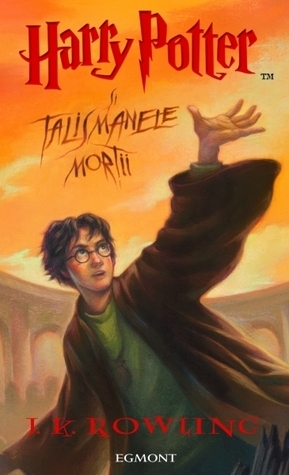
- Romanian Title: Harry Potter și Talismanele Morții
- Author: J. K. Rowling
- Series: Harry Potter #7
- Genre: Fantasy, Children’s Books, Young Adult
- Publisher (EN): Bloomsbury
- Publisher (RO): Egmont
- Published (EN): 2007
- Published (RO): 2007
- Pages (EN): 607 pages
- Pages (RO): 624 pages
- Format Experienced: Physical book
- Edition Owned: Romanian hardcover edition, Egmont
- Translator: Ioana Iepureanu
- ISBN (RO): 978-973-583-890-4
📚 Reading Order
- Harry Potter and the Philosopher’s Stone
- Harry Potter and the Chamber of Secrets
- Harry Potter and the Prisoner of Azkaban
- Harry Potter and the Goblet of Fire
- Harry Potter and the Order of the Phoenix
- Harry Potter and the Half-Blood Prince
- Harry Potter and the Deathly Hallows
🛒 Buy the Book
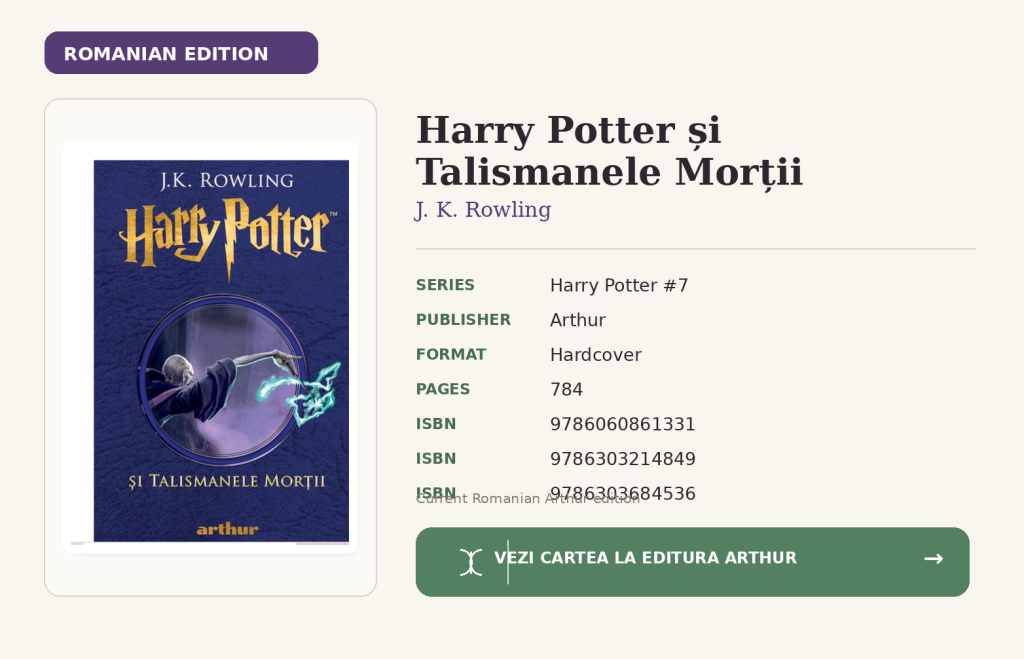
If Harry Potter and the Deathly Hallows sounds like your kind of read, you can support BookFairy by purchasing the book through the links below. It won’t cost you anything extra, and using these links helps support the site while allowing me to continue creating honest, independent book reviews.