 Fantasy


📝 First Impressions
The Last Wish is not a conventional fantasy novel, but a collection of interconnected stories inspired by childhood fairy tales, folklore and familiar legends. Andrzej Sapkowski takes stories we think we know—cursed princes, beautiful princesses, dangerous witches, enchanted creatures and impossible bargains—and turns them into something darker, sharper and far less predictable.
As someone who loves RPGs, I approached the book partly through the world of The Witcher games. I have never actually played the games, but reading these stories helped me recognise the kinds of characters, quests and moral choices that shaped them. I could almost picture Geralt moving from one mission to the next, investigating curses, negotiating with monsters and discovering that the truth is rarely as simple as it first appears.
What makes the collection particularly interesting is the way it challenges the traditional division between heroes and villains. The monsters are not always the real danger, the humans are not always innocent, and the old stories do not end with neat solutions or uncomplicated happy endings. Sapkowski gives these tales a distinctly adult, cynical and often surprisingly humane perspective.
💜 What I Loved
What I enjoyed most about The Last Wish is the way Andrzej Sapkowski takes familiar fairy-tale elements and gives them a darker, more complicated life. These stories may begin with recognisable ideas—curses, enchanted creatures, beautiful princesses, dangerous forests and impossible choices—but they rarely develop in the direction we expect. The old tales are still there, just stripped of their simplicity.
I particularly liked the moral ambiguity running through the collection. Geralt is often expected to choose between two sides, yet the stories repeatedly show that neither side is entirely innocent or entirely guilty. Humans can be cruel, monsters can be vulnerable, and the right decision is not always the one that produces the most satisfying ending. Geralt’s work is therefore much more than killing creatures: it involves listening, investigating, negotiating and deciding which kind of danger is least destructive.
The connection with The Witcher games also made the reading experience especially interesting for me. Even though I have not played the games yet, I could recognise the structure of quests and encounters: Geralt arrives somewhere, hears a frightening story, follows a trail of clues and gradually discovers that the truth is far more complicated than the rumours suggested. Reading the book gave me a better understanding of the world that the games later transformed into such a memorable role-playing experience.
I also appreciated the collection format. Each story has its own atmosphere and central conflict, but together they begin to build a larger picture of Geralt, his profession and the world he inhabits. The stories feel like fragments from a much bigger history, allowing the reader to discover the Continent gradually rather than receiving a long explanation all at once.
🤔 What Didn’t Quite Work for Me
Although I enjoyed the collection, not every story worked equally well for me. Some felt more memorable and emotionally complete than others, while a few seemed mainly to introduce an idea, a creature or a conflict without giving it quite enough room to develop. Because the book is made up of connected short stories, the pacing can also feel uneven. Just as I was becoming fully invested in one situation, the story would end and move on to something else.
I sometimes felt that the world itself was more fascinating than the individual plots. The Continent is full of legends, political tensions, old grudges and creatures with their own histories, but this first volume only gives us glimpses of that wider reality. I wanted more context about the different kingdoms, the people Geralt encounters and the rules governing his profession.
The book also carries the shadow of the games for me. Even without having played them, I know how influential and beautifully developed that world became in its video-game form. As a result, I occasionally found myself imagining the stories as quests rather than experiencing them entirely on their own terms. That is not necessarily a flaw in Sapkowski’s writing, but it did affect the way I read the book. I could see the foundations of something extraordinary, while still feeling that this particular volume was only the beginning.
👥 Who Would Enjoy This Book?
The Last Wish is a good choice for readers who enjoy fantasy built around folklore, fairy tales and moral ambiguity rather than straightforward battles between good and evil. It will appeal to anyone who likes stories about curses, monsters, magic and legendary creatures, especially when those familiar elements are given a darker or more adult interpretation.
Readers who enjoy short-story collections may also appreciate the structure. Each tale offers a different situation and atmosphere, while Geralt provides a thread of continuity between them. The book can be read relatively easily in smaller portions, although the stories gradually create a richer picture of the world and of Geralt himself.
It is also an obvious choice for fans of The Witcher games or the television adaptations who want to discover where the world began. The book offers a different experience from the games, but it makes the later adaptations easier to understand by introducing the characters, the tone and the kind of moral choices that define the series.
💭 Final Thoughts
I went into The Last Wish with an interest in RPGs and with some curiosity about the literary origins of The Witcher. I have not played the games yet, but reading the book helped me understand the structure of their world: the missions, the monsters, the rumours, the moral dilemmas and the constant uncertainty about who is actually telling the truth.
What I found most appealing was Sapkowski’s decision to work with stories that feel familiar from childhood and then complicate them. The book does not simply retell old legends. It questions them. It asks what happens after the curse is broken, whether a princess is really helpless, whether a monster deserves to be feared and whether a supposedly heroic choice can still cause harm.
At the same time, I cannot say that this was an extraordinary reading experience for me. It is a good and imaginative collection, with a fascinating protagonist and an intriguing world, but some of the stories worked better than others and I often felt that I was looking at the first outline of something much larger. The connection with the games also made me aware of how brilliantly this material was later transformed into an interactive world.
I am glad I finally read it, and I am curious to see how the series develops from here. The Last Wish gave me a new perspective on the legends and fairy tales behind The Witcher, while also introducing a world I would like to explore further.
✨ The BookFairy Verdict
The Last Wish
📖 Book Details
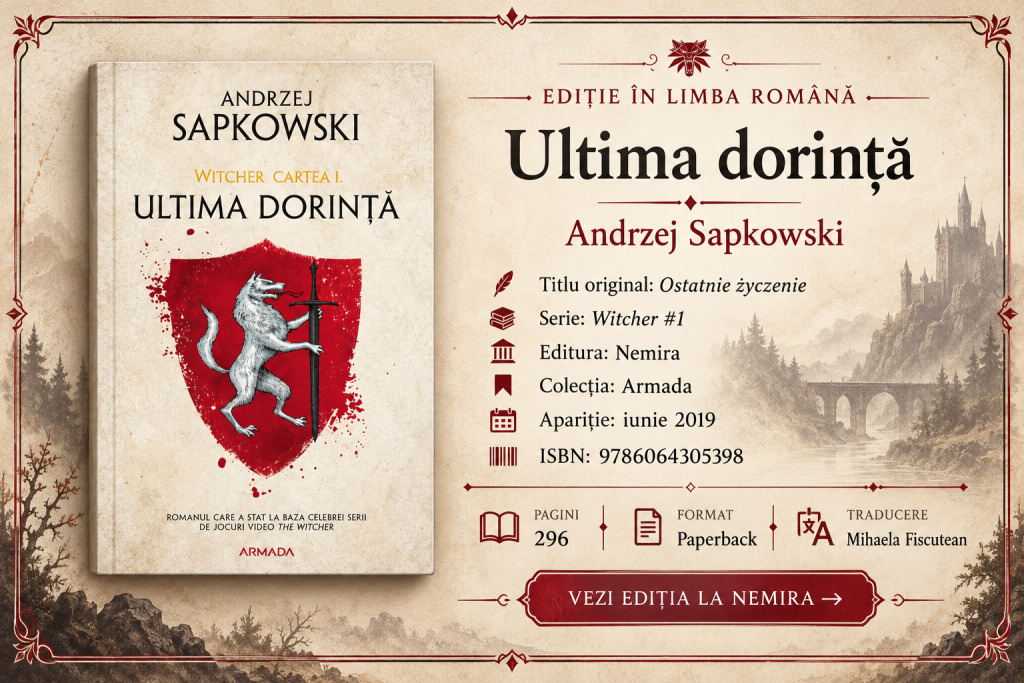
Title: The Last Wish
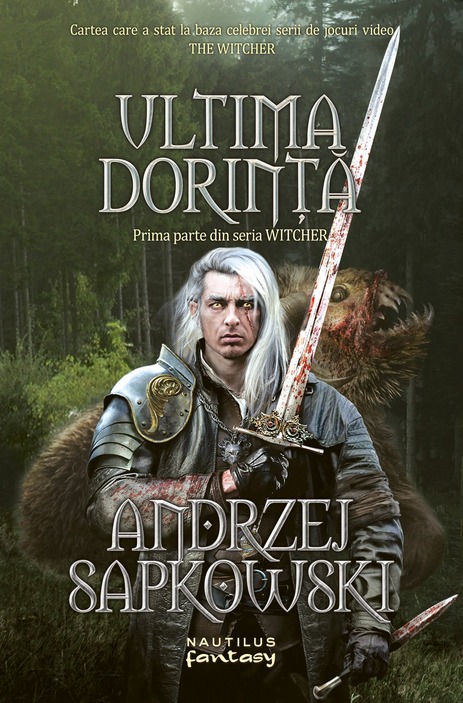
Romanian Title: Ultima dorință
Original Title: Ostatnie życzenie
Author: Andrzej Sapkowski
Series: The Witcher — Book 1
Genre: Fantasy
Publisher (EN): Gollancz
Publisher (RO): Nemira — Armada
Published (EN): 2007
Published (RO): 11 June 2019
Pages (EN): 288
Pages (RO): 296
Format Experienced: Physical book
Edition Owned: Romanian paperback edition, Nemira/Armada, 2019
📚 Reading Order
- Ultima dorință — The Last Wish
- Sabia destinului — Sword of Destiny
- Sângele elfilor — Blood of Elves
- Vremea disprețului — Time of Contempt
- Botezul focului — Baptism of Fire
- Turnul rândunicii — The Tower of the Swallow
- Domnița Lacului — The Lady of the Lake
- Anotimpul furtunilor — Season of Storms
- Răscrucea Corbilor — Crossroads of Ravens — later prequel
For a first-time read, Crossroads of Ravens is best read after the original eight books.
🛒 Buy the Book
If The Last Wish sounds like your kind of read, you can support BookFairy by purchasing the book through the links below. It won’t cost you anything extra, and your purchase helps support the site.