Books, Short Stories, Reading Order & Romanian Editions | BookFairy
📖 About This Bibliography
Andrzej Sapkowski is best known as the creator of The Witcher, but his literary career extends beyond Geralt of Rivia and the fantasy world that made him internationally famous.
His work includes short fiction, historical fantasy, standalone novels, essays, literary criticism, a role-playing game and book-length conversations about literature.
This BookFairy bibliography covers Sapkowski’s principal published works, organised by their original Polish publication dates.
It also includes the recommended reading order for his two major fantasy series, the contents of his principal short-story collections, and information about Romanian translations.
A note on publication dates: The years in the main bibliography refer to original Polish publication, not the later English translations. Where a collection includes previously published stories, it is listed by the year that collection first appeared.
📚 Andrzej Sapkowski Books in Publication Order
| Year | Original Polish Title | English Title / Description | Type |
|---|---|---|---|
| 1986 | Wiedźmin | The Witcher | Short story; first published in Fantastyka |
| 1990 | Wiedźmin | The Witcher | Original five-story collection |
| 1992 | Miecz przeznaczenia | Sword of Destiny | Witcher short-story collection |
| 1993 | Ostatnie życzenie | The Last Wish | Witcher short-story collection |
| 1994 | Krew elfów | Blood of Elves | Witcher Saga #1 |
| 1995 | Czas pogardy | Time of Contempt | Witcher Saga #2 |
| 1995 | Świat króla Artura. Maladie | The World of King Arthur / Maladie | Essay and novella |
| 1995 | Oko Yrrhedesa | The Eye of Yrrhedes | Fantasy role-playing game |
| 1996 | Chrzest ognia | Baptism of Fire | Witcher Saga #3 |
| 1997 | Wieża Jaskółki | The Tower of the Swallow | Witcher Saga #4 |
| 1999 | Pani Jeziora | The Lady of the Lake | Witcher Saga #5 |
| 2000 | Coś się kończy, coś się zaczyna | Something Ends, Something Begins | Short-story collection |
| 2001 | Rękopis znaleziony w Smoczej Jaskini | Manuscript Found in a Dragon’s Cave | Fantasy reference book |
| 2002 | Narrenturm | The Tower of Fools | Hussite Trilogy #1 |
| 2004 | Boży bojownicy | Warriors of God | Hussite Trilogy #2 |
| 2005 | Historia i fantastyka | History and Fantasy | Book-length interview with Stanisław Bereś |
| 2006 | Lux perpetua | Light Perpetual | Hussite Trilogy #3 |
| 2009 | Żmija | The Viper | Standalone novel |
| 2012 | Maladie i inne opowiadania | Maladie and Other Stories | Expanded short-story collection |
| 2013 | Sezon burz | Season of Storms | Standalone Witcher novel |
| 2024 | Rozdroże kruków | Crossroads of Ravens | Witcher prequel |
This chronology records distinct original publications rather than every subsequent printing, translation or cover redesign.
Sapkowski also published individual stories and essays in magazines and anthologies. Some of these appeared years before they were collected in book form.
⚔️ The Witcher – Complete Reading Order
The modern Witcher sequence contains nine principal books: two introductory short-story collections, five interconnected saga novels and two later standalone prequels.
The Introductory Short Stories
- The Last Wish — Ostatnie życzenie (1993)
- Sword of Destiny — Miecz przeznaczenia (1992)
Although Sword of Destiny was published first in Poland, The Last Wish provides the better introduction to Geralt and should be read first.
The Witcher Saga
- Blood of Elves — Krew elfów (1994)
- Time of Contempt — Czas pogardy (1995)
- Baptism of Fire — Chrzest ognia (1996)
- The Tower of the Swallow — Wieża Jaskółki (1997)
- The Lady of the Lake — Pani Jeziora (1999)
These five novels form the central Witcher Saga.
Later Witcher Novels
- Season of Storms — Sezon burz (2013)
- Crossroads of Ravens — Rozdroże kruków (2024; English translation 2025)
Both novels explore periods before the main saga.
However, their position in the fictional chronology does not necessarily make them ideal starting points.
💜 BookFairy Recommendation: Read The Last Wish and Sword of Destiny first, follow them with the five saga novels, and save Season of Storms and Crossroads of Ravens until afterwards.
📜 The Witcher Short Stories
Wiedźmin – The Original Collection (1990)
Published by Reporter, this early collection contained five stories:
- Droga, z której się nie wraca — A Road with No Return
- Kwestia ceny — A Question of Price
- Ziarno prawdy — A Grain of Truth
- Mniejsze zło — The Lesser Evil
- Wiedźmin — The Witcher
Four stories were subsequently included in The Last Wish.
A Road with No Return, which connects to the Witcher universe, was collected elsewhere.
Collector’s note: Wiedźmin (1990) is historically significant, but it should not be mistaken for an additional instalment in the modern nine-book reading sequence.
The Last Wish (1993)
Original title: Ostatnie życzenie
The collection includes the following stories:
- The Witcher
- A Grain of Truth
- The Lesser Evil
- A Question of Price
- The Edge of the World
- The Last Wish
These stories are connected by The Voice of Reason, a framing narrative divided into seven sections.
The collection establishes Geralt’s profession, his approach to monsters and the complicated moral questions that become central to the series.
Sword of Destiny (1992)
Original title: Miecz przeznaczenia
The collection contains six stories:
- The Bounds of Reason
- A Shard of Ice
- Eternal Flame
- A Little Sacrifice
- Sword of Destiny
- Something More
These stories continue developing Geralt’s world and introduce relationships and events that become particularly important in the main saga.
🏰 The Hussite Trilogy
Sapkowski’s second major fictional series takes place in a very different setting.
Rather than following a professional monster hunter through an invented fantasy world, The Hussite Trilogy blends historical fiction, medieval politics, religion, magic and supernatural elements.
The trilogy follows Reinmar of Bielawa, commonly known as Reynevan.
Complete Reading Order
- The Tower of Fools — Narrenturm (2002)
- Warriors of God — Boży bojownicy (2004)
- Light Perpetual — Lux perpetua (2006)
The books should be read in this order.
They form one continuing narrative and are entirely separate from The Witcher.
🐍 Standalone Novels
Żmija – The Viper (2009)
Żmija is a standalone work combining historical and fantastic elements.
Its setting draws upon the Soviet–Afghan War, providing a departure from the medieval-inspired worlds most closely associated with Sapkowski.
It is not part of either The Witcher or The Hussite Trilogy.
📚 Other Short-Story Collections
Coś się kończy, coś się zaczyna (2000)
English title: Something Ends, Something Begins
This collection brought together eight stories from different stages of Sapkowski’s career, including fantasy, science fiction and fiction outside his principal series.
Its contents were:
- Droga, z której się nie wraca
- Muzykanci
- Tandaradei!
- W leju po bombie
- Coś się kończy, coś się zaczyna
- Bitewny pył
- Złote popołudnie
- Zdarzenie w Mischief Creek
Two works have connections with the Witcher universe:
- Droga, z której się nie wraca — A Road with No Return
- Coś się kończy, coś się zaczyna — Something Ends, Something Begins
The title story is a playful, non-canonical Witcher-related work rather than an alternative ending that should replace the saga’s published conclusion.
Maladie i inne opowiadania (2012)
English title: Maladie and Other Stories
Published by superNOWA, this expanded collection contains ten stories:
- Droga, z której się nie wraca
- Muzykanci
- Tandaradei!
- W leju po bombie
- Coś się kończy, coś się zaczyna
- Bitewny pył
- Złote popołudnie
- Zdarzenie w Mischief Creek
- Spanienkreuz
- Maladie
The 2012 volume brings together the eight stories from the earlier collection and adds Spanienkreuz and Maladie.
The collection explores several genres, including fantasy, science fiction and political fiction.
Collector’s note: Readers who own Maladie i inne opowiadania already have the eight stories included in Coś się kończy, coś się zaczyna. The earlier collection remains a separate bibliographic edition, but the stories should not be counted twice.
Maladie
Originally published in book form alongside Sapkowski’s writing about Arthurian legend, Maladie draws upon the literary traditions surrounding Tristan and Isolde.
It is also available in later collections and translations.
For bibliographic purposes, it is identified as an individual novella, but its republication should not be confused with a completely new work.
🖋️ Essays, Literary Criticism & Non-Fiction
Sapkowski has also written about fantasy as a literary genre.
Świat króla Artura. Maladie (1995)
English: The World of King Arthur / Maladie
A volume combining writing about Arthurian tradition with Sapkowski’s novella Maladie.
It demonstrates his interest in reinterpreting established literary and mythological material.
Rękopis znaleziony w Smoczej Jaskini (2001)
English: Manuscript Found in a Dragon’s Cave: A Compendium of Fantasy Literature
A reference work examining fantasy literature, its traditions and its terminology.
An updated and expanded edition appeared in 2011.
The revised edition is not counted as a separate original work.
Historia i fantastyka (2005)
English: History and Fantasy
A book-length conversation between Andrzej Sapkowski and literary scholar Stanisław Bereś.
It discusses literature, history, imagination and Sapkowski’s work.
Because this is a collaborative interview volume, it is identified separately from his fiction.
Other Essays
Sapkowski’s shorter nonfiction includes:
- Piróg, albo Nie ma złota w Szarych Górach (1993) — an essay concerning fantasy literature.
Additional magazine articles, criticism and shorter nonfiction may appear in periodical bibliographies rather than in his principal book catalogue.
🎲 Role-Playing Games
Oko Yrrhedesa (1995)
English: The Eye of Yrrhedes
Published by MAG, Oko Yrrhedesa is a fantasy role-playing game associated with Sapkowski’s broader interest in fantasy worlds and storytelling.
It is a separate publication, not a Witcher novel.
This title is included because a complete bibliography should acknowledge Sapkowski’s contribution to role-playing literature as well as conventional fiction.
📚 Anthologies, Omnibus Editions & Related Publications
Anthologies Featuring Sapkowski
Sapkowski’s short fiction has appeared in various Polish and international anthologies.
Examples of relevant publications include:
- Trzynaście kotów (1997) — a Polish multi-author anthology associated with his bibliography.
- A Polish Book of Monsters (2010) — includes an English translation of Wiedźmin titled “Spellmaker”.
- The Apex Book of World SF 2 (2012) — includes an English translation of Maladie.
These are multi-author anthologies, not additional original novels by Sapkowski.
Omnibus and Collected Editions
The Witcher stories and novels have appeared in combined editions and boxed sets.
Such editions are useful for collectors, but they normally repackage previously published material.
The original 1990 collection Wiedźmin is noted separately because of its historical significance.
Likewise, the later expanded Maladie collection is identified without counting its previously published stories as new titles.
Witcher Works by Other Writers
The anthology Andrzej Sapkowski przedstawia. Wiedźmin. Szpony i kły (2017) contains fan-written Witcher stories selected for publication.
Despite Sapkowski’s name appearing prominently in its title, the stories are not a collection of original fiction written by him.
It belongs among related publications rather than in the list of Sapkowski-authored novels.
🌍 Translations and International Publications
The Witcher books were originally published in Polish.
English-language readers encountered the series considerably later, beginning with The Last Wish in 2007.
This distinction matters when comparing bibliographies: an English publication date does not necessarily indicate when Sapkowski originally wrote or published a particular work.
For example:
- Sword of Destiny was published in Polish in 1992 but appeared in English in 2015.
- The Last Wish was published in Polish in 1993 but appeared in English in 2007.
- Crossroads of Ravens was first published in Polish in 2024 and translated into English in 2025.
For chronological literary research, the original Polish publication dates are used throughout this bibliography.
🇷🇴 Andrzej Sapkowski – Romanian Editions
Romanian editions of Sapkowski’s two major fantasy series are published by Nemira, including titles under the Armada imprint.
The following tables identify translated works rather than listing every reprint or redesigned cover as a separate book.
The Witcher – Romanian Translations
| # | Original English Title | Romanian Title | Romanian Publisher |
|---|---|---|---|
| 1 | The Last Wish | Ultima dorință | Nemira / Armada |
| 2 | Sword of Destiny | Sabia destinului | Nemira / Armada |
| 3 | Blood of Elves | Sângele elfilor | Nemira / Armada |
| 4 | Time of Contempt | Vremea disprețului | Nemira / Armada |
| 5 | Baptism of Fire | Botezul focului | Nemira / Armada |
| 6 | The Tower of the Swallow | Turnul rândunicii | Nemira / Armada |
| 7 | The Lady of the Lake | Domnița Lacului | Nemira / Armada |
| 8 | Season of Storms | Anotimpul furtunilor | Nemira / Armada |
| 9 | Crossroads of Ravens | Răscrucea Corbilor | Nemira / Armada |
A coordinated nine-volume Romanian Witcher set has also been offered by Nemira.
The Hussite Trilogy – Romanian Translations
| # | English Title | Romanian Title | Romanian Publisher |
|---|---|---|---|
| 1 | The Tower of Fools | Turnul nebunilor | Nemira |
| 2 | Warriors of God | Luptătorii lui Dumnezeu | Nemira |
| 3 | Light Perpetual | Lumina eternă | Nemira |
All three volumes are represented in Nemira’s Romanian catalogue.
Romanian Publication Notes
The publisher information above distinguishes the original literary works from later Romanian reprints.
For collectors, changes in cover design, format or imprint do not automatically make a title a different work.
This bibliography therefore records each translated title once rather than creating duplicate entries for subsequent Nemira or Armada editions.
Other standalone works, essays and collections are listed by their original titles unless a confirmed Romanian publication can be identified.
📖 Books Reviewed on BookFairy
The Last Wish
My introduction to Sapkowski’s fiction was The Last Wish, read in its Romanian Nemira/Armada edition.
I particularly enjoyed the reinterpretations of familiar fairy tales, the moral ambiguity of Geralt’s encounters and the way apparently straightforward monster-hunting assignments become much more complicated.
Although I found some stories more engaging than others, the collection made me curious to continue exploring the Witcher universe.
📕 Read my spoiler-free review of The Last Wish
More BookFairy reviews will be added as I continue reading his books.
💜 A Personal Note
My connection with Andrzej Sapkowski isn’t limited to his fiction.
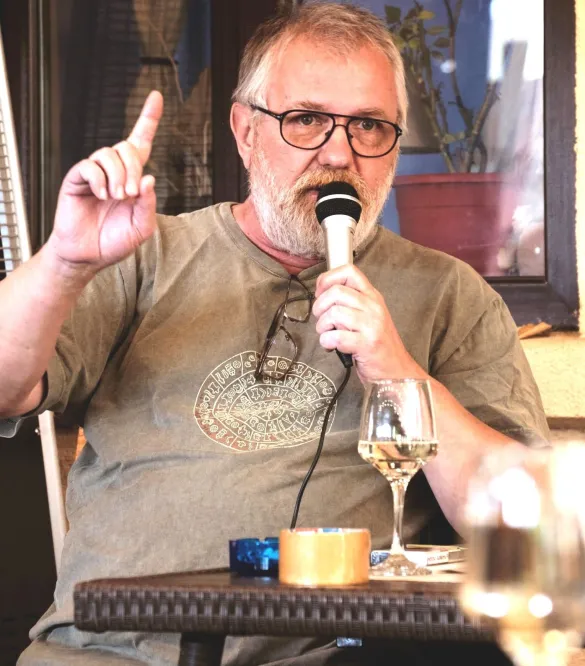
I had the opportunity to meet him in person and speak with him at Eurocon 2016 in Barcelona, an experience that gives his books an additional personal significance for me.
As I continue reading his work, I’ll update BookFairy with new reviews and impressions.
⭐ Where Should You Start Reading Andrzej Sapkowski?
For readers interested in Geralt of Rivia, the natural starting point is The Last Wish.
It introduces the Witcher universe through stories involving folklore, curses, monsters and difficult moral choices.
Continue with Sword of Destiny before beginning the five-novel Witcher Saga.
Readers who prefer historical fantasy can start independently with The Tower of Fools, the opening volume of the Hussite Trilogy.
The two series do not need to be read together.
📚 Bibliographical Sources
The bibliography was compiled using Polish literary references, publisher catalogues and bibliographic records.
Useful sources include:
- Andrzej Sapkowski – Polish-language book catalogue
- Polish Literary Journal – Andrzej Sapkowski bibliography
- Polish Literary Encyclopedia – Andrzej Sapkowski
- Culture.pl – Andrzej Sapkowski
- The Encyclopedia of Science Fiction – Andrzej Sapkowski
- Nemira – Andrzej Sapkowski
- Nemira – The Witcher Series
This page focuses on Sapkowski’s distinct published works, with reprints and translations identified separately where relevant.
Last updated: October 2026.