


 Dystopian
📝 First Impressions
I read Fahrenheit 451 in 2014, and what stayed with me most was not just the story itself, but how uncomfortable it felt to realise that a book published in 1953 could still describe certain aspects of modern life so well.
That was the part that really got under my skin.
At first glance, the premise sounds almost exaggerated: a society where books are forbidden, where firemen burn them instead of putting fires out, and where people are encouraged not to think too deeply about anything. It should feel like a very distant dystopia.
And yet it didn’t.
What struck me was how much of Bradbury’s world is built not only on censorship imposed from above, but on distraction, simplification and the gradual disappearance of curiosity. People are surrounded by entertainment, noise and constant stimulation, but there is very little real reflection underneath it. That felt far too familiar even when I first read it.
I remember thinking that this was one of those books that does not simply tell you a story and then let you move on.
It makes you look around.
It makes you wonder how much a society can lose before people even notice that something important has disappeared.
And because I was reading it decades after Bradbury wrote it, there was something almost eerie about seeing how accurately some of those fears had aged. Not every detail, obviously, but the broader anxiety about people becoming increasingly disconnected from books, ideas, difficult conversations and even from one another felt incredibly relevant.
My note from 2014 ended on a slightly dark joke: I hoped we would not have to be “cleansed” by an atomic bomb in order to rise again like the Phoenix.
That line tells me a lot about how strongly the book affected me at the time.
I clearly did not finish Fahrenheit 451 thinking, “interesting dystopia.”
I finished it thinking about society, destruction, repetition and whether people actually learn anything before they are forced to.
And that, for me, is exactly what the best dystopian fiction should do.
💜 What I Loved
What I loved most about Fahrenheit 451 was the way it made me think about far more than the story itself. The premise is memorable, of course — a world in which books are forbidden and firemen burn them — but what disturbed me more was the society around that idea. Bradbury does not simply show censorship appearing out of nowhere. He shows a culture that has gradually become less interested in complexity, uncomfortable ideas and serious reflection. That is what made the novel feel so unsettling to me, because it did not seem entirely impossible.
I was especially struck by the way people in Bradbury’s world are surrounded by entertainment and stimulation while becoming increasingly disconnected from real thought. There is always noise, always something to watch, always something to occupy their attention, but very little space left for curiosity or genuine conversation. Reading this in 2014, decades after the book had been published, I remember being surprised by how contemporary some of those ideas felt. That was probably the point when the novel stopped feeling like an old dystopian classic and started feeling uncomfortably relevant.
I also loved the relationship between destruction and memory. Burning a book is a very visible act, but destroying an idea is much more difficult. The novel keeps returning to the possibility that knowledge can survive through people, through memory and through the decision to preserve something even when the physical object is gone. I found that particularly powerful because it gives the story some hope without pretending that everything can simply be repaired.
The Phoenix imagery stayed with me as well. Humanity destroys itself, rises again, makes the same mistakes and then somehow has to try once more. It is not exactly an optimistic image, but there is hope inside it. My own note from 2014 shows that this was one of the things I was thinking about most strongly when I finished the book: whether we really need catastrophe before we learn anything, and whether we are capable of breaking that cycle before reaching that point.
What impressed me in the end was how much Bradbury manages to do in a relatively short novel. Fahrenheit 451 is not huge, but its ideas are. I finished it feeling that the book had given me far more to think about than its length suggested, and that is probably why it stayed with me for so long.
🤔 What Didn’t Quite Work for Me
What didn’t work quite as well for me was that Fahrenheit 451 sometimes feels more interested in its ideas than in its people. I understood Montag’s journey and why his growing discomfort matters, but I never connected with him as strongly as I connected with the world Bradbury had built around him. The themes stayed with me much more vividly than the individual characters did.
There are also moments when the symbolism feels very deliberate. Bradbury clearly wants the reader to think about censorship, conformity, distraction, destruction and rebirth, and sometimes you can feel the machinery of those ideas working quite visibly underneath the story. That did not ruin the book for me, but there were places where the message felt stronger than the character work.
I also think the novel benefits from being short, but that same brevity means some parts of the world are only sketched rather than deeply explored. There were moments when I wanted more detail about how society had reached that point, how ordinary people had adapted to it, and what the wider consequences looked like beyond Montag’s immediate experience.
Still, none of these things damaged the book for me in any serious way. If anything, they are the kinds of flaws I am much more willing to forgive when the central idea is this strong. Even when I wanted more from the characters or from the world-building, I was still thinking about what Bradbury was trying to say.
👥 Who Would Enjoy This Book
Fahrenheit 451 is an easy recommendation for readers who enjoy dystopian fiction that is more interested in ideas than in action. If you like books that make you think about censorship, conformity, media, distraction and the way societies slowly normalise things that should probably alarm them, this is exactly that kind of novel.
It would also suit readers who enjoy older science fiction that still feels relevant. Some details obviously belong to the period in which Bradbury wrote the book, but the larger concerns have aged remarkably well. The fear that people might gradually lose interest in difficult ideas because easier forms of entertainment are more comfortable is not exactly hard to recognise.
I would especially recommend it to readers who like books that stay in their heads after they finish them. This is not the kind of novel where the main pleasure comes from plot twists or complicated world-building. The real impact comes later, when you start comparing Bradbury’s society with your own and asking yourself how much distance there really is between the two.
On the other hand, readers who need deep character development or a highly detailed explanation of how the dystopian society works may find it a little thin. Bradbury gives you enough to understand the world, but the book is ultimately much more interested in the warning than in building an enormous fictional system around it.
For anyone who enjoys dystopias as social criticism rather than just as dramatic settings, though, Fahrenheit 451 is absolutely worth reading.
💭 Final Thoughts
What stayed with me after Fahrenheit 451 was not simply the image of books being burned, but the idea of a society gradually losing its appetite for thought. That is what made the novel feel much more unsettling than I expected when I first picked it up. Bradbury’s world is extreme, but the route towards it does not feel entirely impossible, and that is exactly why the book still works.
I read it in 2014, and even then I remember being struck by how modern some of its concerns felt. The constant distraction, the preference for easy entertainment, the discomfort with difficult ideas and the pressure to keep everything simple all felt far too recognisable. More than anything, the novel made me think about how easily people can give things up when they stop valuing them.
The Phoenix image is probably what remained strongest in my mind. Humanity destroys itself, rebuilds and then risks making the same mistakes again. There is something bleak in that, but also something hopeful, because the possibility of starting again is still there. My hope, obviously, is that we do not need to burn everything down before we learn.
For such a short novel, Fahrenheit 451 left me with a surprisingly large amount to think about. It is one of those books where the ideas keep echoing after the story itself has ended, and that is probably the best compliment I can give it.
✨ The BookFairy Verdict
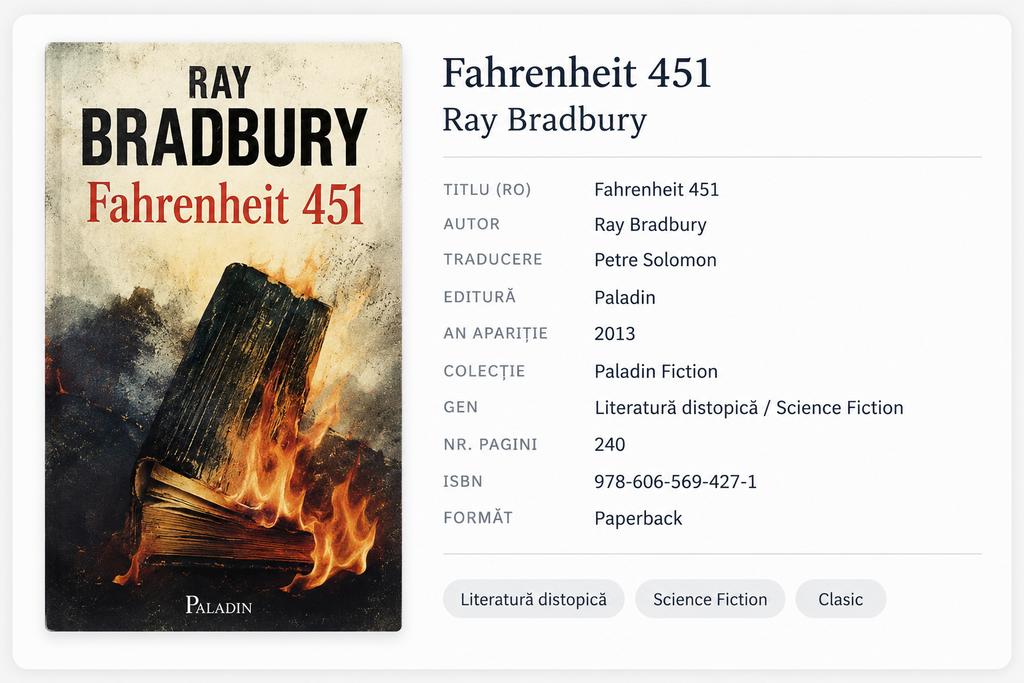
Fahrenheit 451
📖 Book Details
Title: Fahrenheit 451
Author: Ray Bradbury
Series: Standalone
Genre: Dystopian Fiction / Science Fiction
Original Publisher: Ballantine Books
First Published: 1953
Original Language: English
Format: Novel
🛒 Buy the Book
If Fahrenheit 451 sounds like your kind of read, you can support BookFairy by purchasing the book through the links below. It won’t cost you anything extra, and using these links helps support the site while allowing me to continue creating honest, independent book reviews.
📚 Waterstones
🎧 Audio CD
📦 Amazon UK
📱 Kobo
📘 eBook


