Fantasy
 Horror
 Historical Fiction
 Paranormal
📝 First Impressions
The title Bury Our Bones in the Midnight Soil was the first thing that caught my attention. It sounded dark, poetic and mysterious, although I somehow did not expect the novel to be about vampires. Looking back at the roses, darkness and dramatic lettering on the cover, perhaps I should have suspected something gothic, but the revelation still took me completely by surprise.
The opening surprised me in a different way. When Alice arrived at university and met the other young women in her dorm, I assumed they would become friends and that the story would follow them as they navigated student life and a series of adventures together. Instead, the novel separated them remarkably quickly and narrowed its attention to Alice. It was an unexpected turn, and the contemporary storyline initially felt rather disorientating.
Part of that confusion may have come from the format. I listened to the Romanian audiobook rather than reading a physical copy, and the structure—with its changing protagonists, historical periods, countries and chapter numbering—was not always easy to follow by ear. It sometimes took me a moment to understand whose story I was listening to and where it fitted into the larger narrative.
Still, the confusion did not make me want to stop. Quite the opposite: I became increasingly curious about how Alice, Sabine and Charlotte could possibly be connected. What initially appeared to be a contemporary university story gradually revealed itself as something darker and much more ambitious—a novel about queer desire, freedom, violence, immortality and the ways in which the struggle to escape one form of control can lead directly into another.
💜 What I Loved
The storyline that captivated me most was Sabine’s, beginning with María in sixteenth-century Spain. I admired her fierce determination to escape the life chosen for her and her willingness to do something truly terrible in order to reclaim control over her own future. Her actions are violent and morally complicated, but they also emerge from a world in which a woman has very little power over her body, marriage or destiny. That combination of desperation, courage and ruthlessness made her the most compelling of the three women for me.
Charlotte’s story approaches the same desire for freedom from a different historical moment. She also wants the right to decide who she is, whom she loves and what kind of life she will lead. One of the quieter moments that stayed with me occurs when Charlotte leaves her family home. Her mother tells her that she has never been afraid to be herself and urges her not to lose that quality. I interpreted this as an indirect acknowledgement that she had read Charlotte’s journal and understood that her daughter loved women. In a period when Charlotte could barely admit that truth even to herself, her mother’s words felt surprisingly tender.
The queer element is central to all three women rather than being added around the edges of the story. Alice, Sabine and Charlotte live in very different periods, but each must negotiate desire, identity and the expectations placed upon her. For Sabine and Charlotte in particular, even privately recognising that they want a woman rather than a man beside them is frightening. The novel also includes queer male relationships, widening the sense that these characters have always existed even when history required them to hide.
I also enjoyed the way the three lives gradually converged. The novel moves across centuries and countries, yet London repeatedly becomes a point of return, almost as though all roads eventually lead there. I could not help interpreting this as a small tribute to Bram Stoker’s Dracula, another vampire novel in which different people, places and narrative paths are ultimately drawn towards London.
Above all, I was fascinated by the relationship between Sabine and Charlotte. It begins as an apparent opportunity for Charlotte to escape the cage built by her family and society, but gradually reveals itself as another kind of captivity. The promise Charlotte makes during her transformation—that she will never hurt Sabine—turns love and loyalty into a supernatural restraint. Their relationship is intimate, obsessive and deeply toxic, and it ultimately became the true centre of the novel for me.
🤔 What Didn’t Quite Work for Me
My main problem with Bury Our Bones in the Midnight Soil is very similar to the one I had with The Invisible Life of Addie LaRue. Schwab begins with a fascinating idea and places her characters inside an enormous historical canvas, but she does not explore that world as deeply as I wanted her to. Her focus remains firmly on the characters, while the countries, cities and historical periods surrounding them often feel more like scenery than fully inhabited places.
At times, the effect is almost theatrical: the central character remains beneath the spotlight while the sets change behind her, signalling a different century or country without giving the audience enough time to explore the wider world. Sabine and Charlotte cross borders, live for centuries and witness societies changing around them, yet much of that extraordinary experience remains beyond the edges of the stage. I generally understood where and when they were, but I did not always feel immersed in those places.
This feels particularly frustrating in a novel spanning almost five hundred years. The premise offers countless possibilities for exploring history through the eyes of immortal women—especially queer women forced to adapt repeatedly to cultures that either deny or condemn their identities. Instead, the historical settings often function primarily as backgrounds for the characters’ emotional journeys. Those journeys are interesting, but I kept wanting the novel to look outward as well as inward.
I also felt that Sabine’s transformation from María, a woman desperate to escape control, into someone cruel, possessive and determined to control others was not explored deeply enough. Her human life explains her hunger for freedom, but it does not fully explain the person she eventually becomes.
For a time, she appears capable of living relatively peacefully with Matteo and Alessandro. Later, however, her love becomes ownership and her fear of abandonment produces extraordinary violence. The novel suggests that immortality, loneliness and centuries of loss have eroded her humanity, but it does not spend enough time showing that evolution. Considering how important her cruelty is to everything that follows, I wanted a more convincing bridge between the oppressed María and the abusive Sabine.
Alice’s contemporary storyline was also the least engaging of the three for me. It is essential because she brings the centuries-long conflict between Sabine and Charlotte to its conclusion, but at times she feels more like the mechanism through which their story can end than an equally developed protagonist. The beginning initially suggested a broader university story, only to abandon most of those characters almost immediately. Combined with the frequent switches between timelines and the unusual chapter structure, this made the modern narrative feel somewhat dizzying—particularly in audiobook format.
Finally, although I understand the meaning of the ending, its final wording struck me as unnecessarily ambiguous. Alice remains a vampire, but after killing both Sabine and Charlotte, she feels “alive” because she is finally free and able to choose her own path. The idea works thematically: she is biologically dead but existentially alive. However, the phrasing briefly made me wonder whether her transformation had somehow been reversed. A little more clarity would not have diminished the symbolism.
👥 Who Would Enjoy This Book?
Bury Our Bones in the Midnight Soil will appeal most to readers who enjoy character-driven gothic fantasy, morally complicated women and vampire stories in which immortality is as much a curse as it is a form of freedom. This is not a traditional horror novel built around constant fear, nor is it a conventional vampire romance. It is darker, more introspective and far more interested in desire, identity, obsession and control.
Readers who enjoyed The Invisible Life of Addie LaRue will recognise several of Schwab’s recurring interests: women refusing the futures chosen for them, lives unfolding across centuries, the cost of freedom and the danger of bargains that appear to offer escape. The two novels are not the same story, but they share a similar emotional and thematic foundation.
It should also resonate with readers looking for queer historical fantasy. Alice, Sabine and Charlotte come from different periods, but all three must confront the distance between who society expects them to be and who they actually are. The novel explores lesbian desire without making the relationships uncomplicated, safe or idealised.
However, readers hoping for extensive historical world-building may find the settings too lightly explored. The book is much more interested in its women than in the centuries surrounding them. Anyone listening to the audiobook should also be prepared to pay close attention to the changing protagonists, countries and timelines, especially during the first half.
If you enjoy beautiful prose, toxic relationships, morally grey characters and vampires who are genuinely dangerous rather than merely decorative romantic heroes, this novel is likely to hold your attention.
💭 Final Thoughts
By the end, Bury Our Bones in the Midnight Soil felt less like a story about three equally important women and more like the story of Sabine and Charlotte, with María explaining how Sabine came into existence and Alice becoming the final consequence of their relationship. Alice may bring their story to an end, but the emotional centre of the novel lies in the almost two centuries of desire, resentment, dependence and violence between the other two women.
I understood why Alice ultimately killed Charlotte as well as Sabine. Charlotte did not personally murder the young women who came before Alice, but she knew what Sabine was capable of and continued to enter their lives. In that sense, she carries moral responsibility for their deaths. Alice refuses to accept the version of events in which Charlotte is merely another innocent victim, and by killing them both, she breaks a cycle that neither woman had been able—or willing—to end.
Despite my criticisms, this is a novel I continued thinking about after finishing it. I wanted more from its historical world, more explanation for Sabine’s evolution and a stronger sense that Alice existed as a complete character rather than primarily as the resolution to someone else’s story. Nevertheless, Schwab’s central ideas are powerful, and the relationship between Sabine and Charlotte is compelling precisely because it is so uncomfortable and morally tangled.
My exact reaction sits somewhere around 3.75 stars. Since BookFairy uses whole ratings, I am rounding that up to four. The novel did not explore every element of its ambitious premise as fully as I hoped, but its characters, themes and toxic central relationship gave me far more to consider than a three-star rating would suggest.
✨ The BookFairy Verdict
Bury Our Bones in the Midnight Soil
Fantasy
Horror
Historical Fiction
Paranormal
📖 Book Details
Title: Bury Our Bones in the Midnight Soil
Author: V. E. Schwab
First Published: 10 June 2025
Original Publisher: Tor Books
Original Language: English
Genre: Gothic Fantasy / Horror / Historical Fantasy / LGBTQ+ Fiction
Series: Standalone
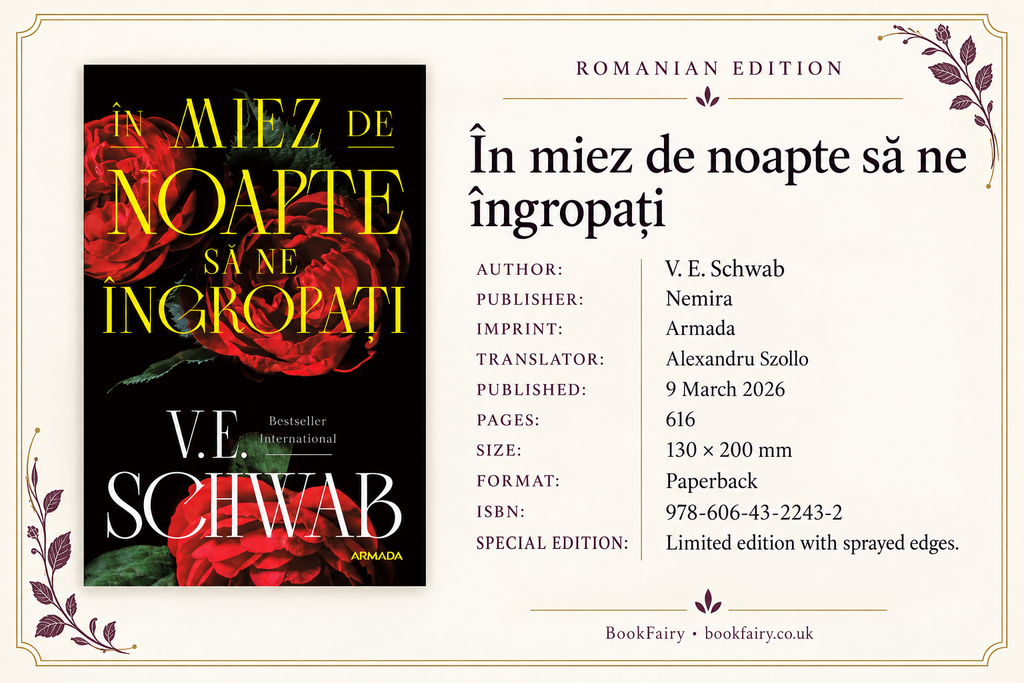
Romanian Title: În miez de noapte să ne îngropați
Romanian Publisher: Nemira – Armada
Format Reviewed: Audiobook
Language Listened To: Romanian
Narrator: Gabriela Marin
Platform: AudioTribe
Audiobook Duration: 18 hours, 59 minutes
Finished: 19 September 2026
🛒 Buy the Book
If Bury Our Bones in the Midnight Soil sounds like your kind of read, you can support BookFairy by purchasing the book through the links below. It won’t cost you anything extra, and using these links helps support the site while allowing me to continue creating honest, independent book reviews.