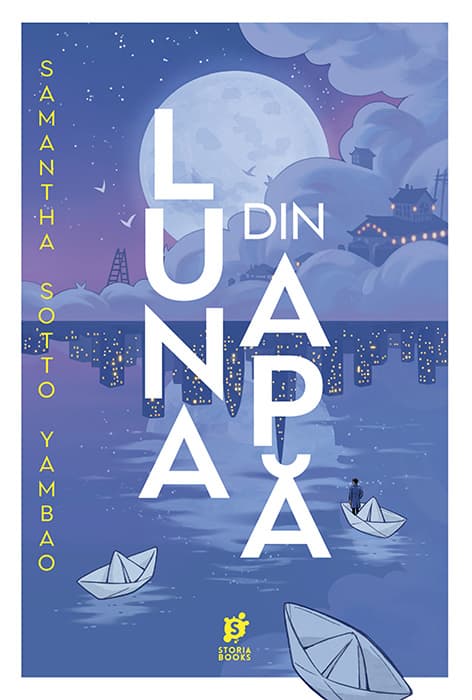
An enchanting Japanese-inspired fantasy about fate, love, personal freedom, and the consequences of our choices.
 Fantasy
 Romance
 Magic
📝 First Impressions
Some books turn out to be much deeper than they appear at first glance, and Water Moon by Samantha Sotto Yambao is one of them. What initially seems like a whimsical fantasy filled with magical places, mysterious bargains, and a developing romance gradually reveals itself to be a thoughtful exploration of choices, consequences, family expectations, and the freedom to decide our own futures.
I listened to the Romanian audiobook, Luna din apă, on AudioTribe, and I found the story enjoyable from beginning to end. The pacing was good, the characters were engaging, and the magical world was imaginative enough to keep me interested. However, despite appreciating the story and its underlying message, I never experienced that extraordinary moment that makes a book truly memorable for me.
What surprised me most was how much there was to think about beneath the beautiful, dreamlike atmosphere. This isn’t simply a story about magic and romance. It is also about the decisions we make, the people affected by those decisions, and the sometimes uncomfortable difference between doing what we believe is right and allowing others to choose what is right for themselves.
💜 What I Loved
The strongest aspect of Water Moon, for me, was its exploration of personal choices and their consequences. The idea of a place where people can give up the decisions they regret is fascinating, particularly because it raises questions about responsibility and the experiences that shape us. If we could erase a mistake, would our lives necessarily improve? And what happens when the decisions we make affect someone else’s future?
I found the relationship between Hana and her father especially interesting because it reflects something that exists well beyond the fantasy world of the novel. I believe most parents genuinely try to offer their children the best possible future, but that doesn’t mean their choices are necessarily the right ones for those children. A parent might act with the purest intentions, motivated entirely by love and a desire to protect, yet still fail to understand what their child actually wants. I could understand Hana’s father’s reasoning, particularly when considering the expectations imposed by more traditional societies. His intentions weren’t necessarily wrong, but the future he considered ideal for his daughter wasn’t automatically the future she would have chosen for herself.
The characters also worked well for me, and I became attached to both Hana and Keishin. Their relationship developed naturally, which I appreciated. Hana repeatedly tried to push Keishin away, and their growing closeness felt convincing rather than rushed. I also found Haruto’s story particularly tragic. The sacrifices he makes, the suffering he endures, and the complicated circumstances surrounding Hana’s intentions towards him add considerable emotional depth to the novel. I couldn’t entirely condemn Hana for being willing to betray him in order to save her father, but I couldn’t completely justify her actions either. I understood her desperation, yet Haruto didn’t deserve to pay the price for it. That moral ambiguity was one of the more interesting aspects of the story.
I also enjoyed the world Samantha Sotto Yambao created. Its Japanese-inspired atmosphere, unusual magical rules, and supernatural creatures gave the novel a distinctive identity. Some of the darker elements reminded me of the unsettling stories associated with Japanese folklore, particularly the children buried beneath the ground who continue to exist as strange, monstrous creatures. I found those scenes disturbing rather than frightening, and the contrast between the beautiful fantasy setting and its underlying horrors was effective.
Finally, I thought the ending was exactly what the story needed. Hana ultimately makes a decision that belongs entirely to her, rather than following the future her father had planned. That doesn’t necessarily mean her chosen path will make her happier than the alternative. Perhaps she could have been happy with Haruto; perhaps not. There is no way to know. What matters is that, for once, she is choosing for herself, accepting the possibility of both happiness and regret.
🤔 What Didn’t Quite Work for Me
Although I enjoyed the imaginative worldbuilding, I sometimes felt that certain elements weren’t explained sufficiently. The novel draws on Japanese-inspired imagery, customs, and supernatural concepts that may not be immediately familiar to readers from very different cultural backgrounds. I don’t expect a fantasy author to explain every detail, and I certainly appreciate a little mystery, but there were moments when I would have welcomed more context. The children living beneath the ground were a particularly striking example. Their existence was disturbing and intriguing, but I was left wondering why they existed in the first place and how they fitted into the wider structure of this magical society.
My main reservation, however, was much simpler: the book never really amazed me. I enjoyed the story, cared about the characters, appreciated the underlying themes, and thought the pacing was consistently good. There weren’t any sections that felt unnecessarily drawn out, and I never struggled to continue listening. Nevertheless, nothing stood out as truly extraordinary. It was a pleasant and interesting experience, but it lacked that special spark that would have made me feel I had discovered something exceptional.
I should also mention one small detail about the Romanian audiobook. Some of the narrator’s pronunciations caught my attention, particularly the way certain names and Japanese words seemed to have their final vowels extended. I noticed this with Hana’s name and with the word sake. I don’t know whether this was an intentional interpretation or simply a particular pronunciation choice, so I wouldn’t describe it as an error without further verification. It was noticeable, though, and occasionally distracted me. This observation concerns the audiobook performance rather than the novel itself and didn’t influence my rating.
👥 Who Would Enjoy This Book?
I think Water Moon would appeal to readers who enjoy imaginative fantasy with a dreamlike atmosphere, Japanese-inspired settings, unusual supernatural elements, and a romantic relationship that develops gradually. There is enough mystery and darkness beneath the magical surface to interest readers who appreciate fantasy that isn’t entirely comforting or predictable in tone.
It would also suit readers who enjoy stories that explore fate, free will, family expectations, sacrifice, and the consequences of personal decisions. Although romance plays an important role, I wouldn’t consider it the only reason to read this book. For me, the philosophical questions behind the story were considerably more interesting than the romance itself.
Readers who prefer detailed explanations of magical systems and unfamiliar cultural elements might occasionally feel that something is missing. And those looking for a particularly spectacular or unforgettable fantasy may find it enjoyable without being completely impressed.
💭 Final Thoughts
What stayed with me after finishing Water Moon wasn’t so much the magic or the romance, but the idea that we cannot decide someone else’s future for them, no matter how much we love them. We can offer advice, try to protect the people we care about, and genuinely believe that we know what would make them happy, but ultimately their lives belong to them.
I found this particularly meaningful in the relationship between Hana and her father. His desire to protect her was understandable, and I don’t think his intentions should simply be dismissed as selfish or controlling. At the same time, good intentions cannot guarantee that the decisions we make for others will bring them happiness. There is a difference between wanting the best for someone and allowing that person to discover what the best actually means to them.
Hana’s own decisions aren’t always admirable either, and I appreciated that the story didn’t make everything morally straightforward. Her willingness to sacrifice Haruto for her father’s sake was something I could understand and condemn in almost equal measure. People sometimes make questionable choices for reasons that are deeply human, and understanding those reasons doesn’t mean we have to agree with the choices themselves.
Ultimately, I was satisfied with the ending because Hana finally took responsibility for her own future. Whether her decision was the best possible one is almost irrelevant. It was hers, and that was what mattered.
Water Moon is a well-paced, imaginative fantasy with engaging characters and considerably more depth than its whimsical premise initially suggests. I enjoyed listening to it, and I appreciated the questions it raised about love, responsibility, and personal freedom. However, some aspects of its world needed more explanation, and the story never quite delivered the extraordinary experience I look for in a higher-rated book. A good novel with a meaningful message, but not one that completely swept me away.
✨ The BookFairy Verdict
Water Moon
📖 Book Details
| Detail | Information |
|---|---|
| Title | Water Moon |
| Author | Samantha Sotto Yambao |
| Original publication | 2025 |
| Genre | Fantasy, Romance, Magical Realism |
| Format read | Romanian audiobook |
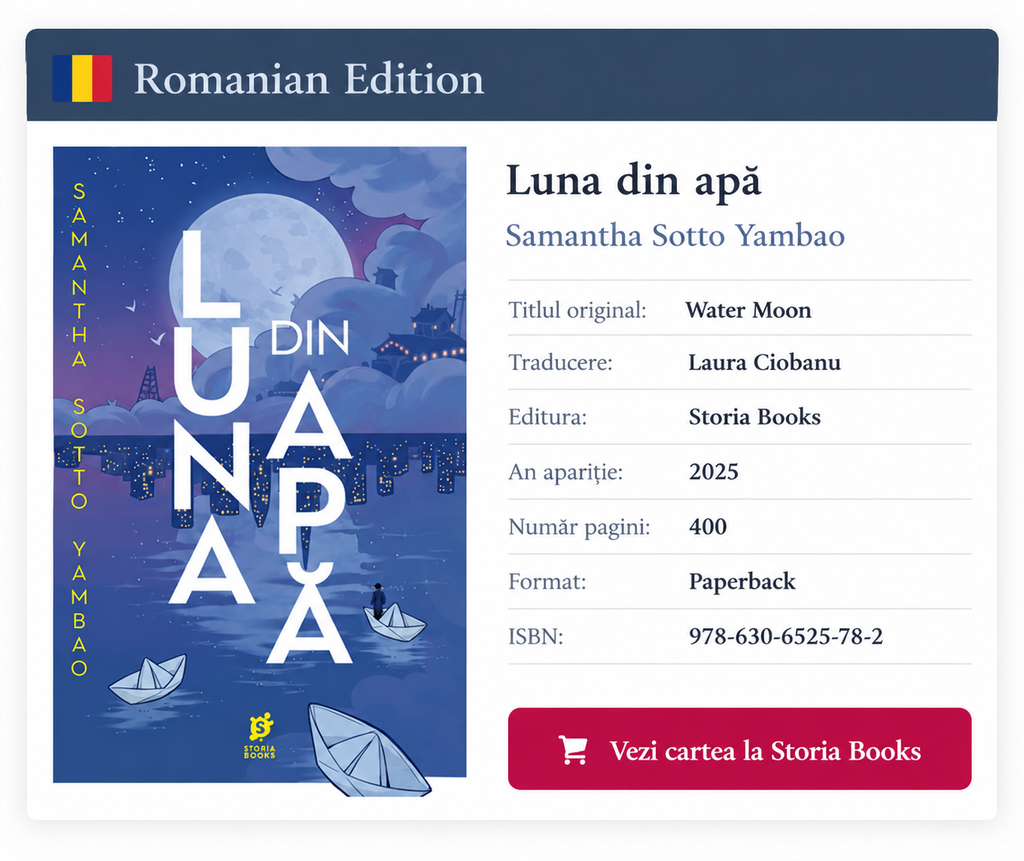
| Romanian title | Luna din apă |
| Romanian publisher | Storia Books |
| Audiobook platform | AudioTribe |
| Audiobook duration | 9 hours 26 minutes |
| Reading dates | 26–28 October 2026 |
| Series | Standalone |
🛒 Buy the Book
If Water Moon sounds like your kind of read, you can support BookFairy by purchasing the book through the affiliate links below. It won’t cost you anything extra, and using these links helps support the site while allowing me to continue creating honest, independent book reviews.