 Fantasy
 Mystery
 Paranormal

📝 First Impressions
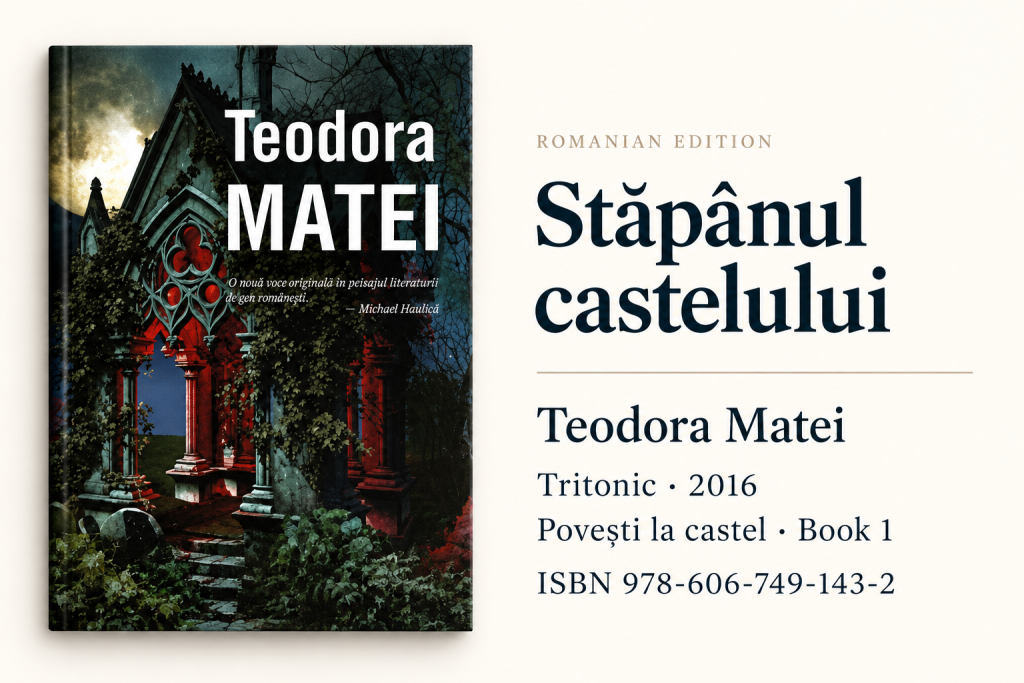
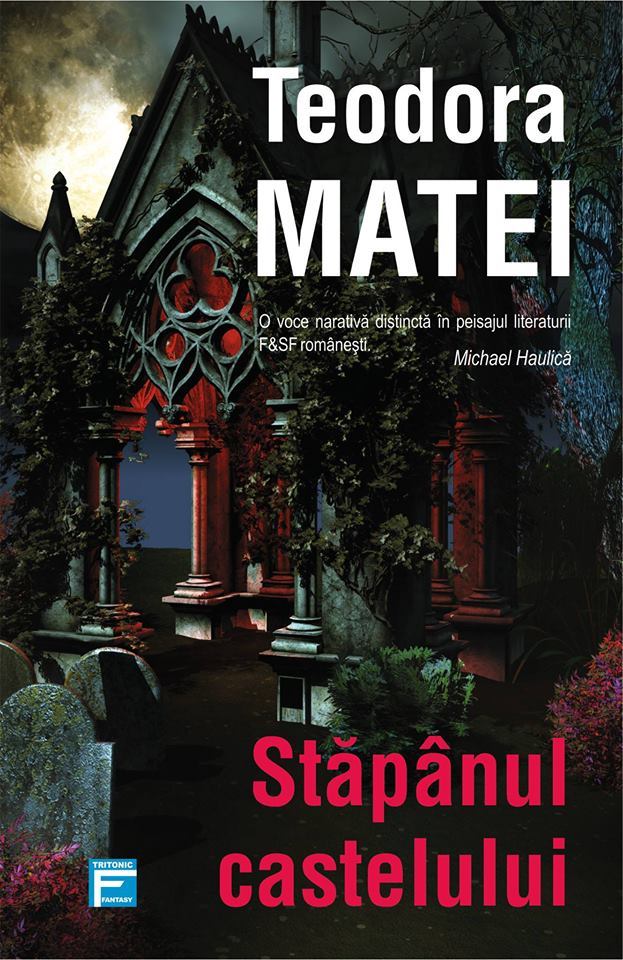
Some books capture your imagination through extraordinary worlds, spectacular battles or characters whose adventures seem larger than life. Others achieve something equally remarkable through a much quieter kind of magic, gradually transforming an apparently ordinary reality into something mysterious and impossible to explain. Stăpânul castelului by Teodora Matei belongs to the second category, and it is precisely this quality that made such a strong impression on me.
What I loved about this novel was how naturally the fantastic emerged from the familiar. The story doesn’t demand that you immediately accept an entirely different universe with complicated rules or elaborate explanations. Instead, it draws you into a world that initially feels recognisable, allowing the unusual elements to reveal themselves gradually. Before you quite realise what is happening, the boundaries between reality and imagination have shifted, and you find yourself questioning things that seemed perfectly ordinary only a few pages earlier.
While reading, I was reminded of La țigănci by Mircea Eliade, one of the most memorable examples of Romanian fantastic literature. I am not suggesting that the two stories are identical, but they share something I particularly appreciate: that subtle transition from everyday reality into a space where familiar rules no longer seem entirely reliable. There is a special pleasure in reading this kind of fiction because the mystery doesn’t depend exclusively on what happens, but also on the atmosphere surrounding those events and the questions they leave behind.
I thoroughly enjoyed Stăpânul castelului. The atmosphere fascinated me, the storytelling kept me engaged, and the way Teodora Matei developed and concluded the novel left me deeply satisfied. It was one of those rare reading experiences in which I appreciated not just individual elements, but the entire work.
💜 What I Loved
The atmosphere was undoubtedly one of the things I loved most about Stăpânul castelului. Teodora Matei has a wonderful ability to make the ordinary feel extraordinary without forcing the transformation. She doesn’t need to overwhelm the reader with supernatural events from the beginning. Instead, she allows mystery to develop organically, creating the impression that something unusual has always existed beneath the surface of reality, waiting to be discovered. I found this approach particularly effective because it made the fantastic elements feel like a natural extension of the story rather than something introduced simply to surprise the reader.
I also appreciated the way the novel moves between different literary traditions without losing its identity. There are elements of mystery, touches of the supernatural and the unmistakable atmosphere of fantastic fiction, but they don’t feel like separate ingredients assembled mechanically. Everything belongs to the same story. This is one of the reasons the comparison with Mircea Eliade came so naturally to me. As in La țigănci, the appeal lies partly in the uncertainty surrounding what is real, what might be imagined and whether those distinctions are as clear as we would like to believe.
Another quality I admired was Teodora Matei’s storytelling. The novel never felt as though it was trying too hard to impress me. Its strength came from the author’s ability to maintain my curiosity and gradually reveal a world that became increasingly intriguing. I enjoyed following the narrative, discovering its mysteries and allowing the atmosphere to draw me further into the story. There is something particularly satisfying about a book that trusts its own ideas and gives them room to develop without constantly explaining everything to the reader.
And then there is the ending. Without revealing anything about what happens, I can say that I loved the way the story was brought together. For me, a successful ending doesn’t necessarily need an enormous twist or a spectacular revelation. What matters is whether it feels meaningful in relation to everything that has come before, whether the author has earned it and whether it leaves me satisfied with the journey. Stăpânul castelului achieved that beautifully. I appreciated the construction of the entire narrative, from its atmosphere and gradual development to the way it reached its conclusion.
Perhaps what impressed me most was how complete the reading experience felt. I didn’t finish the novel thinking that I had enjoyed the atmosphere but wished the characters were better, or that the premise was wonderful but the ending disappointing. I loved the whole thing. And when a book manages to satisfy me on so many levels, it becomes something truly special.
🤔 What Didn’t Quite Work for Me
Honestly, I struggle to find something meaningful to criticise about Stăpânul castelului. This is not because I believe every book I enjoy must be flawless, or because I am unwilling to recognise weaknesses in a story that has made an impression on me. I can be quite demanding as a reader, particularly when it comes to the development of an interesting premise and the way an author brings a narrative to its conclusion. In this case, however, I remember being genuinely delighted with the entire experience.
The combination of mystery and fantastic elements worked wonderfully for me, and I appreciated the author’s ability to sustain that atmosphere throughout the novel. I never felt that the unusual aspects were introduced merely for effect, nor did the story lose my interest as it moved further away from everyday reality. On the contrary, I enjoyed discovering where Teodora Matei was taking me, especially because that gradual transformation was such an important part of the book’s appeal.
Of course, readers who prefer their fantasy to have clearly defined rules and explicit explanations might respond differently. Stăpânul castelului belongs to a tradition of fantastic storytelling in which uncertainty and atmosphere are essential to the experience. Personally, that is exactly what I loved about it, so I wouldn’t consider it a weakness.
For me, there was nothing significant that diminished the pleasure of reading this novel. Sometimes a book simply works, and I think it is important to acknowledge that without inventing criticisms merely to fill a section of a review.
👥 Who Would Enjoy This Book?
I would enthusiastically recommend Stăpânul castelului to readers who appreciate atmospheric fantasy, supernatural mysteries and stories in which the ordinary world gradually becomes something far more intriguing. This is particularly suitable for those who enjoy being drawn into a mystery without immediately receiving explanations for everything they encounter. The pleasure comes not only from discovering what happens, but also from experiencing the uncertainty and atmosphere that surround the events.
Readers familiar with Romanian fantastic literature may find the novel especially appealing. If you appreciate Mircea Eliade’s La țigănci, particularly its subtle movement between everyday reality and the inexplicable, I think Teodora Matei’s approach is well worth exploring. The comparison is not about identical plots or characters, but about a shared ability to make reality itself feel mysterious. I love this tradition of storytelling, and it was a pleasure to encounter a contemporary Romanian novel that evoked a similar feeling.
I would also recommend the book to readers who enjoy fiction that refuses to fit neatly into a single genre. Stăpânul castelului combines fantastic elements with mystery and emotional storytelling, creating an experience that is difficult to reduce to one simple label. If you prefer stories driven by atmosphere, curiosity and the gradual discovery of hidden possibilities, there is a great deal to appreciate here.
And because this is the opening volume of the Poveștile castelului series, it offers the additional pleasure of introducing a fictional world that readers can continue exploring in subsequent books.
💭 Final Thoughts
Stăpânul castelului was a magnificent reading experience, and one that reminded me why I love fantastic literature so much. Teodora Matei created a story that captured my attention through its atmosphere, maintained my interest through its mysteries and left me completely satisfied with the way everything developed. I appreciated the writing, the careful construction of the narrative and the author’s ability to blend familiar reality with elements that gradually become impossible to explain through ordinary logic.
The connection I felt with Mircea Eliade’s La țigănci made the experience even more memorable. There is something wonderful about fiction that encourages you to question the nature of reality without immediately telling you what to believe. I enjoy stories that leave room for mystery, that invite the reader to participate in discovering their meaning and that create the impression that extraordinary things might exist just beyond the boundaries of everyday life. Stăpânul castelului gave me precisely that feeling.
What makes the novel stand out in my memory is that I loved the entire journey. It wasn’t simply a case of an intriguing premise compensating for a weaker ending, or beautiful writing disguising an unremarkable story. The different elements complemented one another, creating a reading experience that felt satisfying from beginning to end. The final part of the novel was particularly rewarding because I appreciated how the narrative came together without losing the atmosphere that had fascinated me from the start.
As the first volume of Poveștile castelului, the book also serves as an introduction to a larger fictional world. But even knowing that the story continues, I found this opening instalment deeply satisfying in its own right. It gave me everything I wanted from a fantastic novel: mystery, atmosphere, an engaging narrative and that wonderful sensation of stepping beyond the familiar into something extraordinary.
For me, Stăpânul castelului is an outstanding example of Romanian fantastic fiction and a book I remember with enormous affection. I loved everything about it, and I wouldn’t hesitate to recommend it to anyone who appreciates imaginative, beautifully constructed stories.
✨ The BookFairy Verdict
Stăpânul castelului
📖 Book Details
- Title: Stăpânul castelului
- Author: Teodora Matei
- Original Publication: 2012 (serialised in Nautilus magazine)
- Book Publication Year: 2016
- Publisher: Tritonic
- Language: Romanian
- Genre: Fantasy, Mystery, Paranormal
- Series: Povești la castel #1
- Format: Paperback
- Pages: 200
- ISBN: 9786067491432
- English Translation: No known English edition
📚 Povești la castel — Reading Order
- Stăpânul castelului (2016)
- O noapte la castel (2018)
- Inima castelului (2020)
📚 Omnibus Edition
Povești la castel (2022) — collects all three novels in a single volume. This is not a fourth instalment in the series.