


 Children
📝 First Impressions
Matilda is one of those stories I have known in more than one form, and I think that probably helped make it even more memorable for me. I read the book, but I also saw the film adaptations, so the characters and the atmosphere have stayed with me in a way that goes beyond the page.
What I loved immediately was Matilda herself. She is clever, curious, independent and completely underestimated by the adults around her. That contrast is such a big part of what makes the story work. She is surrounded by people who are louder, more selfish and more ridiculous than she is, yet she is the one who sees the world most clearly.
There is also something very satisfying about the way Roald Dahl writes horrible adults. Miss Trunchbull is exaggerated to the point of absurdity, but that is exactly why she works so well. She is terrifying and funny at the same time, while Miss Honey brings the complete opposite energy to the story: kindness, patience and warmth.
I think that balance is what drew me in most. Matilda can be dark and cruel in places, but it never loses its humour or its sense of wonder. It is a children’s book that understands how unfair childhood can sometimes feel, especially when adults refuse to listen, but it also gives its young heroine the intelligence and courage to fight back.
And because I had also seen the films, the story already felt familiar in a very comforting way. Reading it was not simply about discovering what happened; it was about spending time again with characters and moments I already loved.
💜 What I Loved
What I loved most about Matilda was how easy it was to root for her. She is intelligent without being smug, curious without being naive, and strong in a way that feels earned rather than forced. The adults around her constantly underestimate her, dismiss her or try to control her, and that makes every moment in which she pushes back feel deeply satisfying.
I also loved the contrast between the adults in the story. Miss Trunchbull is outrageous, cruel and larger than life, almost like a monster from a fairy tale, while Miss Honey is gentle, patient and kind. That contrast gives the book a lot of emotional weight because it shows just how much difference one decent adult can make in a child’s life.
The humour worked really well for me too. Roald Dahl has a particular talent for making unpleasant people ridiculous, and Matilda is full of that slightly wicked humour. The story can be dark, but it never becomes heavy because there is always something absurd, funny or mischievous happening around the edges.
And then there is the simple pleasure of watching a child who loves books be taken seriously. Matilda’s intelligence and her love of reading are not treated as strange little quirks; they are central to who she is. I think that is one of the reasons the story has stayed so beloved. It celebrates curiosity, imagination and the idea that being different from the people around you can be a strength rather than a problem.
Having also seen the films probably made me even more attached to the characters, because the story exists in my mind in more than one version. But the heart of it is still the same: Matilda is a wonderful heroine, and spending time in her world is simply a joy.
🤔 What Didn’t Quite Work for Me
There honestly was not much that did not work for me in Matilda. This is one of those Roald Dahl books where the overall experience is so strong that the weaker points feel minor rather than genuinely frustrating.
If I had to point to anything, it would probably be the exaggeration of some of the adults. Miss Trunchbull in particular is so monstrous that she almost stops feeling like a real person and becomes more of a fairy-tale villain. That absolutely works for the tone of the book, and I enjoyed her as a character, but it also means there is not much subtlety in the conflict.
The same is true of Matilda’s parents. They are so selfish, dismissive and ridiculous that they are easy to dislike immediately, but they are not especially complex. Again, I do not think Dahl was trying to create nuanced psychological portraits here, so this never became a serious problem for me. It is simply part of the exaggerated style of the story.
And because the book is written for children, some developments are naturally quite straightforward. The emotional beats are clear, the villains are obvious, and the sense of justice is very strong. As an adult reader, I could see exactly where the story was going, but that did not make it less enjoyable.
For me, those things are part of the charm rather than real flaws. Matilda knows exactly what kind of story it wants to be, and it delivers that very confidently.
👥 Who Would Enjoy This Book
Matilda is an easy recommendation for younger readers who love stories about clever children, terrible adults and the satisfaction of seeing unfairness challenged. It has enough humour, mischief and imagination to keep the story light, even when some of the situations are genuinely cruel.
It is also perfect for children who already love books. Matilda’s relationship with reading is such an important part of who she is, and that makes the story especially appealing to young readers who have ever felt more at home with a book than with the people around them.
Adults who grew up with Roald Dahl will probably enjoy revisiting it too, especially if they already know the films. There is a lot of nostalgia in returning to these characters, and the story still works because its central ideas are so simple and strong: kindness matters, intelligence matters, and being underestimated does not mean being powerless.
Readers who prefer very realistic children’s fiction may find the exaggeration too much, but if you enjoy dark humour, larger-than-life villains and a little bit of magic mixed into everyday life, Matilda is still an excellent choice.
💭 Final Thoughts
Matilda is one of those children’s books that works because it understands both how difficult childhood can feel and how powerful a child’s imagination can be. Matilda is surrounded by adults who dismiss her, misunderstand her or actively make her life harder, but she never loses her curiosity, intelligence or sense of self. That makes her incredibly easy to love.
What I enjoy most is the balance between darkness and humour. The book deals with cruelty, neglect and unfairness, but it never feels bleak. Roald Dahl keeps everything moving with absurd characters, wicked jokes and just enough magic to make the story feel larger than ordinary life.
Having seen the films as well probably strengthened my attachment to the story, because the characters and scenes have lived in my head in several different forms. But the heart of Matilda still comes back to the same thing: a brilliant little girl who loves books, refuses to be crushed by the people around her and eventually finds the kindness she deserves.
For me, it remains one of Roald Dahl’s most memorable and satisfying stories.
✨ The BookFairy Verdict
Matilda
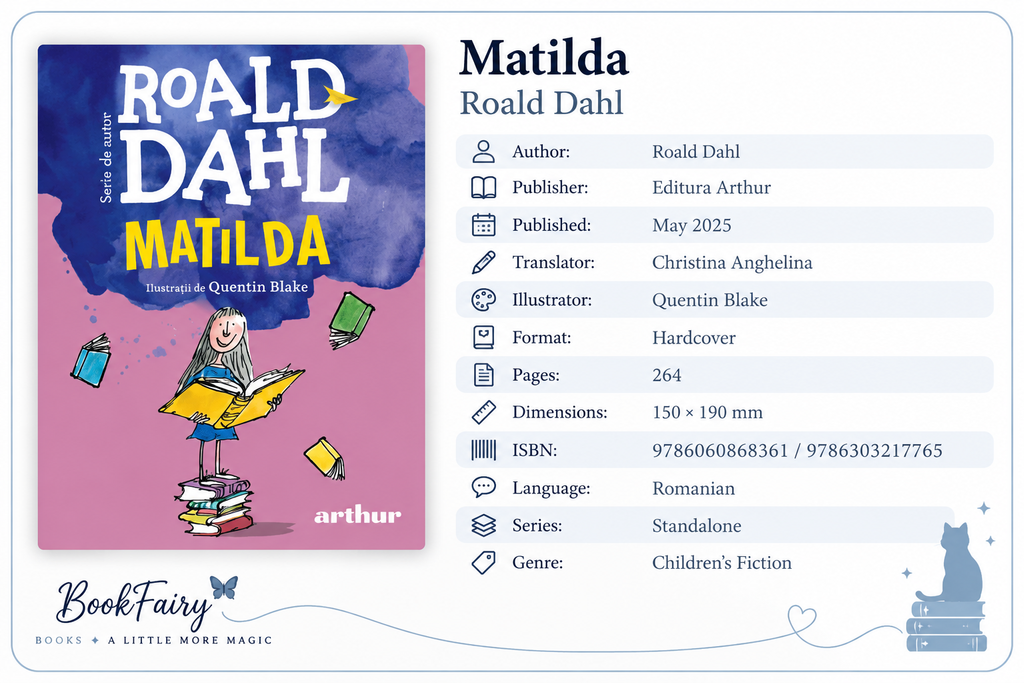
📖 Book Details
Title: Matilda
Romanian Title: Matilda (Editura Arthur)
Author: Roald Dahl
Series: Standalone
Genre: Children’s Fiction, Fantasy, Humour
Publisher (English): Jonathan Cape / Puffin Books
Publisher (Romanian): Editura Arthur
Published (English): 1988
Published (Romanian): May 2025
Pages (English hardback edition): 240
Pages (Romanian edition): 264
Translator (Romanian): Christina Anghelina
Illustrator: Quentin Blake
ISBN (Romanian): 9786060868361 / 9786303217765
Format (Romanian): Hardcover
Dimensions (Romanian): 150 × 190 mm
Format Experienced: Hardcover
Edition Reviewed: Romanian Hardcover (Editura Arthur)
🛒 Buy the Book
If Matilda sounds like your kind of read, you can support BookFairy by purchasing the book through the links below. It won’t cost you anything extra, and using these links helps support the site while allowing me to continue creating honest, independent book reviews.


