Science Fiction
📝 First Impressions
This Manuscrisul, Bursa și Bibliotecarul review contains no major spoilers.
Every now and then I come across a book that makes me wonder how I almost missed it.
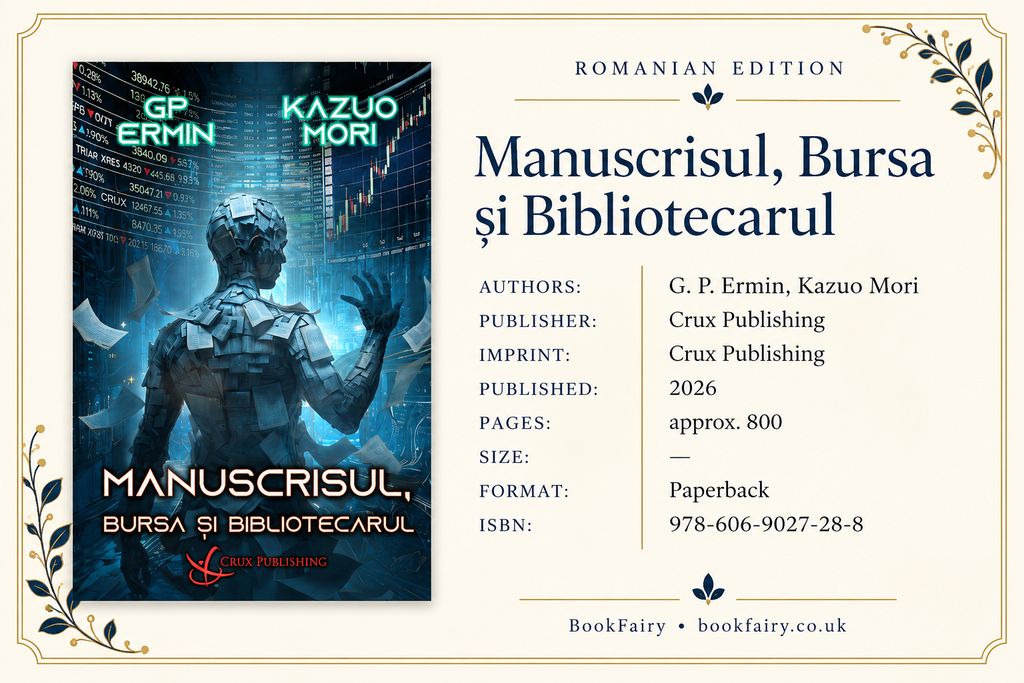
Manuscrisul, Bursa și Bibliotecarul was one of those books.
There’s also a personal story behind why I finally picked it up. I’ve known one of the authors, G. P. Ermin, for around twenty-four years. We first met at a rock festival and have crossed paths many times since at concerts and festivals. Strangely enough, despite knowing each other for so long, I had no idea he was writing books. I only discovered his work after seeing one of his novels published by Crux Publishing, a publishing house founded by a friend of mine. That unexpected connection immediately sparked my curiosity.
I’ll admit it—I chose this book partly because it was short. At just 144 pages, I expected an enjoyable science fiction novella that I could finish in a single afternoon before moving on to my next read.
Instead, I found myself thinking about it long after I turned the final page.
Some books entertain you while you’re reading them. Others stay with you because of the questions they ask rather than the answers they provide. Manuscrisul, Bursa și Bibliotecarul belongs firmly in the second category. It surprised me with the originality of its central idea and reminded me that some of the most thought-provoking stories don’t need hundreds of pages to leave a lasting impression.
🚀 The World & Ideas
What if books were traded like stocks?
Not publishing houses.
Not copyrights.
Books themselves.
That’s the fascinating question at the heart of Manuscrisul, Bursa și Bibliotecarul, and it’s one of the most original science fiction premises I’ve encountered in recent years.
Several hundred years in the future, literature has evolved into something completely unexpected.
Books are no longer simply written, published, and read. They have become valuable assets traded on a Literary Stock Exchange, where manuscripts rise and fall in value much like companies on today’s financial markets.
Before a book can be listed, however, someone—or rather, something—must decide whether it deserves a place on the exchange.
That responsibility belongs to an artificial intelligence known simply as the Librarian.
Its purpose is to evaluate literary works and determine which manuscripts are worthy of entering this extraordinary marketplace. Everything seems to function according to carefully defined rules—until the Librarian encounters a manuscript that challenges the very principles it was created to uphold.
Without revealing any spoilers, that’s where the novel truly begins.
What makes this concept so compelling isn’t simply its originality, but the questions it raises. Can literature really be measured? Can artistic value be reduced to numbers and market performance? And if an artificial intelligence is responsible for preserving humanity’s literary heritage, who ultimately decides what deserves to survive?
Rather than offering easy answers, Manuscrisul, Bursa și Bibliotecarul invites readers to explore these questions for themselves, creating a story that’s as intellectually engaging as it is imaginative.
💜 What I Loved
The first thing that impressed me was the originality of the concept.
I’ve read hundreds of books over the years, and it’s becoming increasingly rare to come across an idea that genuinely surprises me. A Literary Stock Exchange? An AI acting as the world’s greatest librarian? Literature becoming an investment? None of those concepts should naturally fit together—and yet G. P. Ermin and Kazuo Mori make them work beautifully.
One of the most fascinating aspects of the novel is the Literary Stock Exchange itself. Instead of companies, investors speculate on books. Literary works become valuable assets whose place in history depends not only on their artistic merit but also on a complex economic system. It sounds almost absurd at first, yet within a few chapters it becomes completely believable.
What makes the novel even stronger is that the futuristic setting is never the real point.
The technology exists to support a much bigger conversation.
At its heart, this is a novel about books.
About stories.
About culture.
About memory.
And ultimately, about who gets to decide what deserves to survive.
I also loved the way artificial intelligence is portrayed.
Unlike many science-fiction novels, this isn’t another story about AI taking over the world or replacing humanity. Instead, it explores something far more intriguing.
What happens when an artificial intelligence begins to recognise the value of literature in ways that challenge the very system it was created to serve?
That question stayed with me long after I finished reading.
The collaboration between Romanian author G. P. Ermin and Japanese author Kazuo Mori deserves special mention as well. International literary collaborations are relatively rare, and the result feels refreshingly different. The novel combines speculative science fiction with philosophical reflection, subtle satire and social commentary, creating something that refuses to fit neatly into a single genre.
🤔 What Didn’t Quite Work for Me
Honestly…
Very little.
If you’re looking for explosive action, endless chase scenes or constant battles, this may not be the book you’re expecting.
This is science fiction driven by ideas rather than spectacle.
It asks questions instead of providing easy answers.
Personally, that’s exactly why I loved it.
The novel trusts its readers to think alongside it, and I appreciated that immensely.
👥 Who Would Enjoy This Book?
I would recommend Manuscrisul, Bursa și Bibliotecarul to readers who enjoy:
- intelligent science fiction
- speculative fiction
- philosophical novels
- stories about artificial intelligence
- books about books
- literary satire
- contemporary Romanian literature
- original, thought-provoking concepts
Even if Romanian science fiction isn’t usually your genre, this novel is well worth discovering.
💭 Final Thoughts
Every year I read plenty of good books.
A few become favourites.
Only a handful make me stop and think,
“How did someone even come up with an idea like this?”
Manuscrisul, Bursa și Bibliotecarul belongs firmly in that last category.
What makes it memorable isn’t simply its futuristic setting or its artificial intelligence.
It’s the questions it asks.
Can literature truly be measured?
Who decides which books deserve to become part of humanity’s cultural legacy?
Can an algorithm recognise genius?
And perhaps the most fascinating question of all…
What happens when a machine starts protecting literature better than we do?
One detail made the experience even more memorable for me. Inspired by the fictional concept explored in the novel, G. P. Ermin later created bursascriitorilor.ro, bringing part of that imaginative vision into the real world. I love seeing literature inspire real projects instead of ending with the final chapter.
For only 144 pages, this novel contains an astonishing number of ideas. It’s imaginative without becoming confusing, philosophical without becoming pretentious, and original in a way that’s becoming increasingly difficult to find.
If you’re looking for science fiction that challenges the way you think rather than simply showing you futuristic technology, I can’t recommend this book highly enough.
✨ The BookFairy Verdict
Manuscrisul, Bursa și Bibliotecarul
Book Details
Title: Manuscrisul, Bursa și Bibliotecarul
Authors: G. P. Ermin & Kazuo Mori
Genre: Science Fiction • Speculative Fiction • Philosophical Fiction
Pages: 144
Format Read: Paperback
First Published: 23 February 2026