 Magic
Magic
📝 First Impressions
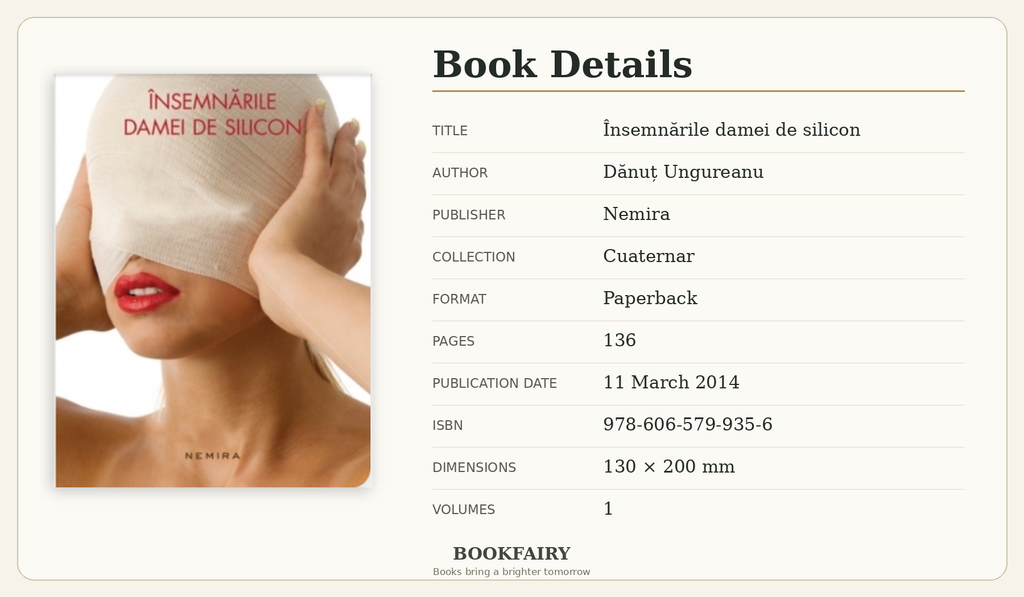
I read Însemnările damei de silicon many years ago, but unlike some books whose details have faded almost completely, this one left me with a very clear idea of what it was trying to do.
For me, this book is an allegory.
At the centre of the story is something deliberately absurd: an inflatable doll with magical qualities who becomes, in effect, a human being and moves through Bucharest among real people. But the “silicon lady” is not really the point. She is the lens through which Dănuț Ungureanu allows us to look at the city, its inhabitants and all the contradictions that come with them.
And Bucharest, here, is not presented as a postcard city.
We move through neighbourhoods, blocks of flats, small shops, parks, streets and places inhabited by people who are very rarely the polished version of urban life. There are ordinary workers, neighbourhood characters, people living on the margins, local tough guys, sex workers, stray dogs, homeless people, musicians, policemen and all kinds of figures who together create a version of the city that is messy, uncomfortable, funny, ugly and strangely beautiful at the same time.
What impressed me most was the way all of this is filtered through humour.
The situations can be unpleasant, ridiculous or even depressing, but the book rarely loses that slightly mischievous way of looking at them. It sees the ugliness of the city without pretending it is not there, but it also refuses to reduce Bucharest to that ugliness.
One line from the book stayed with me especially strongly: from far enough away, even the ugly begins to look beautiful.
That, for me, captures the spirit of the whole novel.
Însemnările damei de silicon is not simply a strange fantasy about an inflatable doll becoming human. It is a journey through Bucharest and through the people who make it what it is. It is affectionate without being sentimental, critical without becoming cold, and funny without pretending that everything underneath the humour is harmless.
More than anything, I remember it as a love letter to Bucharest — although certainly not the kind that would ever appear in a tourist brochure.
💜 What I Loved
What I loved most about Însemnările damei de silicon was the way Dănuț Ungureanu uses something completely absurd to talk about something very real.
The central idea could easily have become nothing more than a joke: an inflatable doll with magical qualities becomes human and moves through Bucharest. But the book uses that premise as a way of looking at the city from a slightly different angle. Because the “dama de silicon” is both inside and outside this world, she allows us to observe people who would normally pass unnoticed and situations that are so familiar to us that we barely look at them anymore.
That worked extremely well for me.
The Bucharest of this book is not clean, polished or romanticised. It is crowded with contradictions. We meet neighbourhood characters, small shopkeepers, building administrators, mechanics, butchers, homeless people, sex workers, local tough guys, policemen, stray dogs and people simply trying to survive however they can. Some are ridiculous, some unpleasant, some vulnerable, and some surprisingly moving.
And almost everyone gets a voice.
That is one of the things I appreciated most. The book does not simply parade these people past us as colourful background. Their stories matter. Through them, Bucharest becomes less a setting and more a living organism made from thousands of small lives, frustrations, compromises, loyalties and absurdities.
The humour is essential.
Without it, much of what happens could feel unbearably bleak. Instead, Ungureanu tells these stories with a kind of warmth and irony that makes the ugliness easier to look at without hiding it. The humour does not erase poverty, violence, exploitation or cruelty. It simply gives the book enough distance to observe them without becoming unbearably heavy.
And then there is Bucharest itself.
For me, this book is absolutely a love letter to the city, but not an idealised one. It loves Bucharest with all its flaws. It sees the dirt, the noise, the social tensions, the absurd characters and the things that make you want to scream, and somehow still finds affection underneath all of that.
That is why the line about ugliness looking beautiful from a distance stayed with me for so long. It expresses something very recognisable about the city: you can be furious with it and still love it.
I also loved how deeply Romanian the book feels.
There are references, types of people, ways of speaking and social realities that are immediately recognisable if you know Romania, and especially Bucharest. That gives the book a flavour that would be extremely difficult to reproduce in translation. Someone from outside the culture could understand the events, certainly, but part of the charm comes from recognition — from knowing exactly the kind of person being described, exactly the kind of neighbourhood, exactly the tone behind a phrase.
That cultural specificity is one of the book’s greatest strengths.
And underneath all the humour and social observation, there is empathy.
That surprised me most.
The novel moves through groups of people who are often judged from a distance — homeless people, sex workers, stray-dog feeders, local “şmecheri”, people living on the margins — and it repeatedly reminds us that labels are easy, while lives are complicated.
For me, that is where the allegory becomes strongest. The silicon lady is artificial, but she becomes a way of asking what being human actually means. And the more people she encounters, the harder that question becomes to answer simply.
🤔 What Didn’t Quite Work for Me
There is very little I remember actively disliking about Însemnările damei de silicon, and I do not want to invent problems now just because every review needs a critical section.
If anything, the book can feel deliberately chaotic. It moves from one person to another, from one corner of Bucharest to another, and from social observation to absurdity and fantasy with very little concern for keeping everything neat and tidy.
For some readers, that may feel uneven.
There is also a lot that depends on cultural recognition. The humour, the characters, the references and even the way certain situations are presented make much more immediate sense if you know Romania and, especially, Bucharest. I can imagine parts of the book losing some of their impact for someone completely unfamiliar with that world.
But for me, those things were not real weaknesses.
The messiness fits the city. The cultural specificity is exactly what gives the book its personality. And the fact that it refuses to smooth everything into something more universal is one of the reasons it felt so alive to me.
👥 Who Would Enjoy This Book?
I think Însemnările damei de silicon would work best for readers who enjoy fiction that mixes social observation, humour and the fantastic without keeping those elements neatly separated.
If you like books where a city becomes almost a character in its own right, there is a lot to enjoy here. Bucharest is everywhere in this novel: in the people, the language, the neighbourhoods, the absurd situations, the social tensions and the strange affection that runs underneath all of it.
It would also appeal to readers who enjoy satire and allegory, especially when they are grounded in ordinary life rather than abstract ideas. The premise is absurd, but the world around it is recognisable, sometimes painfully so.
And I think Romanian readers, particularly those who know Bucharest, will probably connect with it most easily. So much of the humour and charm comes from cultural recognition: the types of people, the way they speak, the social situations, the contradictions.
This is also a good choice for readers who do not mind a book being a little messy, a little strange and very local.
If you want polished, conventional fantasy, this probably is not it.
If you want something funny, observant, very Romanian and unexpectedly warm, though, Însemnările damei de silicon is absolutely worth discovering.
💭 Final Thoughts
Însemnările damei de silicon is one of those books that stayed with me not because I remember every single event, but because I remember what it made me see.
For me, this book is an allegory about Bucharest, about the people who live in it and about the strange way a city can be ugly, ridiculous, cruel, funny and beautiful at the same time.
The “dama de silicon” gives Dănuț Ungureanu the perfect excuse to move through different layers of the city and to look at people who are usually judged very quickly from the outside. Through her, we meet a version of Bucharest that is messy and imperfect, but also full of stories.
That is what I loved most.
The book never pretends that the city is nicer than it really is. It shows poverty, violence, marginalisation, ridiculous local hierarchies, people trying to survive, people trying to look important, people being cruel and people being unexpectedly loyal. But it also finds humour and humanity in all of it.
And that line about ugliness becoming beautiful from a distance still feels like the perfect summary.
For me, Însemnările damei de silicon is ultimately a love letter to Bucharest — not the polished Bucharest, not the tourist version, but the real one, with all its contradictions.
And once you have looked at the city through the eyes of the “dama de silicon”, it becomes very difficult to look at it in exactly the same way again.
✨ The BookFairy Verdict
Însemnările damei de silicon
Magic