

 Science Fiction
📝 First Impressions
I read Cum să fabrici un semizeu years ago, and unfortunately this is one of those books where the disappointment has stayed with me much more clearly than the details of the story itself.
What makes that slightly frustrating is that the premise is exactly the sort of thing that should have worked for me. A posthuman world, altered evolution, robots and plants helping humanity, different branches of human civilisation developing apart from one another and eventually coming into conflict — there is a lot there that sounds interesting, especially for someone who normally enjoys speculative and science-fiction ideas.
That is probably why I picked it up in the first place. The concept suggested a strange, ambitious world with plenty of room for interesting questions about evolution, technology and what humanity might become. Looking at the premise again now, I can still see the potential in it.
But my memory of actually reading the book is much less enthusiastic.
I no longer remember enough of the plot to pretend I can reconstruct every problem I had with it, and I would rather be honest about that than invent criticism just to make the review sound more detailed. What I do remember is the feeling that the ideas were more interesting than the book built around them. There was a lot going on conceptually, but somehow very little of it managed to pull me in.
The rating I gave it at the time reflects that pretty clearly. This was not simply a book I forgot because too many years have passed. I remember being disappointed by it.
And sometimes that is almost more telling than remembering every individual scene.
💜 What I Loved
Even though Cum să fabrici un semizeu did not work for me overall, I still think the central idea had real potential.
The posthuman setting was probably the strongest part for me. The thought of humanity changing so much that technology, biology and evolution begin to overlap is exactly the kind of science-fiction territory I usually find interesting. The idea of plants and robots becoming integrated into everyday life, while different branches of humanity develop in different directions, gives the world a scope that is much bigger than a simple adventure story.
I also liked the ambition behind the book. It clearly tries to imagine a future that feels genuinely different from the present rather than simply taking modern society and adding a few futuristic gadgets. There is an attempt to build something stranger and more evolved, and I can appreciate that even if I did not connect with the way the story was ultimately told.
The conflict between different human offshoots also interested me in theory. There is something compelling about the idea that humanity can spread, change, adapt and still carry old tensions and destructive instincts with it. That kind of theme can create excellent science fiction because it asks whether technological or biological progress actually makes us better, or simply gives us new ways to repeat the same problems.
So I cannot say there was nothing here that appealed to me. Quite the opposite: the frustrating thing is that several of the ingredients were exactly the sort of things I normally enjoy.
The problem was that, for me, the promise of those ideas was much stronger than the reading experience itself.
🤔 What Didn’t Quite Work for Me
The biggest problem for me was that the book never managed to turn its interesting ideas into a story I genuinely cared about. The premise promised a lot, but while reading I apparently never became invested enough in the characters, the conflict or the world itself for those ideas to have the impact they could have had.
I also seem to have found the execution confusing rather than intriguing. There is a difference between a book making you work a little because the world is complex and a book leaving you feeling as though you are simply not connecting with what it is trying to do. My memory of Cum să fabrici un semizeu is much closer to the second experience.
Because I read it so long ago, I cannot honestly point to one specific scene or one exact structural problem and say, “this is where it failed.” What I can say is that the novel did not leave me with a clear sense of its characters, its emotional stakes or even its central journey. Considering how ambitious the premise is, that is a fairly significant weakness.
The ideas should have stayed with me.
Instead, what stayed was the sense of frustration.
And that is probably the clearest explanation of why the book did not work for me: I could see the potential, but I never felt the payoff.
👥 Who Would Enjoy This Book
Cum să fabrici un semizeu could work much better for readers who enjoy idea-driven science fiction and are comfortable with unusual worlds that do not necessarily explain themselves in the most straightforward way. If you like posthuman themes, speculative evolution, strange technologies and societies that have developed far away from what we would recognise as normal human life, there is plenty here to be curious about.
It may also appeal to readers who enjoy Romanian science fiction specifically and want to explore more local authors and more experimental speculative ideas. The book is ambitious, and even though it did not work for me, I can absolutely imagine another reader responding very differently to the same elements.
What I would not recommend it for is someone who needs a strong emotional connection to the characters or a very clear, immediately accessible narrative. My own experience was that the ideas remained more interesting than the actual story, and that made it difficult for me to become properly invested.
So this is probably one of those books where the right reader matters a lot. If the premise itself already excites you, it may be worth trying. If you need character-driven science fiction first and conceptual ambition second, this may be a harder fit.
💭 Final Thoughts
Cum să fabrici un semizeu is the kind of book that frustrates me precisely because I can still see why I wanted to like it. The premise is ambitious, the world has interesting ingredients, and the posthuman ideas should have been enough to keep me fascinated. But somehow, for me, they never became a compelling whole.
Years later, I remember the disappointment much more clearly than I remember the plot itself, and that probably says everything. The book did not leave me with a character I cared about, a scene I wanted to revisit or a mystery I was desperate to solve. What remained was mostly the feeling that there had been potential there that never quite reached me.
I also do not want to be unfair to a book I read such a long time ago. Memory changes, details disappear, and I am not going to pretend I can reconstruct every reason behind my reaction. What I can trust is the overall impression I had at the time, and that impression was clearly a weak one.
There are readers who may connect much more strongly with the conceptual side of the novel than I did, especially if they enjoy Romanian science fiction that is willing to experiment with posthuman ideas and unusual futures.
For me, though, Cum să fabrici un semizeu remained much more interesting as a concept than as a reading experience.
✨ The BookFairy Verdict
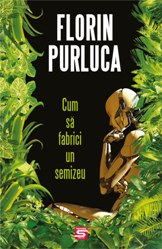
Cum să fabrici un semizeu
📖 Book Details
Title: Cum să fabrici un semizeu
Author: Florin Purluca
Series: Standalone
Genre: Science Fiction / Posthuman SF
Publisher: Tritonic
Collection: SFFH
First Published: 2016
Language: Romanian
Format: Paperback
Pages: 150
Dimensions: 200 × 130 mm
ISBN: 978-606-749-196-8
Availability: Out of stock / currently unavailable


