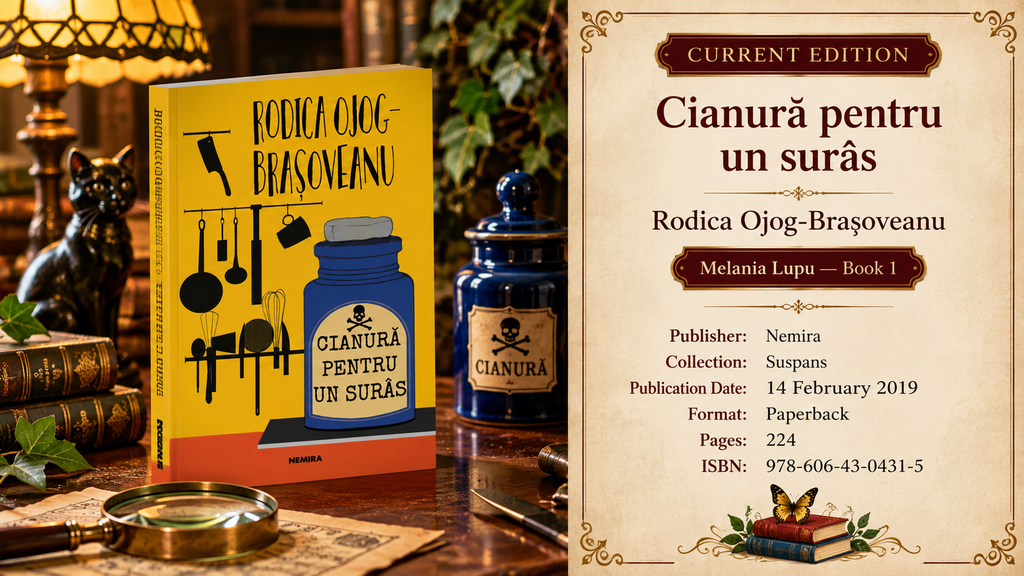
 Mystery
 Thriller


📝 First Impressions
Some books become part of your life long before you realise how important they are going to be. For me, Cianură pentru un surâs by Rodica Ojog-Brașoveanu is one of those books. I first discovered it in my parents’ library when I was still in school, although I couldn’t tell you exactly how old I was. What I remember clearly is the pleasure of discovering Melania Lupu for the first time and how quickly this wonderfully eccentric woman captured my imagination.
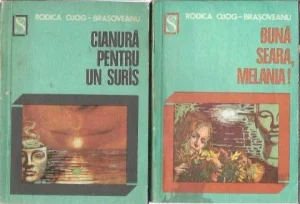
I still remember the two green-covered books sitting on my parents’ shelves: Cianură pentru un surâs and Bună seara, Melania!. They were separate volumes, but in my memory they have always belonged together because they introduced me to a character I would continue to love for years. I have reread these novels several times since that first encounter, and Melania has never lost her charm.
At the time, I hadn’t yet discovered television detectives such as Jessica Fletcher, played by Angela Lansbury in Murder, She Wrote. Melania was one of my earliest encounters with an older female character whose intelligence and resourcefulness made her far more formidable than anyone might initially suspect. She was nothing like the conventional investigators I associated with crime stories, and that made her immediately fascinating.
What attracted me was not just the mystery, but Melania herself: her extraordinary intelligence, her apparent innocence, her relationship with Mirciulică and the delightful way she interacted with the people around her. I loved the contrast between how others perceived her and how cleverly she could turn a situation to her advantage.
Looking back, Cianură pentru un surâs was much more than an entertaining detective novel. It was the beginning of a lasting affection for one of Romanian crime fiction’s most memorable characters.
💜 What I Loved
What I have always loved most about Cianură pentru un surâs is Melania Lupu. She is intelligent, unpredictable, mischievous and wonderfully difficult to underestimate once you understand what she is capable of. There is something irresistible about a seemingly harmless elderly lady who can outthink people who consider themselves far more experienced and sophisticated.
Melania’s greatest weapon is her mind. She observes people, understands their weaknesses and knows exactly how to use conversation to her advantage. She can appear confused, innocent or completely absorbed in some trivial matter while remaining remarkably aware of everything happening around her. I have always found that contrast delightful, especially because it creates so many opportunities for humour.
I particularly enjoy her interactions with the investigators, including Cristescu and Colonel Azimioară. The conversations are a pleasure in themselves, filled with clever remarks, apparent misunderstandings and subtle attempts to gain the upper hand. Melania has a wonderful way of making people believe they are directing a conversation when she is often the one influencing its course. Her intelligence is never simply something the author tells us about; it becomes entertaining through the way she speaks and behaves.
And then there is Mirciulică. I absolutely love the relationship between Melania and her cat. Their companionship brings warmth and eccentricity to her world, and it is impossible for me to think of Melania without also thinking of him. As a cat lover, I have always appreciated this aspect of the series. Mirciulică is part of what makes Melania such a distinctive and memorable character.
Another reason I love Rodica Ojog-Brașoveanu’s writing is her sense of humour. Her crime fiction never feels like a mechanical exercise in solving a puzzle. The characters have personalities, their conversations are entertaining, and the mysteries unfold within a recognisable Romanian social environment. There is irony, wit and a wonderful understanding of how people behave when they believe they are cleverer than everyone else.
I also appreciate the way the novel belongs to its own time and place. Reading it now is not quite the same as encountering it as a child, but the atmosphere remains part of its charm. The dialogue, the social conventions and the details of everyday life give the story a distinctive identity that I would never want to lose.
Above all, I love that Cianură pentru un surâs introduced me to a character I would happily revisit again and again. Very few fictional personalities remain so entertaining after multiple readings, but Melania is one of them. Even when you already know the story, there is still enormous pleasure in watching her think, talk and outmanoeuvre the people around her.
🤔 What Didn’t Quite Work for Me
It is difficult for me to find something to criticise about Cianură pentru un surâs, partly because I have known and loved the novel since childhood. I have reread it several times, and my affection for Melania, Mirciulică and Rodica Ojog-Brașoveanu’s storytelling has remained remarkably consistent.
The book belongs to an earlier style of detective fiction, with a greater emphasis on conversations, character interactions and gradual developments than on the relentless action of many contemporary thrillers. Some readers might find that pacing old-fashioned, but it has never bothered me. In fact, I enjoy having the time to appreciate the characters and the humour that emerges from their encounters.
The setting also reflects the social attitudes and everyday realities of the period in which the novel was written. Rather than seeing these details as weaknesses, I consider them part of the book’s identity. They remind me of the world in which I first encountered these stories and contribute to the distinctive atmosphere of Romanian crime fiction from that era.
I cannot point to a particular flaw that diminished my enjoyment. This is a book I return to because I genuinely love spending time in Melania’s world, and I see no reason to invent criticisms simply to make the review appear more balanced.
👥 Who Would Enjoy This Book?
Cianură pentru un surâs is an excellent choice for readers who enjoy traditional detective fiction with intelligent plotting, memorable characters and a generous helping of humour. It is particularly appealing if you prefer mysteries in which observation, conversation and psychological insight play an important role.
Readers who appreciate unconventional female protagonists will find Melania Lupu especially entertaining. She is older, eccentric and frequently underestimated, yet her intelligence makes her far more formidable than her appearance suggests. If you enjoy characters who defeat their opponents through wit rather than physical strength, Melania is a wonderful discovery.
The novel is also a good introduction to classic Romanian crime fiction. Rodica Ojog-Brașoveanu’s stories have a distinctive cultural atmosphere, with humour and social interactions that feel rooted in Romanian everyday life. Readers interested in older mysteries may particularly appreciate the measured pacing and the attention given to characters and dialogue.
And, of course, cat lovers have an additional reason to become attached to Melania’s world. Her relationship with Mirciulică adds warmth and personality to the series, making her even more memorable.
As the first novel in the Melania Lupu series, Cianură pentru un surâs is the ideal place to begin. It introduces the characters and establishes the combination of intelligence, humour and mystery that makes the subsequent books such enjoyable reading.
💭 Final Thoughts
Cianură pentru un surâs will always be special to me because it takes me back to my childhood and the pleasure of discovering books in my parents’ library. I can still picture those green-covered editions and remember how fascinated I became by Melania Lupu. Some fictional characters enter your life at exactly the right moment, and she was certainly one of them.
What has stayed with me through multiple readings is her wonderful personality. I love her intelligence, her apparent innocence, her mischievous humour and the way she interacts with Mirciulică and the investigators. She is the kind of character who makes a story worth revisiting even when you already know what happens.
Rodica Ojog-Brașoveanu created something genuinely memorable with Melania Lupu: a protagonist whose charm comes not from conventional heroism, but from her ability to observe, understand and manipulate the world around her. The mysteries are entertaining, but her presence is what makes the novels unforgettable.
Years after that first reading, I still enjoy returning to these books. They remind me not only of why I love Romanian detective fiction, but also of how certain stories become connected to our earliest experiences as readers.
For me, Cianură pentru un surâs is more than the beginning of a beloved crime series. It is one of those books that has accompanied me from childhood into adulthood, and I suspect Melania and Mirciulică will continue to make me smile whenever I return to their world.
✨ The BookFairy Verdict
Cianură pentru un surâs
📖 Book Details
- Title: Cianură pentru un surâs
- Author: Rodica Ojog-Brașoveanu
- First Published: 1975
- Original Language: Romanian
- Genre: Mystery, Thriller
- Series: Melania Lupu — Book 1
- Setting: Bucharest, Romania
- Format: Crime novel
📚 Reading Order — Melania Lupu Series
- Cianură pentru un surâs (1975)
- Bună seara, Melania! (1976)
- 320 de pisici negre (1978)
- Anonima de miercuri (1984)
- Dispariția statuii din parc (1987)
- O toaletă à la Liz Taylor (1992)