
Author Guide | BookFairy
📖 About Marian Coman
Marian Coman is a Romanian writer, comic-book scriptwriter, journalist and editor, best known for creating the dark fantasy universe of Haiganu. His writing draws upon Romanian folklore, mythology and supernatural traditions, transforming familiar cultural influences into imaginative stories about gods, mortals, power and the consequences of their choices. His literary work spans novels, short fiction and comics, reflecting a career shaped by a genuine fascination with storytelling in its many forms.
Born in Mangalia in 1977, Coman spent an important part of his life in Brăila, where he worked as a journalist in print media and television. His connection with Mangalia, Brăila and Iași remains an important part of his personal and creative history. Before becoming widely associated with mythology-inspired fantasy, he established himself through short fiction, publishing Nopți albe, zile negre in 2005, Testamentul de ciocolată in 2007 and Teoria flegmei. Apel la mitocănie in 2008. These early works demonstrated his interest in unusual situations, the fantastic and the different ways literature can challenge our understanding of everyday reality.
His career took another important direction through comic books. Coman wrote scripts for Harap Alb continuă, published between 2012 and 2017, and Tinerețe fără bătrânețe, both inspired by Romania’s rich storytelling traditions. Rather than treating fairy tales as material belonging exclusively to the past, these projects explored how familiar characters, supernatural forces and traditional beliefs could become the foundations of contemporary adventures. They also introduced readers to a more ambitious fictional universe that would eventually develop into one of his most significant literary achievements.
That universe was Haiganu. Originally introduced through Harap Alb continuă, the story gradually expanded beyond its comic-book origins. In 2015, Coman published Fluviul Șoaptelor, the first novel in the series, followed by Furia Oarbă in 2017. The trilogy was completed in 2026 with Tristețea Zeilor, while the first two novels returned to print in revised and expanded editions published by Nemira. The result was a fantasy project developed over more than a decade, moving between illustrated storytelling and prose while retaining its distinctive mythology and atmosphere.
Coman’s literary activity continued beyond Haiganu. In 2019, he published Omulețul din perete și alte povestiri fantastice, a collection that received a revised and expanded edition in 2023. His novel Ultima carte followed in 2024. His stories have also appeared in anthologies and have been translated into several languages, while his writing has received recognition through Romanian fantasy and science fiction awards and at the European Science Fiction Convention.
His contribution to speculative fiction extends beyond the books he writes. Since joining Nemira in 2018, Coman has coordinated Armada, the publisher’s imprint dedicated to science fiction, fantasy and thrillers, alongside its audiobook production. He is also a member of PEN Romania and the Science Fiction & Fantasy Writers Association. Through these activities, he occupies an interesting position within Romanian literature: both a creator of original fictional worlds and an editor helping bring speculative fiction to a wider audience.
On BookFairy, you can discover Marian Coman’s major works, explore the mythology behind the Haiganu trilogy and read about my experience of discovering his fictional universe through Harap Alb continuă before encountering it as a complete novel.
📚 Marian Coman’s Books and Literary Worlds
Marian Coman’s bibliography brings together novels, short-story collections, comic-book scripts and other literary projects. Although Haiganu is his most recognisable fantasy universe, his writing is not limited to a single genre or form. Across his work, he returns to imaginative storytelling, the unexpected possibilities hidden within ordinary situations and the relationship between familiar traditions and unfamiliar worlds.
🐺 The Haiganu Trilogy
The Haiganu trilogy is Marian Coman’s most ambitious fantasy project, drawing inspiration from Romanian folklore and ancient supernatural beliefs. Its world is populated by gods and mortals whose destinies are shaped by power, suffering, memory and conflicts that extend far beyond individual lives. At its centre stands Haiganu, a fallen god whose existence raises difficult questions about divine authority, responsibility and the fragile relationship between humanity and the supernatural.
The series begins with Fluviul Șoaptelor (2015), which introduces the mythology and establishes the foundations of the fictional universe. Furia Oarbă (2017) expands the conflict and explores the forces struggling for power, while Tristețea Zeilor (2026) completes the story. The first two novels were originally published by HAC!BD and later appeared in revised and expanded Nemira editions, alongside the concluding volume.
One of the most interesting aspects of Haiganu is its development from a comic-book story into a complete literary trilogy. Readers who encountered the universe through Harap Alb continuă experienced its mythology and characters through illustrations and serialised storytelling before the novels offered a different way of exploring the same world. This unusual creative journey gives Haiganu a distinctive place in contemporary Romanian fantasy.
👹 Harap Alb Continuă and Comic-Book Storytelling
Harap Alb continuă was a Romanian comic-book series that reimagined traditional fairy-tale material through contemporary fantasy storytelling. Instead of simply repeating familiar adventures, the series developed new interpretations of characters and supernatural elements associated with Romanian folklore. Marian Coman contributed as a scriptwriter, helping create stories that connected traditional influences with larger fictional conflicts and more complex imaginative worlds.
The project was particularly important for the development of Haiganu, whose fictional universe first appeared within its pages. Coman also wrote scripts for Tinerețe fără bătrânețe, another comic-book series inspired by Romanian storytelling traditions, and for the graphic novel TFB (2016). Together, these works demonstrate his interest in visual narrative and the possibilities of exploring mythology through different artistic forms.
His comic-book background also helps explain why the transition between illustrated storytelling and prose is such an interesting aspect of his career. Both forms offer opportunities for atmosphere, character development and world-building, but each approaches those elements differently. Coman’s work illustrates how a fictional universe can evolve without remaining confined to the medium in which it first appeared.
📖 Fantastic Short Stories
Before the publication of Haiganu, Marian Coman had already established himself through short fiction. His early collections, Nopți albe, zile negre (2005) and Testamentul de ciocolată (2007), introduced readers to his interest in unusual situations and imaginative storytelling. These books represent an important stage in his literary development, revealing a writer willing to explore the fantastic beyond the boundaries of traditional genre expectations.
His later collection, Omulețul din perete și alte povestiri fantastice (2019), continued that exploration, bringing together stories in which familiar situations can acquire strange or unsettling dimensions. Unlike a multi-volume fantasy series, short fiction offers less space to establish an elaborate mythology, encouraging the writer to build an atmosphere or develop an extraordinary idea within a more concentrated narrative.
For readers interested in discovering Marian Coman beyond Haiganu, his short-story collections offer another perspective on his imagination. They demonstrate that the attraction of the fantastic does not always depend upon ancient gods, elaborate magical systems or entire invented worlds. Sometimes, the smallest disturbance in ordinary reality can be enough to create a memorable story.
📕 Other Fiction and Literary Projects
Marian Coman’s bibliography also includes Teoria flegmei. Apel la mitocănie (2008), a work that reflects literary interests extending beyond conventional fantasy. His graphic novel script TFB (2016) represents another aspect of his involvement with illustrated storytelling, while Ultima carte (2024) marks a later stage in his career as a novelist.
Together with his contributions to anthologies and comic-book publications, these works demonstrate the variety of his writing. Rather than focusing exclusively on one fictional universe, Coman has explored different forms and approaches to storytelling throughout his career.
For a complete publication chronology, individual stories, anthology appearances, translations and revised editions, see the separate Marian Coman bibliography.
✨ What Makes Marian Coman’s Stories Special?
One of the most distinctive qualities of Marian Coman’s writing is his ability to transform Romanian folklore into contemporary fantasy without losing the atmosphere that makes those traditions fascinating. While international fantasy frequently draws inspiration from Greek, Norse and Celtic mythology, Coman explores a different cultural heritage, one filled with ancient beliefs, supernatural creatures and unsettling stories that deserve a place in modern imaginative literature.
What makes his approach particularly interesting is that he does not simply reproduce traditional legends. In Haiganu, mythology becomes the foundation of an original fictional universe, complete with its own history, conflicts and moral uncertainties. The gods are not merely distant figures whose names belong to forgotten traditions; they become active participants in a world shaped by suffering, power and the consequences of their actions. Their supernatural abilities do not necessarily make them wiser, kinder or more capable of avoiding the mistakes associated with human existence.
Atmosphere is another important element of his storytelling. The Haiganu universe is dark, violent and deeply connected to the sense that ancient forces continue to influence mortal lives. Yet its darkness is not simply a decorative feature intended to make the story more dramatic. It emerges from the mythology, the conflicts between characters and the complicated relationship between divine authority and human vulnerability.
Coman’s work also stands out for its connection with visual storytelling. The development of Haiganu through comics and novels demonstrates how the same imaginative world can acquire different dimensions depending on how it is presented. Illustrations can establish an immediate visual identity, while prose offers opportunities to explore the history of a world, the motivations of its characters and the emotional consequences of its conflicts. Having encountered Haiganu in both forms, I find that creative relationship especially fascinating.
What impresses me most, however, is the originality of the result. Coman’s fantasy does not feel like an attempt to reproduce the familiar worlds of internationally successful authors. Its foundations are different, and that difference gives the story a distinctive identity. For readers interested in exploring fantasy beyond the most frequently represented mythological traditions, his writing offers an opportunity to discover just how much imaginative potential exists within Romanian folklore.
📖 Marian Coman on BookFairy
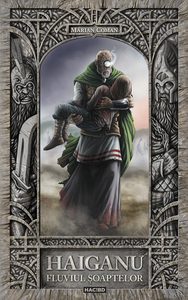
🐺 Haiganu. Fluviul Șoaptelor (2015)
My BookFairy review explores Fluviul Șoaptelor, the first novel in Marian Coman’s Haiganu trilogy, a dark fantasy inspired by Romanian mythology and folklore. I first encountered its universe through the comic-book series Harap Alb continuă before reading the complete novel in 2016, an experience that made the story particularly memorable.
The mythology, atmosphere and originality of Coman’s world left an extraordinary impression on me. My review explores what made the novel such a special reading experience and why it remains one of my favourite discoveries in Romanian fantasy.
📖 Read My Haiganu. Fluviul Șoaptelor Review
📚 Where Should You Start Reading Marian Coman?
For readers discovering Marian Coman for the first time, Fluviul Șoaptelor is my personal recommendation. As the opening novel of the Haiganu trilogy, it introduces the fictional world, its supernatural mythology and the conflicts developed throughout the series. Readers who enjoy dark fantasy inspired by ancient gods, folklore and morally complicated characters will find plenty to appreciate, particularly if they are interested in exploring mythology beyond the traditions most commonly encountered in international fantasy.
The trilogy should be read in order: Fluviul Șoaptelor, Furia Oarbă and Tristețea Zeilor. The Nemira editions published in 2026 offer readers the complete series, including revised and expanded versions of the first two novels. Reading the books in sequence allows the mythology, characters and larger conflicts to develop as intended.
Readers who prefer shorter fiction may wish to begin with Omulețul din perete și alte povestiri fantastice. The collection offers a different introduction to Coman’s imagination, exploring unusual situations and unsettling possibilities without requiring an immediate commitment to a trilogy. Those interested in following his literary development can also explore his earlier collections, including Nopți albe, zile negre and Testamentul de ciocolată.
For readers fascinated by comics and visual storytelling, Harap Alb continuă provides another interesting way of exploring Coman’s creative work, especially because of its connection with the origins of Haiganu. However, for someone approaching his fiction primarily as a fantasy reader, I believe Fluviul Șoaptelor remains the most compelling starting point.
💜 My Favourite Marian Coman Reading Experience
My favourite Marian Coman reading experience is Haiganu. Fluviul Șoaptelor, a book that holds a special place in my memories because of the way I discovered it. I first followed the story in Harap Alb continuă, reading it in serialised comic-book form before it eventually appeared as a complete novel. Watching that extraordinary fictional universe gradually take shape made the experience particularly memorable.
When I read the novel in 2016, I absolutely loved it. Its dark atmosphere, ancient gods and imaginative reinterpretation of Romanian folklore left a lasting impression on me. I particularly appreciated discovering a fantasy world that drew so confidently upon Romanian cultural traditions while creating something unmistakably original.
Even ten years later, although some details have naturally faded from memory, my enthusiasm for the book remains unchanged. It is one of those rare stories whose impact stays with you long after the reading experience itself has ended.
📚 Complete Marian Coman Bibliography
Explore the complete bibliography of Marian Coman, including his novels, fantasy series, short-story collections, individual stories, comic-book scripts and other literary publications. The bibliography follows his work in original publication order and includes the complete Haiganu reading sequence, anthology appearances, available translations and links to BookFairy reviews.
It also distinguishes the original HAC!BD editions from the revised and expanded Nemira publications, while identifying related comic-book projects such as Harap Alb continuă, Tinerețe fără bătrânețe and TFB.