 Fantasy
 Magic
📝 First Impressions
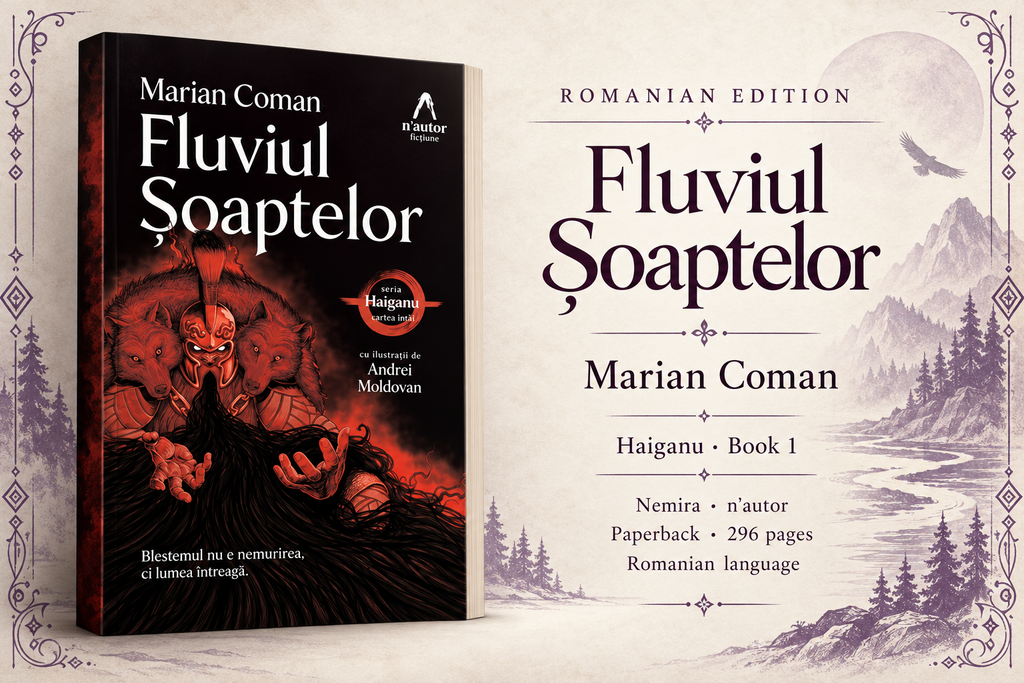
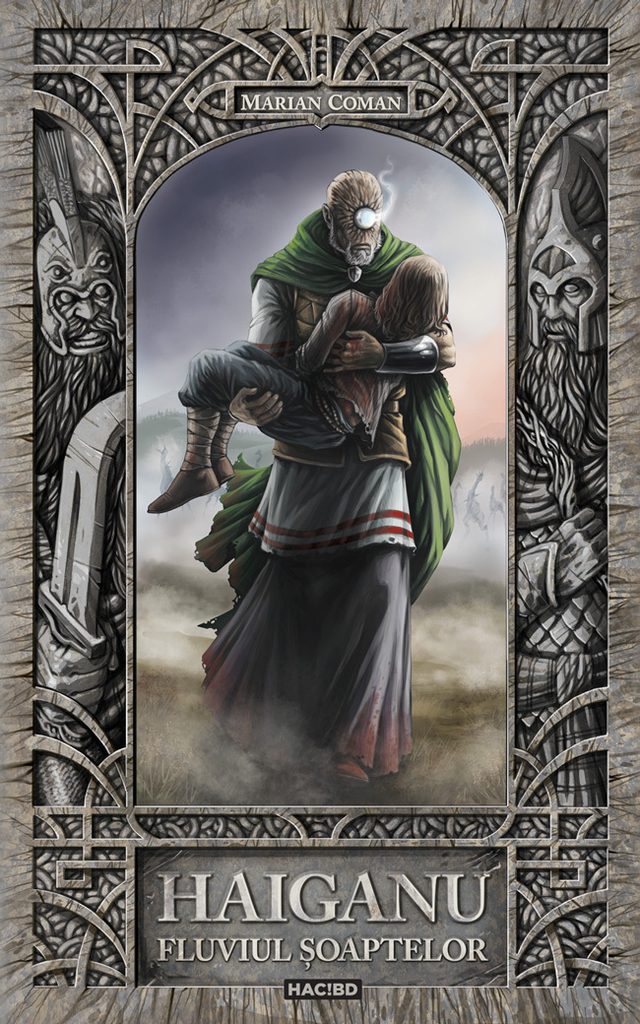
My journey into Marian Coman’s world of Haiganu began long before I held Fluviul Șoaptelor as a complete novel. I first discovered this extraordinary universe through Harap Alb Continuă (HAC!), a Romanian comic magazine in which the story appeared in serialised form. I followed it through the magazine, watching this strange and fascinating world gradually take shape, and when the novel was finally published in 2015, I already had a connection to it.
There is something special about discovering a story this way. You don’t simply open a book and enter an unfamiliar world. You meet its characters little by little, become acquainted with its mythology and begin to recognise the atmosphere that surrounds it. By the time the complete novel appeared, Haiganu’s universe had already captured my imagination.
And what a magnificent universe Marian Coman created!
Inspired by Romanian folklore and ancient Thracian-Dacian mythology, Fluviul Șoaptelor takes familiar elements from our cultural heritage and transforms them into something wonderfully dark, strange and original. Forgotten gods, sorcerers, fantastic creatures and ancient powers inhabit a world where magic is dangerous, divine beings are not necessarily benevolent, and human lives can be terribly fragile.
At the centre of it all stands Haiganu, a fallen god condemned to wander among mortals, tormented by an endless river of whispers flowing through his mind. Prayers, curses, thoughts and voices reach him without pause, turning what might initially seem like an extraordinary divine ability into a punishment.
When a child’s voice emerges from this overwhelming noise, Haiganu’s existence becomes entangled with events that may alter the balance between gods and mortals.
What struck me about this story was not simply its imaginative premise, but the way everything seemed to belong together. The mythology, the atmosphere, the characters and the storytelling created a world that felt both deeply connected to Romanian traditions and entirely its own.
For someone who loves fantasy, discovering such an ambitious universe inspired by the folklore of my own country was an absolute delight.
💜 What I Loved
A fantasy world rooted in Romanian mythology
One of the things I loved most about Fluviul Șoaptelor was its relationship with Romanian mythology and folklore.
I have always enjoyed fantasy worlds populated by gods, supernatural beings and ancient creatures, but so much of the genre draws its inspiration from the same familiar traditions. Greek gods, Norse mythology and Celtic legends have inspired countless wonderful books, and I certainly have nothing against them. Nevertheless, I find it exciting when an author introduces readers to a different mythological heritage.
Romanian folklore is extraordinarily rich. We have stories about supernatural creatures, ancient beliefs, mysterious beings and powers that exist somewhere between the human and the divine. Some of these traditions are familiar from childhood, while others survive in legends, regional customs and fragments of older beliefs.
Marian Coman takes inspiration from this heritage without turning his novel into a collection of traditional tales. He doesn’t simply borrow familiar creatures and place them in a conventional fantasy setting. Instead, he reshapes them, giving them new roles within a world that possesses its own history, conflicts and internal logic.
That is what impressed me so much. The mythology feels like an essential part of the universe rather than decoration added to make the setting more unusual.
There is something enormously satisfying about recognising echoes of your own cultural traditions in a fantasy novel, particularly when those traditions are presented with such imagination and ambition.
And I think this is one of the reasons Haiganu deserves a much wider international audience. Romanian mythology has so much to offer fantasy literature, and this novel demonstrates how fascinating it can become when an author is willing to reinterpret it rather than merely reproduce it.
Haiganu and the terrible burden of being a god
Haiganu himself is an extraordinary creation.
We tend to imagine gods as powerful beings who exist above ordinary human concerns. They may have rivalries, weaknesses and complicated relationships, but their divine nature usually places them in a position of superiority over mortals.
Haiganu’s situation is considerably more tragic.
He is a fallen god, condemned to wander through a world that offers him little peace. His mind is overwhelmed by the endless voices of living beings, a constant torrent of prayers, curses and thoughts that he cannot escape.
I love the contradiction at the heart of this idea. Something that might initially appear to be an extraordinary gift becomes an unbearable punishment. Haiganu possesses abilities beyond human understanding, yet those abilities cannot save him from suffering.
His immortality is hardly something to envy.
There is a wonderful sense of tragedy in the idea of a divine being who cannot find silence. Ordinary people can retreat from the world, close a door or seek solitude. Haiganu cannot simply escape the voices that torment him. The suffering of the world follows him wherever he goes.
It makes his existence feel almost unbearably lonely.
And when the voice of a child emerges from that endless river of whispers, the possibility that something might finally interrupt his torment becomes an intriguing beginning for the story.
I particularly appreciate fantasy that allows powerful characters to be vulnerable. A god who can do almost anything is rarely as interesting to me as one whose extraordinary abilities come with consequences.
Haiganu’s curse gives him precisely that complexity.
A dark atmosphere that suits the story
The world Marian Coman creates is not a comfortable place.
There are gods, sorcerers, magical creatures and extraordinary powers, but their presence does not make life easier for the people who inhabit it. On the contrary, supernatural forces often make an already dangerous world even more unpredictable.
War, ambition, cruelty and superstition shape the lives of ordinary people. Divine intervention does not guarantee justice, and the distinction between monsters and humans is not always as reassuring as one might wish.
I loved this darker atmosphere because it felt entirely appropriate to the story.
Traditional folklore is not always gentle. Beneath the familiar tales we remember from childhood, there are often frightening creatures, terrible punishments and disturbing warnings about the dangers lurking beyond the ordinary world.
Fluviul Șoaptelor embraces that darker side of mythology.
The result is a fantasy universe that feels ancient and dangerous, where the supernatural is not simply a source of wonder but something that can inspire genuine fear.
And yet, despite all that darkness, the world remains captivating.
I enjoy fantasy settings that make me curious about what lies beyond the places and characters already introduced. A convincing fictional universe should feel larger than the immediate story, as though countless other lives and histories continue beyond the pages of the book.
That is one of the impressions I took away from Haiganu. Its mythology suggests a much wider world, filled with stories waiting to be discovered.
The relationship between gods and mortals
Another aspect I particularly appreciated was the way divine and human destinies become intertwined.
The gods of Haiganu are not distant figures confined to ancient legends. Their existence and conflicts influence the lives of mortals, sometimes with devastating consequences.
Ordinary people must survive in a world where supernatural beings possess powers they can barely comprehend, while those same divine beings are far from immune to anger, suffering or the desire for revenge.
The relationship between Haiganu and the young Zourazi brings these different worlds together.
On one side stands a fallen god who has endured centuries of torment. On the other is a child caught in circumstances shaped by cruelty, magic and forces beyond his control.
I find this contrast particularly compelling because it brings an intimate human dimension to a story involving ancient powers and enormous conflicts.
Fantasy can become so preoccupied with gods, kingdoms and battles that it occasionally loses sight of the individuals whose lives are affected by them. Here, the presence of a vulnerable child alongside a tormented divine being creates a fascinating starting point.
The mythology gives the story its scale, but the characters provide the human connection that makes such a world worth exploring.
And I appreciate that the supernatural beings themselves are not presented as simple symbols of good or evil. Their existence is complicated, their motives are not always reassuring, and their powers do not automatically make them wise or merciful.
It feels appropriate for a world inspired by ancient mythology, where gods often possess very human flaws despite their extraordinary abilities.
Discovering Haiganu through Harap Alb Continuă
I cannot discuss Fluviul Șoaptelor without returning to Harap Alb Continuă, because that is where my experience with the story began.
HAC! was much more than an ordinary comic magazine for me. It offered an opportunity to discover imaginative Romanian storytelling in a format that combined literature and visual art, giving familiar cultural material a completely new life.
Following Haiganu in serialised form was a wonderful experience. The world gradually unfolded through successive instalments, and the artwork helped establish its distinctive atmosphere.
There is something almost magical about the relationship between illustrations and imagination. A well-drawn character or landscape can remain in your mind long after you have finished reading, becoming part of the way you picture a fictional universe.
That visual connection made the eventual publication of the novel particularly exciting.
I was already acquainted with the world and its atmosphere, but the complete book allowed me to experience the story as a continuous narrative.
I loved that transition from serialised storytelling to the finished novel.
It also made me appreciate the ambition behind the entire project. Creating an original fantasy universe inspired by Romanian mythology is already an impressive undertaking. Developing it through an illustrated publication before bringing it to readers as a novel gives the project an additional dimension.
For me, Haiganu is inseparable from those beginnings in HAC!. They are part of what makes the book so memorable.
A genuinely original Romanian fantasy universe
What I admire most about Marian Coman’s achievement is that Fluviul Șoaptelor has its own identity.
It would have been relatively easy to create a fantasy world modelled closely on familiar international works, replacing their creatures and gods with Romanian equivalents. Such an approach might still have produced an entertaining story, but it would have missed the opportunity to create something genuinely distinctive.
Coman goes much further.
He takes inspiration from mythology, folklore and old beliefs, then builds an original fictional world around them. Its characters, conflicts and supernatural forces feel connected to those traditions without being restricted by them.
That is a difficult balance to achieve, and one I appreciate enormously.
I don’t want Romanian fantasy to succeed merely because it is Romanian. I want it to offer the same imagination, ambition and quality that I look for in fantasy literature from anywhere in the world.
Fluviul Șoaptelor gave me exactly that.
It reminded me that our folklore contains enough extraordinary material to inspire entire fictional universes, and that those universes can be every bit as compelling as the worlds created by internationally celebrated fantasy authors.
Most importantly, it did so through a story I genuinely loved.
🤔 What Didn’t Quite Work for Me
There is very little I would identify as a significant weakness in my experience of Fluviul Șoaptelor. The mythology, dark atmosphere and imaginative world-building were precisely the elements that made it such a memorable book for me.
That does not mean the novel will necessarily appeal to every fantasy reader.
Its world is dark, sometimes brutal, and deeply influenced by supernatural forces that are not always benevolent. Readers expecting a gentle adventure inspired by familiar fairy tales may be surprised by how unsettling this interpretation of folklore can become.
The story also introduces an original universe with its own mythology, creatures, history and conflicts. It asks readers to enter that world on its own terms, rather than relying entirely on familiar fantasy conventions.
For someone who enjoys discovering elaborate imaginary worlds, however, that richness can be part of the pleasure.
I certainly wouldn’t want the novel to sacrifice its distinctive atmosphere or mythological complexity simply to become more conventional.
The elements that might require some adjustment from other readers were among the very things I appreciated most.
👥 Who Would Enjoy This Book?
I would enthusiastically recommend Fluviul Șoaptelor to readers who enjoy dark fantasy, ancient mythology and original world-building.
If you love stories involving fallen gods, powerful sorcerers, supernatural creatures and conflicts that reach far beyond ordinary human concerns, Marian Coman’s universe has plenty to offer.
I would particularly recommend it to readers interested in Romanian folklore. The novel provides a fascinating example of how traditional beliefs and mythological imagery can be reimagined within contemporary fantasy literature.
Romanian readers may recognise echoes of stories and traditions they encountered growing up, while international readers may discover an unfamiliar mythological heritage with enormous creative potential.
Those who enjoy morally complicated fantasy worlds should also appreciate the atmosphere. Gods are not automatically protectors, supernatural powers can be dangerous, and human cruelty is sometimes every bit as frightening as the monsters.
I would also recommend the book to readers who appreciate illustrated storytelling and are interested in the development of original fantasy projects. The connection with Harap Alb Continuă is an important part of Haiganu’s creative history, and one that makes the universe especially interesting to explore.
Above all, this is a book for readers who want fantasy that feels different. Not different merely for the sake of originality, but because it draws upon a rich cultural tradition and transforms it into something with a distinctive voice.
💭 Final Thoughts
Haiganu. Fluviul Șoaptelor was a magnificent reading experience, and one that occupies a special place among the Romanian fantasy stories I have discovered.
Part of that connection comes from the way I first encountered it. Following the story through Harap Alb Continuă before reading the complete novel allowed me to become acquainted with its universe gradually, and I loved seeing that world develop from its serialised beginnings into a finished book.
But my admiration for the novel goes far beyond nostalgia or the circumstances of its publication.
Marian Coman created something genuinely remarkable by transforming elements of Romanian folklore and ancient mythology into a dark, imaginative and original fantasy world. Haiganu himself is a fascinating central figure, a fallen god whose extraordinary abilities have become an unbearable burden, while the surrounding universe is filled with dangerous powers, mysterious beings and conflicts that blur the boundaries between the divine and the human.
What I appreciate most is the confidence of the storytelling. The novel doesn’t need to imitate more familiar fantasy worlds to prove its worth. It draws strength from its own cultural foundations and uses them to create something that feels entirely distinctive.
And perhaps that is what makes Fluviul Șoaptelor so satisfying to me. I love discovering extraordinary imaginary worlds, but there is an additional pleasure in finding one inspired by the mythology and traditions of my own country, especially when it is brought to life with such ambition and imagination.
For me, this is Romanian fantasy at its most exciting: dark, atmospheric, imaginative and deeply connected to a fascinating mythological heritage.
An absolutely magnificent book, and a wonderful reminder that some of the most extraordinary fantasy worlds can grow from stories that have been part of our own culture for centuries.
✨ The BookFairy Verdict
Haiganu. Fluviul Șoaptelor
📖 Book Details
| Detail | Information |
|---|---|
| Title | Haiganu. Fluviul Șoaptelor |
| Original Title | Haiganu. Fluviul Șoaptelor |
| Author | Marian Coman |
| Author’s Nationality | Romanian |
| Original Language | Romanian |
| Series | Haiganu #1 |
| Genre | Fantasy, Dark Fantasy, Mythological Fantasy |
| Publisher (Original Edition) | HAC!BD |
| Publisher (Current Edition) | Nemira |
| Collection / Imprint | n’autor ficțiune |
| First Published | 2015 |
| Current Edition Published | 28 May 2026 |
| Pages (2026 Edition) | 296 |
| Format | Paperback |
| Illustrations | Andrei Moldovan |
| Edition Owned | Romanian physical edition, Nemira (2026) |
| Language Availability | Romanian |