
Author Guide | BookFairy
📖 About Franz Kafka
Franz Kafka (1883–1924) was a German-language writer born in Prague, then part of the Austro-Hungarian Empire. Widely regarded as one of the most influential literary figures of the twentieth century, Kafka transformed ordinary situations into unsettling explorations of alienation, fear, power, guilt and the absurdity of human existence.
Born into a German-speaking Jewish family, Kafka studied law at the German University in Prague and spent much of his professional life working for an accident insurance institution. Although he took his responsibilities seriously, writing remained his deepest passion. His demanding professional life frequently conflicted with the time and solitude he needed to create.
Kafka’s fiction often begins with something inexplicable happening to an apparently ordinary person. From that moment onwards, familiar surroundings become threatening, institutions operate according to incomprehensible rules, and characters find themselves struggling against forces they cannot understand or control.
His writing combines psychological depth, dark humour, philosophical questions and a profoundly disturbing sense of uncertainty. The word Kafkaesque eventually entered everyday language to describe situations characterised by absurdity, oppressive bureaucracy and helplessness.
Among his most celebrated works are The Metamorphosis, The Trial, The Castle and Amerika.
Kafka died of tuberculosis in 1924, aged just forty. Much of his literary reputation developed after his death, largely because his close friend Max Brod disregarded Kafka’s request to destroy his unpublished manuscripts.
Today, Kafka’s influence extends far beyond literary fiction, reaching philosophy, theatre, cinema, science fiction and contemporary discussions about individual freedom and institutional power.
✍️ Kafka’s Literary World
What makes Kafka particularly remarkable is his ability to make the impossible feel disturbingly ordinary.
His protagonists rarely inhabit traditional fantasy worlds. Instead, they encounter situations that seem impossible but are treated by everyone around them as perfectly normal.
A man wakes up transformed into an enormous insect-like creature. Another is arrested without being told what crime he has committed. A land surveyor arrives in a village but cannot gain access to the authorities who supposedly employ him.
These premises may sound surreal, yet Kafka presents them with remarkable precision and restraint.
His characters struggle with questions that remain deeply relevant:
- How much control do we really have over our lives?
- What happens when authority becomes impossible to challenge?
- Can individuals preserve their identities under overwhelming social pressure?
- Why do people accept rules they cannot understand?
- Is guilt something imposed upon us, or something we create ourselves?
Kafka rarely provides comforting answers. Instead, his stories leave readers questioning the structures, assumptions and expectations that govern everyday existence.
📚 Franz Kafka’s Major Works
The Metamorphosis (1915)
Original title: Die Verwandlung
One of Kafka’s most recognisable works, The Metamorphosis follows Gregor Samsa, a travelling salesman who awakens one morning to discover that he has undergone an extraordinary physical transformation.
Beneath its surreal premise, the novella examines family obligations, isolation, identity, guilt and the consequences of losing one’s perceived usefulness to others.
The Trial (1925)
Original title: Der Process
Published posthumously, The Trial follows Josef K., a man arrested by a mysterious authority without being informed of the charges against him.
As he attempts to understand the accusations and defend himself, he becomes trapped in an increasingly incomprehensible legal system.
The novel remains one of literature’s most powerful explorations of bureaucracy, institutional authority and helplessness.
The Castle (1926)
Original title: Das Schloss
Another unfinished novel published after Kafka’s death, The Castle follows a land surveyor known only as K., who struggles to communicate with the mysterious authorities governing a village.
Its themes include exclusion, inaccessible power, belonging and the seemingly endless pursuit of recognition.
Amerika / The Man Who Disappeared (1927)
Original title: Der Verschollene
Kafka’s earliest novel, left unfinished and published posthumously under the title Amerika, follows the young Karl Rossmann after he is sent from Europe to the United States.
The novel explores displacement, social hierarchies, injustice and the uncertainty of finding one’s place in an unfamiliar world.
The Man Who Disappeared more closely reflects the title associated with Kafka’s manuscript, while Amerika remains widely used in English-language editions.
📚 Short Fiction, Diaries and Letters
Kafka’s literary legacy extends well beyond his three unfinished novels.
His shorter fiction includes important works such as:
- The Judgment (1913)
- The Stoker (1913)
- In the Penal Colony (1919)
- A Country Doctor (1920, collection)
- A Hunger Artist (1924, collection)
- A Report to an Academy
- Before the Law
- The Burrow
His diaries, notebooks, aphorisms and personal correspondence provide additional insight into his intellectual life, creative struggles and relationships.
Particularly significant are Letter to His Father, Letters to Felice and Letters to Milena.
These writings reveal another dimension of Kafka: a sensitive, observant and frequently self-critical individual whose private thoughts illuminate many of the concerns explored in his fiction.
🇷🇴 Franz Kafka in Romanian Translation
Kafka’s works have been translated and published extensively in Romania.
Among the best-known Romanian titles are:
- Metamorfoza — The Metamorphosis
- Procesul — The Trial
- Castelul — The Castle
- America — Amerika / The Man Who Disappeared
- Colonia penitenciară — In the Penal Colony
- Scrisoare către tata — Letter to His Father
- Scrisori către Milena — Letters to Milena
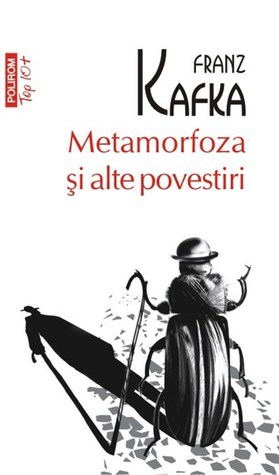
Romanian publishers of Kafka’s works include Polirom, whose catalogue features Procesul, Castelul, America and Metamorfoza şi alte povestiri.
For readers collecting Kafka’s work in Romanian, it is important to distinguish between individual works, collections containing overlapping stories and new translations of previously published texts.
A separate BookFairy bibliography will document the publication history and verified Romanian editions without unnecessarily duplicating reprints.
📚 Where to Start Reading Franz Kafka
Kafka did not write a conventional literary series, so there is no compulsory reading order.
However, for readers discovering his work for the first time, I would recommend the following progression:
- The Metamorphosis — An accessible introduction to Kafka’s distinctive combination of surrealism and psychological unease.
- The Judgment — A short, intense exploration of family relationships, authority and guilt.
- In the Penal Colony — A darker examination of punishment, obedience and institutional cruelty.
- The Trial — One of Kafka’s defining novels and a powerful introduction to his treatment of bureaucracy and helplessness.
- The Castle — A more demanding exploration of alienation and inaccessible authority.
- Amerika / The Man Who Disappeared — An opportunity to discover a different side of Kafka’s imagination.
- Diaries, letters and notebooks — A deeper exploration of the writer behind these extraordinary works.
Readers who prefer chronological discovery can also explore Kafka’s works according to their original dates of publication, keeping in mind that several major works appeared only after his death.
⭐ My Franz Kafka Book Reviews
Discover my personal reviews of Franz Kafka’s books on BookFairy. Each review explores my reading experience, the themes that stood out to me, and my honest thoughts about the book.
⭐ My Franz Kafka Book Reviews
Discover my personal reviews of Franz Kafka’s books on BookFairy. Each review explores my reading experience, the themes that stood out to me, and my honest thoughts about the book.
Click on a book cover below to read the full spoiler-free review.
🦋 Franz Kafka on BookFairy
This author page is part of BookFairy’s growing collection of literary guides, bringing together author biographies, reading recommendations, complete bibliographies, Romanian translations and personal book reviews.
As I explore more of Kafka’s writing, this page will connect to the relevant BookFairy reviews and reading discussions.
Kafka’s work offers something unusual: stories that may appear strange or even impossible at first, yet reveal uncomfortable truths about human behaviour, society and the systems we create.
Whether approached as modernist literature, philosophical fiction, psychological horror or an exploration of the absurd, his books continue to challenge readers more than a century after they were written.
📚 Complete Franz Kafka Bibliography
Explore the Franz Kafka Complete Bibliography on BookFairy.
This comprehensive guide brings together Kafka’s novels, novellas, short stories, original collections, posthumous writings, diaries, letters, and Romanian translations.
Discover his works in publication order, explore the contents of his short-story collections, and find recommended reading orders alongside verified Romanian editions.