
Author Guide | BookFairy
📖 About Andrzej Sapkowski
Andrzej Sapkowski is a Polish fantasy author best known for creating The Witcher, the internationally acclaimed series featuring Geralt of Rivia, a professional monster hunter navigating a world where the distinction between good and evil is rarely straightforward.
Born in Łódź, Poland, in 1948, Sapkowski studied economics before establishing himself as one of the most influential voices in modern European fantasy. His literary career began with the short story The Witcher, published in the Polish fantasy magazine Fantastyka in 1986.
What started as a single story gradually developed into an expansive fantasy universe inspired by Slavic folklore, European fairy tales, mythology, history and political conflict.
Unlike traditional fantasy stories built around clear divisions between heroes and villains, Sapkowski’s books frequently challenge the idea that morality can be reduced to simple choices.
His characters encounter prejudice, political manipulation, religious intolerance, war and the consequences of decisions made by people who believe they are acting for the greater good.
Although Geralt of Rivia remains his most recognisable creation, Sapkowski has also written The Hussite Trilogy, a historical fantasy series set against the religious and political upheavals of fifteenth-century Europe.
The Witcher universe has expanded far beyond literature, inspiring internationally successful video games, television adaptations, comics and other media.
Nevertheless, the original books remain the foundation of Geralt’s world and offer a particularly fascinating exploration of monsters, humanity and moral responsibility.
On BookFairy, I’m discovering Andrzej Sapkowski’s writing through his original books, sharing spoiler-free reviews, reading orders and information about the Romanian editions.
💜 Why I Read Andrzej Sapkowski
I’ve always enjoyed fantasy, particularly stories that combine mythology, unusual creatures and complicated moral questions.
I’m also a fan of role-playing games, although I haven’t actually played The Witcher video games.
I was familiar with the franchise and its reputation, and I was curious to discover the literary world behind it.
I also had the pleasure of meeting Andrzej Sapkowski in person at the European Science Fiction Convention (Eurocon) in Barcelona in 2016. I had the opportunity to speak with him, which makes my connection to his work a little more personal. It’s not every day that you get to meet the creator of such an influential fantasy universe, and I’m glad I had that experience before eventually discovering Geralt’s adventures through the books.
When I eventually read The Last Wish, I found myself recognising many of the elements I enjoy in fantasy RPGs: investigating mysterious events, encountering strange creatures, interpreting clues and making decisions where the apparently obvious solution isn’t necessarily the right one.
Reading the stories felt a little like watching a series of quests unfold.
However, what interested me most was Sapkowski’s treatment of familiar fairy tales.
Cursed princesses, dangerous creatures and seemingly straightforward conflicts become something considerably more complicated in his hands.
The monsters aren’t necessarily evil, the humans aren’t necessarily innocent, and Geralt frequently discovers that understanding a situation matters more than simply drawing his sword.
I particularly appreciate fantasy that challenges expectations, and Sapkowski certainly does that.
His world can be cynical, violent and uncomfortable, but there is also humanity beneath its darker elements.
My first experience with his writing wasn’t perfect. Some stories worked better for me than others, and I occasionally wanted more background information about the world and its characters.
Nevertheless, The Last Wish left me interested in discovering what happens next.
I’m particularly curious to see how the storytelling develops when the individual adventures gradually give way to a larger narrative.
📚 Books Reviewed on BookFairy
My published reviews of Andrzej Sapkowski’s books:
- 📕 The Last Wish — Book Review — The collection that introduced me to Geralt of Rivia, his unusual profession and Sapkowski’s darker interpretations of traditional fairy tales.
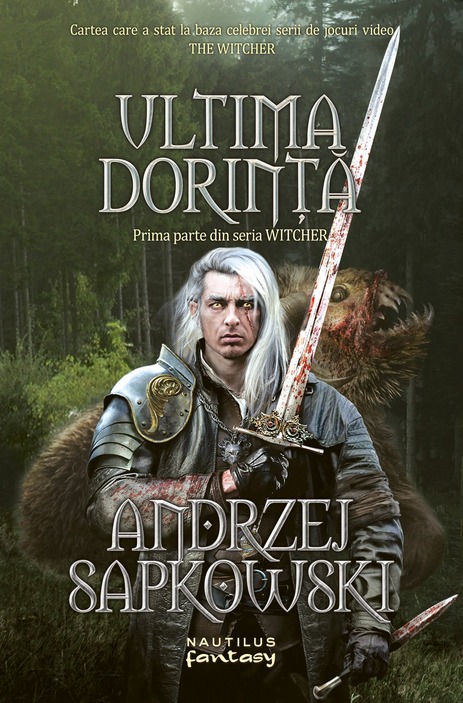
I’m continuing to explore Sapkowski’s work, and this section will grow as I read and review more of his books.
📚 Andrzej Sapkowski Complete Bibliography
Looking for a complete list of Andrzej Sapkowski’s books?
Explore my Andrzej Sapkowski Complete Bibliography, including the original Polish publication chronology, The Witcher and Hussite Trilogy reading orders, short-story collections, standalone works, essays and Romanian editions.
The bibliography also explains how earlier collections, translations and omnibus editions relate to the main reading order.
📖 Andrzej Sapkowski Reading Order
Andrzej Sapkowski has written several works of fantasy, but his two principal series are The Witcher and The Hussite Trilogy.
These series take place in completely different fictional settings and can be read independently.
⚔️ The Witcher — Recommended Reading Order
For readers discovering Geralt of Rivia for the first time, I recommend starting with the short-story collections before moving into the main five-novel saga.
- The Last Wish — Short-story collection
- Sword of Destiny — Short-story collection
- Blood of Elves — The Witcher Saga #1
- Time of Contempt — The Witcher Saga #2
- Baptism of Fire — The Witcher Saga #3
- The Tower of the Swallow — The Witcher Saga #4
- The Lady of the Lake — The Witcher Saga #5
- Season of Storms — Standalone Witcher novel
- Crossroads of Ravens — Witcher prequel
Although the events of Season of Storms and Crossroads of Ravens occur earlier in Geralt’s life, both are best approached after the original stories and saga.
The Last Wish is the ideal starting point because it introduces Geralt, the nature of his work and the moral complexity that defines the series.
🏰 The Hussite Trilogy — Reading Order
Sapkowski’s historical fantasy trilogy combines medieval European history with supernatural elements, religious conflict and political intrigue.
- The Tower of Fools (2002)
- Warriors of God (2004)
- Light Perpetual (2006)
The trilogy takes place during the Hussite Wars and follows Reinmar of Bielawa, also known as Reynevan.
Unlike The Witcher, which unfolds in an invented fantasy world, these novels blend historical events and personalities with magic, folklore and fantastical interpretations of medieval Europe.
📚 Other Works
In addition to these major series, Sapkowski has published standalone fiction, short stories, essays and other literary works.
Among them is Żmija (2009), a standalone novel combining historical and fantastical elements in a setting connected to the Soviet–Afghan War.
His shorter fiction also includes stories outside the Witcher universe.
For a detailed publication chronology covering his novels, collections and other writings, see the complete bibliography.
🇷🇴 Andrzej Sapkowski Books in Romanian
Romanian readers can explore Sapkowski’s major fantasy series through editions published by Nemira, including books released under its Armada imprint.
⚔️ The Witcher — Romanian Editions
| English Title | Romanian Title |
|---|---|
| The Last Wish | Ultima dorință |
| Sword of Destiny | Sabia destinului |
| Blood of Elves | Sângele elfilor |
| Time of Contempt | Vremea disprețului |
| Baptism of Fire | Botezul focului |
| The Tower of the Swallow | Turnul rândunicii |
| The Lady of the Lake | Domnița Lacului |
| Season of Storms | Anotimpul furtunilor |
| Crossroads of Ravens | Răscrucea Corbilor |
The Romanian editions allow readers to follow Geralt’s adventures from the original short stories through the main saga and later prequels.
I read Ultima dorință in the Romanian Nemira/Armada edition.
🏰 The Hussite Trilogy — Romanian Editions
| English Title | Romanian Title |
|---|---|
| The Tower of Fools | Turnul nebunilor |
| Warriors of God | Luptătorii lui Dumnezeu |
| Light Perpetual | Lumina eternă |
These books offer a different side of Sapkowski’s writing, particularly for readers interested in medieval history and historical fantasy.
⏳ Publication Order vs Chronological Order
One of the most common questions about The Witcher is whether readers should follow the fictional timeline or the order in which the books were published.
The situation is slightly unusual because Sword of Destiny was originally published in Polish in 1992, before The Last Wish appeared as a collection in 1993.
Nevertheless, The Last Wish should be read first.
Its stories provide an accessible introduction to Geralt and several important elements of the Witcher universe.
The five main saga novels then build upon the characters and relationships introduced in the short fiction.
Season of Storms and Crossroads of Ravens explore earlier periods in Geralt’s life, but their later publication makes them better suited to readers who are already familiar with the world.
💜 BookFairy Recommendation: Start with The Last Wish, continue with Sword of Destiny, and then read the five-novel Witcher Saga. Leave the later prequels until after you’ve experienced the original story.
⭐ Where Should You Start?
If you’re new to Andrzej Sapkowski, my recommendation is The Last Wish.
Rather than immediately launching into a sprawling fantasy narrative, this collection introduces Geralt through a series of encounters involving curses, dangerous creatures, mysterious situations and difficult moral decisions.
It’s a useful introduction to Sapkowski’s storytelling because each adventure reveals something about the world and its inhabitants.
Readers who enjoy folklore, morally ambiguous characters and darker interpretations of familiar fairy tales will probably find plenty to appreciate.
However, it’s worth knowing that the collection doesn’t always provide detailed explanations of its world.
Some information emerges gradually, and the structure can feel episodic.
If you prefer longer, interconnected fantasy narratives, the main saga beginning with Blood of Elves may ultimately be more satisfying—but I would still recommend reading the two short-story collections first.
For readers interested in historical fantasy rather than Geralt’s adventures, The Tower of Fools offers an alternative introduction to Sapkowski’s work.
💜 My Reading Journey with Andrzej Sapkowski
So far, my experience with Andrzej Sapkowski has been through The Last Wish.
What stayed with me was less the action itself and more the way the author questions familiar ideas about heroes, villains and monsters.
I particularly enjoyed watching Geralt approach situations as problems that require understanding rather than simply enemies that need defeating.
There is something fascinating about a monster hunter who repeatedly discovers that the most dangerous creatures aren’t always the ones people expect.
At the same time, I’m hoping the following books will give me a deeper understanding of the world, its history and the relationships between its characters.
I’m looking forward to seeing how Sapkowski develops his ideas across a longer narrative.
As I continue reading the series, I’ll update this page with new reviews and my evolving impressions.
For now, The Last Wish is where my journey into the Witcher universe began—and where I recommend other newcomers begin theirs.