
Author Guide | BookFairy
📖 About Haralamb Zincă
Haralamb Zincă (1923–2008) was a Romanian author best known for his crime novels, detective mysteries and espionage thrillers. One of the most prolific writers of popular fiction in twentieth-century Romania, he helped establish the Romanian detective and spy novel as an important part of the country’s literary landscape.
Born Hary Isac Zilberman on 4 July 1923 in Roman, Romania, he adopted the literary pseudonym Haralamb Zincă and developed a writing career that spanned several decades.
Although he also wrote historical accounts, war-related fiction and documentary works, Zincă became particularly celebrated for his intricately constructed mysteries and espionage stories.
His novels frequently combine criminal investigations, political intrigue, intelligence operations, hidden identities and secrets connected to the past. Many are rooted in the social and political realities of twentieth-century Romania, giving them a distinctive historical atmosphere.
Unlike contemporary thrillers that often rely on sophisticated forensic technology and rapid action, Zincă’s mysteries place considerable emphasis on observation, deduction, patience and the gradual reconstruction of events.
His investigators must analyse conversations, identify inconsistencies, follow seemingly insignificant clues and understand the motivations of the people involved.
Among his best-known works are Moartea vine pe bandă de magnetofon, Ochii doctorului King, O crimă aproape perfectă, Dragul meu Sherlock Holmes and Un glonte pentru rezident.
He also wrote the espionage sequence Pe urmele agentului B-39, which explores intelligence operations and conflicts shaped by the political circumstances of the Second World War.
During his lifetime, Zincă achieved considerable popularity among Romanian readers. His books reached large audiences, and his ability to combine suspense with recognisable local settings helped distinguish his fiction from translated detective novels.
His literary achievements also brought professional recognition, including awards from the Bucharest Writers’ Association and the Romanian Writers’ Union.
In 2021, Editura Publisol began republishing a selection of his crime and espionage novels, introducing his work to a new generation of readers and making several older titles available again.
On BookFairy, I explore Haralamb Zincă’s fiction through spoiler-free reviews, reading recommendations and information about Romanian editions, with particular attention to the atmosphere and investigative storytelling that make his novels so enjoyable.
💜 Why I Read Haralamb Zincă
My introduction to Haralamb Zincă began with a gift from a friend.
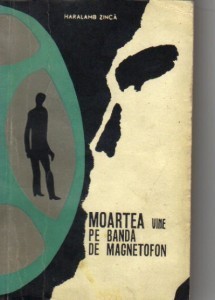
I received a copy of Moartea vine pe bandă de magnetofon, a Romanian detective novel that would turn out to be a particularly memorable reading experience.
I didn’t know at the time just how much I would enjoy discovering this author’s work.
What immediately drew me into the novel was its atmosphere. The story begins with a threatening message recorded on a magnetophone tape, setting in motion an investigation filled with secrets, suspicion and connections to events from the past.
I loved the way Zincă developed the mystery.
Rather than rushing from one dramatic revelation to another, he allowed the investigation to unfold gradually. Every clue seemed important, every conversation offered another possibility, and the characters had to rely on intelligence and patience rather than convenient technological solutions.
I particularly enjoyed Captain Lucian’s methodical approach to the case and the way the novel combined traditional detective fiction with industrial espionage and historical atmosphere.
It was exactly the kind of mystery that makes me want to keep reading.
At some point, I discovered that Editura Publisol had begun republishing Haralamb Zincă’s books in a dedicated author collection.
I no longer remember precisely how I came across the news, but I knew immediately that I wanted those editions.
And so I bought the entire Publisol collection.
That probably says more about my enthusiasm for Moartea vine pe bandă de magnetofon than any elaborate explanation could.
A book given to me by a friend had introduced me to an author whose work I wanted to explore much further.
One of the things I love about reading is how unexpectedly these discoveries can happen. Sometimes a recommendation, a book club or a chance purchase introduces you to a wonderful writer.
In this case, it was a thoughtful gift that eventually led to an entire collection finding its place in my library.
📚 Books Reviewed on BookFairy
Explore my spoiler-free reviews of Haralamb Zincă’s novels, beginning with the book that introduced me to his distinctive approach to Romanian crime fiction.
Each review includes my personal thoughts, book details, edition information and recommendations for readers interested in classic detective stories and espionage thrillers.
Moartea vine pe bandă de magnetofon
Moartea vine pe bandă de magnetofon is a classic Romanian mystery involving a threatening tape recording, hidden motives, industrial espionage and an investigation that gradually uncovers connections to the past.
Captain Lucian must determine who is threatening engineer Dan Stamatiad and why.
What begins as a disturbing message develops into a much more complicated case, filled with suspicious characters, concealed information and unexpected connections.
I particularly enjoyed the careful construction of the mystery, the period atmosphere and the way Zincă allowed the investigation to develop through observation, reasoning and persistence.
It was such an enjoyable reading experience that I eventually bought the entire Haralamb Zincă collection republished by Publisol.
📚 Complete Haralamb Zincă Bibliography
Want to explore more of Haralamb Zincă’s work? I’ve put together a dedicated bibliography covering his crime novels, espionage thrillers, wartime fiction, historical writing and translations. You’ll find his books listed in publication order, the correct reading order for the Pe urmele agentului B-39 series, information about original Romanian editions and the modern Publisol collection.
📖 Explore the Complete Haralamb Zincă Bibliography
📖 Reading Order
Haralamb Zincă wrote numerous detective novels, espionage thrillers and historical works throughout his career.
Many of his mysteries can be enjoyed independently, making his books accessible to readers who want to begin with a particular title rather than follow a long series.
However, some works belong to connected sequences.
📚 Selected Crime and Espionage Novels
The following titles offer an introduction to Zincă’s detective and espionage fiction, arranged by their original publication periods:
- Sfârșitul spionului Fantomă (1963)
- Taina Cavalerului de Dolenga (1965)
- Moartea vine pe bandă de magnetofon (1960s)
- Ochii doctorului King (1968)
- O crimă aproape perfectă (1969)
- Crima de la 217 (1970)
- Limuzina neagră (1973)
- Un glonte pentru rezident (1975)
- Dragul meu Sherlock Holmes (1977)
- Glonțul de zahăr (1981)
- Suspecta moarte a lui Mario Campanella (1991)
- Moartea m-a bătut pe umăr (1993)
- Moartea mirosea a Christian Dior (1997)
This is a selection of notable novels rather than the author’s complete bibliography.
🕵️ Pe urmele agentului B-39
One of Zincă’s best-known connected sequences is Pe urmele agentului B-39, a series of espionage novels set against the background of wartime intelligence operations.
Publication Order:
- Soarele a murit în zori (1976)
- Toamna cu frunze negre (1978)
- Anotimpurile morții (1980)
- Destinul căpitanului Iamandi (1982)
- Operațiunea „Soare” (1984)
For readers interested in the complete narrative, publication order is recommended.
💜 BookFairy Recommendation
I recommend beginning with Moartea vine pe bandă de magnetofon, particularly if you enjoy traditional detective fiction.
The novel provides an excellent introduction to Zincă’s storytelling, combining a carefully developed investigation with espionage, psychological tension and a distinctive Romanian historical setting.
It was my first encounter with his writing, and it immediately made me want to discover more.
For readers who prefer a connected espionage series, Pe urmele agentului B-39 offers a different starting point.
🇷🇴 Romanian Editions
Haralamb Zincă wrote in Romanian, and his books were originally published by Romanian publishing houses throughout the second half of the twentieth century.
Many of his novels appeared during the communist period, when detective and espionage fiction attracted large audiences.
In 2021, Editura Publisol launched a dedicated Haralamb Zincă author collection, bringing a selection of his best-known works back into print.
The reissue programme included detective novels, espionage thrillers and the Pe urmele agentului B-39 sequence.
Among the titles republished by Publisol are:
- Moartea vine pe bandă de magnetofon
- Ochii doctorului King
- Un glonte pentru rezident
- Mapa cenușie G.R.
- Soarele a murit în zori
- Toamna cu frunze negre
- Anotimpurile morții
- Destinul căpitanului Iamandi
- Operațiunea „Soare”
- Glonțul de zahăr
- Suspecta moarte a lui Mario Campanella
- Sfârșitul spionului Fantomă
- Moartea m-a bătut pe umăr
- Moartea mirosea a Christian Dior
- Limuzina neagră
- Crima de la 217
- Dragul meu Sherlock Holmes
- Interpolul transmite: arestați-l!
- Noaptea cea mai lungă
The Republishing programme is particularly valuable because it makes an important part of Romanian popular-fiction history available to modern readers.
I own the Publisol author collection, which I decided to buy after discovering how much I enjoyed Moartea vine pe bandă de magnetofon.
For me, these editions represent more than a matching set of books. They are an opportunity to explore the work of a Romanian author whose mysteries remain engaging decades after their original publication.
⭐ Where Should You Start?
New to Haralamb Zincă? I recommend starting with Moartea vine pe bandă de magnetofon.
It is an excellent choice for readers who enjoy classic detective stories, careful investigations and mysteries in which the truth gradually emerges through observation and deduction.
The novel begins with an intriguing premise: a threatening message recorded on a magnetophone tape.
From there, the investigation develops into a complex story involving personal secrets, industrial espionage and events whose consequences reach far into the present.
One of the things I particularly appreciated was the way Zincă built suspense without relying on constant action.
The tension comes from unanswered questions, suspicious behaviour and the gradual discovery that apparently unrelated details may be connected.
Captain Lucian’s investigation is patient and methodical, allowing readers to follow the clues and consider possible explanations alongside him.
The novel also offers a fascinating glimpse into the atmosphere of an earlier period of Romanian history.
Its technology, social conventions and political background are very different from those found in contemporary crime fiction, but that is part of its appeal.
For readers who enjoy traditional mysteries, historical atmosphere and intelligent investigative storytelling, Haralamb Zincă is well worth discovering.
And if your experience is anything like mine, one book might not be enough.
You may find yourself wanting the entire collection!