
Author Guide | BookFairy
📖 About Ursula K. Le Guin
Ursula K. Le Guin (1929–2018) was one of the most influential American authors of science fiction and fantasy, celebrated for her extraordinary imagination, literary elegance and profound exploration of human society.
Her novels and short stories transformed speculative fiction into a powerful way of examining politics, gender, identity, freedom, cultural differences and the relationship between individuals and the communities they inhabit.
Born in Berkeley, California, Ursula Kroeber Le Guin grew up in an intellectually stimulating environment. Her father, Alfred Kroeber, was a prominent anthropologist, while her mother, Theodora Kroeber, was a writer. Their influence contributed to Le Guin’s lifelong fascination with cultures, languages, social structures and the many different ways human beings organise their lives.
Le Guin studied literature and languages before beginning a writing career that would eventually span novels, short stories, poetry, essays, children’s literature and translation.
Her first published novel, Rocannon’s World (1966), introduced readers to what would later become known as the Hainish Cycle or Ekumen universe. Through stories set on different planets, Le Guin explored the relationships between societies, the consequences of cultural interference and the political structures that shape civilisation.
Her breakthrough science-fiction novel, The Left Hand of Darkness (1969), challenged conventional assumptions about gender and identity, earning both the Hugo and Nebula Awards.
Another major work, The Dispossessed (1974), examines political philosophy, social organisation, freedom and the tensions between individual responsibility and collective ideals.
Alongside her science-fiction novels, Le Guin created the celebrated Earthsea fantasy series, beginning with A Wizard of Earthsea (1968). Through the adventures of Ged and other characters, she explored the nature of power, responsibility, balance and personal growth.
Her approach to fantasy was distinctive. Magic was never simply a convenient solution to problems, and power always carried consequences. Her fictional worlds encouraged readers to question established ideas rather than accept them without examination.
Throughout her career, Le Guin received numerous literary honours, including Hugo and Nebula Awards, recognition from the National Book Foundation and the title of Grand Master from the Science Fiction and Fantasy Writers Association.
Her influence extends far beyond science fiction and fantasy. She demonstrated that speculative literature could explore philosophical, political and social questions with the same depth and complexity traditionally associated with literary fiction.
On BookFairy, I explore Ursula K. Le Guin’s fiction through spoiler-free reviews, recommended reading orders, Romanian editions and personal reflections on the ideas that make her work so enduring.
📚 Ursula K. Le Guin — Complete Bibliography
Explore the complete bibliography of Ursula K. Le Guin, including her celebrated Earthsea and Hainish cycles, standalone novels, short stories, poetry, essays, children’s books, and collected editions.
Discover publication dates, recommended reading orders, and Romanian translations in our comprehensive BookFairy guide.
📖 Explore Ursula K. Le Guin’s Complete Bibliography
💜 Why I Read Ursula K. Le Guin
Ursula K. Le Guin is one of those authors whose name is almost impossible to avoid when you’re part of the science-fiction community.
Her reputation as one of the most influential voices in speculative fiction was already well established long before I discovered her work. Anyone who spends enough time around science-fiction readers will eventually encounter discussions about her novels, her ideas and the extraordinary worlds she created.
I honestly don’t remember exactly when I first read her or which book introduced me to her writing. I believe one of my early encounters with her work may have been connected to a Nemira book club, although I can’t say that with certainty.
What I do remember is that Le Guin was already a familiar name within the Romanian science-fiction community.
Her books were part of the wider conversations surrounding the genre, particularly among readers who appreciated science fiction for its ideas as much as for its imaginative settings.
For me, discovering authors like Ursula K. Le Guin is an important part of exploring the history and evolution of science fiction.
Her work represents a tradition in which speculative fiction becomes a way of examining human societies, questioning established assumptions and imagining radically different possibilities.
One of the things I particularly appreciate about her writing is the way politics and culture become essential parts of her fictional worlds.
In Rocannon’s World, for example, I was especially interested in the relationships between different societies, the fragile balance of power and the consequences of political decisions.
I also enjoyed the unusual combination of science fiction and mythology. The novel moves between interstellar technology and a world that sometimes feels closer to an ancient legend or a traditional fantasy adventure.
Although some parts of the story felt emotionally distant, the larger ideas stayed with me.
That is one of the things I have always appreciated about science fiction: its ability to take us to other worlds while encouraging us to think more carefully about our own.
And Ursula K. Le Guin was exceptionally good at doing precisely that.
📚 Books Reviewed on BookFairy
Explore my spoiler-free reviews of Ursula K. Le Guin’s fiction, beginning with Rocannon’s World, her debut novel and the first published work associated with the Hainish universe.
Each review includes my personal thoughts, book details, Romanian edition information and recommendations for readers interested in classic science fiction.
Rocannon’s World (1966)
Rocannon’s World combines science fiction, mythology and political intrigue in a story set on a distant planet inhabited by several very different societies.
What I found particularly interesting was the political dimension of the novel. Le Guin explores how cultures interact, how alliances are formed and how power can affect entire populations.
I also appreciated the way she blended advanced technology with the atmosphere of an ancient legend, creating a world that feels both futuristic and strangely familiar.
Although the story sometimes felt emotionally distant, its ideas about cultural differences, responsibility and the consequences of interference remained compelling.
📖 Reading Order
Ursula K. Le Guin created several fictional universes, including the Earthsea fantasy series and the interconnected science-fiction works commonly known as the Hainish Cycle or Ekumen.
These require different approaches to reading order.
While Earthsea follows a clear narrative progression, the Hainish books are more loosely connected and can generally be enjoyed independently.
📚 Earthsea — Publication Order (Recommended)
- A Wizard of Earthsea (1968)
- The Tombs of Atuan (1971)
- The Farthest Shore (1972)
- Tehanu (1990)
- Tales from Earthsea (2001)
- The Other Wind (2001)
The Earthsea books are best experienced in publication order, which also follows the main chronological development of the series.
Although some stories in Tales from Earthsea take place earlier, the collection contains important material connecting Tehanu and The Other Wind.
🌌 Hainish Cycle / Ekumen — Suggested Reading Order
Unlike Earthsea, the Hainish novels do not form a single continuous storyline.
They explore different planets, societies and historical periods within a broadly connected fictional universe.
For readers who want to follow the development of Le Guin’s ideas, publication order offers a useful starting point.
- Rocannon’s World (1966)
- Planet of Exile (1966)
- City of Illusions (1967)
- The Left Hand of Darkness (1969)
- The Word for World Is Forest (1972)
- The Dispossessed (1974)
- The Telling (2000)
This list covers the principal Hainish novels and novellas, although Le Guin also wrote shorter fiction connected to the same universe.
The works do not follow a strict internal chronology, and their connections are sometimes deliberately loose.
Readers can therefore begin with individual novels without needing to understand every other book in the sequence.
💜 BookFairy Recommendation
For readers interested in fantasy, I recommend starting with A Wizard of Earthsea, the first volume in Le Guin’s celebrated fantasy sequence.
For science-fiction readers, The Left Hand of Darkness and The Dispossessed are excellent introductions to her exploration of society, politics and human identity.
However, readers who enjoy discovering how an author’s fictional universe developed may prefer to begin with Rocannon’s World.
As Le Guin’s debut novel, it offers an interesting glimpse into the ideas and literary techniques that would become increasingly sophisticated throughout her career.
🇷🇴 Romanian Editions
Ursula K. Le Guin’s work has been translated into Romanian by several publishers, including Nemira, Alexandria, Young Art, Corint and Editura Trei.
Her books have introduced generations of Romanian readers to some of the most important works of modern science fiction and fantasy.
🌌 Science Fiction
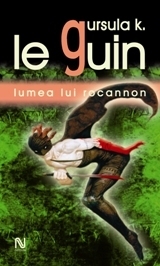
- Rocannon’s World — Lumea lui Rocannon — Nemira.
- City of Illusions — Orașul iluziilor — Nemira.
- The Left Hand of Darkness — Mâna stângă a întunericului — Nemira, including editions in the Armada collection.
- The Dispossessed — Deposedații — Nemira.
- The Word for World Is Forest — Lumii îi spuneau pădure — Nemira and earlier Romanian editions.
- The Lathe of Heaven — Sfâșierea cerului — Editura Trei and Nemira.
Several of these novels have appeared in multiple Romanian editions, making Le Guin’s science fiction accessible to new generations of readers.
🐉 Earthsea
Romanian translations of the Earthsea books include:
- A Wizard of Earthsea — Un vrăjitor din Pământșimare
- The Tombs of Atuan — Mormintele din Atuan
- The Farthest Shore — Cel mai îndepărtat țărm
- Tehanu — Tehanu
Different Romanian editions have also used varying translations of the name Earthsea, including Terramare and Pământșimare.
📚 Other Works
Le Guin’s Annals of the Western Shore trilogy has also appeared in Romanian:
- Gifts — Daruri
- Voices — Voci
- Powers — Puteri
For Romanian readers interested in classic speculative fiction, these translations provide an excellent opportunity to explore the remarkable variety of Le Guin’s literary imagination.
⭐ Where Should You Start?
New to Ursula K. Le Guin? The best starting point depends on what you enjoy most about speculative fiction.
If you prefer science fiction that explores politics, society and human identity, I recommend The Left Hand of Darkness or The Dispossessed.
These novels demonstrate Le Guin’s extraordinary ability to construct convincing fictional societies while asking difficult questions about the assumptions governing our own world.
If you enjoy fantasy, mythology and stories about magic and responsibility, begin with A Wizard of Earthsea.
The Earthsea books approach magic as something inseparable from balance, knowledge and personal responsibility, creating a fantasy world that feels thoughtful, atmospheric and deeply meaningful.
For readers interested in the history of science fiction, Rocannon’s World is another fascinating place to begin.
Although it is an early work and not as refined as some of her later novels, it already demonstrates her fascination with political structures, cultural differences and the relationship between knowledge and power.
I particularly enjoyed the combination of mythology and science fiction, as well as the way political decisions shaped the experiences of the characters and the societies they encountered.
Ultimately, Ursula K. Le Guin is an author worth exploring slowly.
Her novels are not simply adventures set in imaginary worlds. They are opportunities to question familiar ideas, encounter different perspectives and reflect upon what it means to be human.
And that, for me, is one of the greatest strengths of science fiction and fantasy.