

 Science Fiction
📝 First Impressions

I read Rendezvous with Rama back in 2014, so I’m not going to pretend I still remember every technical detail or every stage of the expedition. What I do remember very clearly is the way my reaction to the book changed while I was reading it.
At first, I was bored.
Arthur C. Clarke spends a lot of time describing the interior of Rama, and at the beginning those descriptions felt almost endless to me. I understood why they were there — the entire point is that the characters are exploring something completely unknown, and every detail might matter — but knowing that didn’t automatically make those pages exciting. For a while, I genuinely wondered whether the book was going to be mostly a very long guided tour through an alien cylinder.
And then, somehow, it got me.
The more the crew explored Rama, the more curious I became. The descriptions that had initially slowed me down started contributing to the mystery instead. This enormous object had entered the Solar System, nobody knew who had built it, why it was there, or what any of its structures were actually for, and suddenly I wanted answers just as badly as the people exploring it.
What surprised me most was how easy the book became to read once that curiosity kicked in. Clarke is dealing with huge ideas — alien technology, space exploration, humanity confronting something completely beyond its experience — but the novel never felt inaccessible to me. Once I was invested in Rama itself, I flew through it.
And then came the ending.
I still remember that feeling of reaching the final pages and thinking: there has to be more. The idea that the Ramans “do everything in threes” felt less like a neat closing line and more like Clarke deliberately opening another door just as he was shutting this one.
So my first experience with Rendezvous with Rama was slightly strange: impatience at the beginning, growing fascination in the middle, and by the end I was completely caught.
That turnaround is probably one of the reasons the book stayed with me for so long.
💜 What I Loved
What I loved most about Rendezvous with Rama was the sense of discovery.
Once the book finally clicked for me, Rama stopped feeling like an object being described and started feeling like a mystery I needed to understand. Clarke is very good at creating that particular kind of science-fiction fascination where the unknown is not immediately explained, labelled or made comfortable for the reader. You are simply there with the characters, looking at something enormous and completely alien, trying to make sense of it piece by piece.
I also loved the scale of the idea.
There is something incredibly compelling about a gigantic artificial object entering the Solar System and humanity having only a limited amount of time to explore it. Even now, years after reading the book, that central concept is still what I remember first. It is simple, but it is also huge enough to carry the entire novel.
Another thing that worked for me was the restraint.
Clarke does not rush to give the reader neat answers just because we want them. In fact, a large part of the fascination comes from the fact that Rama remains mysterious. We learn things, but never enough to make it ordinary. That uncertainty made the book much more memorable for me than if every strange feature had been explained away by the end.
I also appreciated how readable it became once I got past that slower beginning. This is classic science fiction built around a very big scientific idea, but I never felt that Clarke was trying to prove how clever he was by making the book unnecessarily difficult. Once the exploration gained momentum, I found myself genuinely invested in what the crew would discover next.
And then there is that final idea — the suggestion that the Ramans do everything in threes.
That stayed with me.
It is exactly the kind of ending I enjoy: not one that ties everything into a neat little bow, but one that makes the universe suddenly feel even larger than it did before. Instead of closing the mystery, it expands it.
By the time I finished Rendezvous with Rama, the same descriptions that had irritated me at the beginning had become part of what made Rama feel real.
That change in my own reaction is probably the clearest sign of how thoroughly the book won me over.
🤔 What Didn’t Quite Work for Me
The obvious problem for me was the beginning.
I know exactly why Clarke spends so much time describing Rama in such detail, and by the end I even appreciated what those descriptions had achieved. But while I was actually reading those early pages, they felt painfully slow.
There is only so much technical description I can take before I start feeling as though I am reading a blueprint instead of a novel, and at first that was very much my experience here. Rama is enormous, strange and fascinating, but before I became emotionally invested in the mystery, the sheer amount of detail made the exploration feel more exhausting than exciting.
The characters were also never really the reason I loved this book.
I remember the object, the atmosphere, the exploration and the unanswered questions much more strongly than I remember individual personalities. For this kind of science fiction, that is not necessarily a fatal flaw — the idea is clearly the star of the book — but I generally connect more deeply with stories when the characters leave as strong an impression as the concept.
And because Clarke keeps so much deliberately unexplained, there is also a certain frustration built into the experience.
I wanted answers.
I wanted to understand who had built Rama, what its purpose was, where it came from and why it worked the way it did. The fact that the book refuses to satisfy all of that curiosity is part of what makes it effective, but it is also maddening.
So the same thing that made Rendezvous with Rama fascinating occasionally made it frustrating as well.
For me, though, the slow beginning was by far the biggest obstacle. Once I got through that and the mystery truly took hold, the book became an entirely different experience.
👥 Who Would Enjoy This Book
Rendezvous with Rama is a very easy recommendation for readers who love classic science fiction built around one enormous idea.
If what excites you most is discovery — strange technology, alien engineering, unexplained structures, the feeling of humans stepping into something far bigger than themselves — then there is a lot to enjoy here. The novel is much more interested in Rama itself than in interpersonal drama, and for the right reader that is exactly the appeal.
It would also suit readers who enjoy science fiction that does not rush to explain everything.
Clarke gives you enough information to keep you curious, but not enough to make the mystery disappear. If you like stories where the unknown stays genuinely unknown for a while, this is a very satisfying experience.
On the other hand, readers who need strong character development or emotional relationships at the centre of a novel may find it colder than they would like. The characters are important because they are exploring Rama, but they are not what stayed with me years later.
And if long technical descriptions make you impatient, be warned: the beginning may test you.
I nearly bounced off the book because of that.
But if you can get through those early sections and let the mystery build, there is a very good chance Rama itself will do the rest of the work.
💭 Final Thoughts
Rendezvous with Rama is one of those books that reminds me why I love science fiction in the first place.
Not because it gave me everything I wanted immediately — it really didn’t — but because it made me curious enough to keep going until the curiosity completely took over.
I started the book feeling impatient with the endless descriptions of Rama’s interior. By the end, I was fascinated by the very same thing. That shift is probably what I remember most clearly about reading it.
The novel does something I really appreciate: it makes the unknown feel genuinely unknown.
Rama is not there to be neatly explained for the reader’s convenience. It is vast, alien and only partially understandable, and that gives the story a sense of scale that still works years later. Even now, I remember the object itself more vividly than most of the characters.
And I don’t mean that as an insult.
In this book, Rama is the character that matters most.
The ending also stayed with me far longer than I expected. The idea that the Ramans do everything in threes immediately makes the entire story feel like only the beginning of something much larger.
When I finished it, I didn’t feel as though I had reached the end of the mystery.
I felt as though I had only just seen the first piece of it.
For a book that initially made me wonder whether I was going to enjoy it at all, Rendezvous with Rama ended up leaving a remarkably strong impression.
✨ The BookFairy Verdict
Rendezvous with Rama
📖 Book Details
Title: Rendezvous with Rama
Author: Arthur C. Clarke
Series: Rama — Book 1
Genre: Science Fiction
First Published: 1973
Original Language: English
Format: Novel
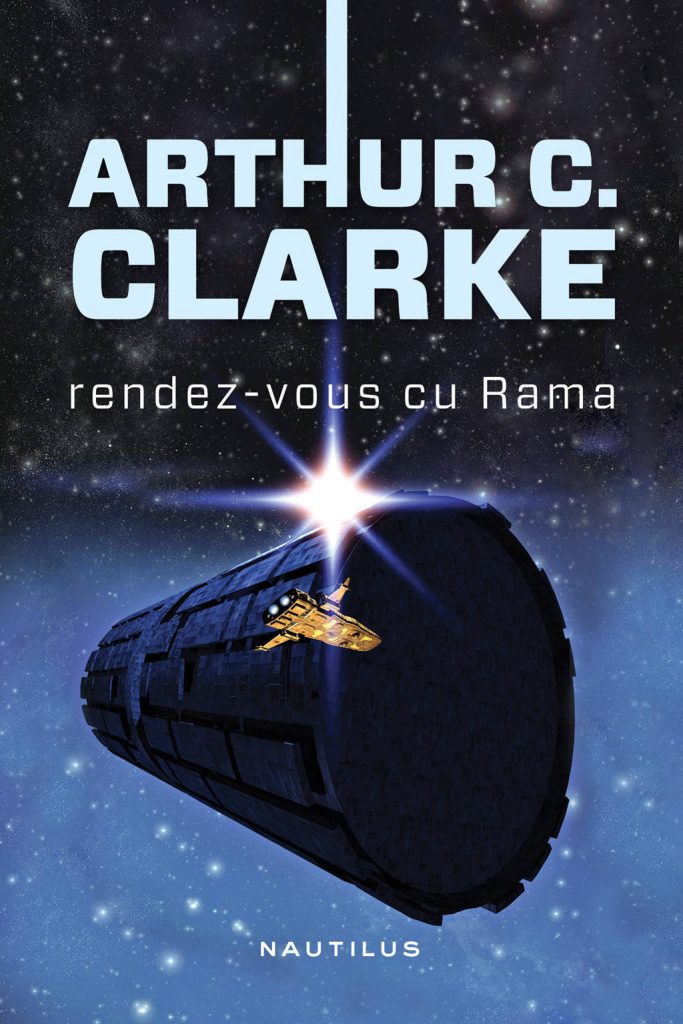
🇷🇴 Romanian Edition
Titlu: Rendez-vous cu Rama
Autor: Arthur C. Clarke
Serie: Rama — Book 1
Editura: Nemira
Colecția: Nautilus
Traducător: Mihai Dan Pavelescu
An apariție: 2014
Ediție: a II-a
Format: Paperback
Dimensiuni: 130 × 200 mm
Pagini: 264
ISBN: 978-606-579-821-2
📚 Reading Order
- Rendezvous with Rama — 1973
- Rama II — 1989 — Arthur C. Clarke & Gentry Lee
- The Garden of Rama — 1991 — Arthur C. Clarke & Gentry Lee
- Rama Revealed — 1993 — Arthur C. Clarke & Gentry Lee
🛒 Buy the Book
If Rendezvous with Rama sounds like your kind of read, you can support BookFairy by purchasing the book through the links below. It won’t cost you anything extra, and using these links helps support the site while allowing me to continue creating honest, independent book reviews.
📚 Waterstones
📦 Amazon UK
📱 Kobo
📘 eBook


