 Fantasy
📝 First Impressions
I went into Babel expecting dark academia, and technically that is exactly what it is. We have Oxford, old buildings, brilliant students, obsessive study, ancient languages, libraries, privilege, academic rivalry and all the things that usually come with the genre. But Babel very quickly becomes much more than that. Beneath the beautiful academic setting, this is really a novel about language, colonialism, power, identity, racism, exploitation and the uncomfortable truth that an empire can despise the very people whose knowledge it depends on.
I should probably admit that Babel and I did not get off to a particularly good start. I bought the English hardcover and genuinely tried to read it, but the language felt so elaborate and self-consciously academic that I eventually put it down. At that point, I also did not understand why Kuang kept stopping to explain the history, roots and subtle differences between words, so instead of finding those passages fascinating, I found them exhausting. It felt as though the book was constantly interrupting itself to give me another linguistic lesson I had not asked for.
Listening to the Romanian audiobook changed that completely. Once I understood what Kuang was actually building with those explanations — that the differences between words are not decorative trivia but the foundation of silver-working and, really, of the entire novel — they suddenly had a purpose. What had initially felt unnecessarily “precious” in English became one of the most interesting ideas in the book. I am still not sure I would have finished Babel if I had forced myself through the English edition, but the Romanian audiobook gave me the way into the story that I had been missing.
Robin Swift is taken from Canton to England by Professor Lovell and educated with one clear purpose in mind: eventually, he is expected to study at Babel, Oxford’s Royal Institute of Translation. Babel is not simply a school for languages. It is the centre of silver-working, a magical system based on the differences between words in different languages. Two words can be translated as equivalents, but they are never completely identical. There is always something missing, something gained, some nuance or cultural meaning that refuses to cross perfectly from one language into another. Silver-working captures that gap and turns it into power.
That idea was probably my favourite thing about the entire book. It is clever, but more importantly, it does not feel like magic added simply because this is supposed to be fantasy. The magic system is inseparable from everything Kuang wants to say. Britain takes the languages, knowledge and resources of other cultures, converts them into power, and then continues to treat the people who created those things as inferior. The hypocrisy is built into the magic itself.
💜What I Loved
What fascinated me most was the way Babel treats language as something far bigger than communication. Language is infrastructure, wealth, access, status and, eventually, a weapon. Translation is political because somebody always decides which language matters, which meaning is preserved and which one is allowed to disappear.
The British Empire in this book depends enormously on foreign languages, yet it simultaneously behaves as though everything outside Britain is somehow less civilised, less valuable or less important. That contradiction runs through the whole story, and I thought Kuang handled it particularly well when she allowed it to appear through small moments rather than speeches.
There is a scene in Canton that made me laugh because it manages to say so much in very little space. Robin tastes something and says that it tastes like rubbish, and Reverend Gützlaff responds that nothing could be more English. It is a tiny joke, but it fits beautifully with everything Kuang is doing. Britain presents itself as independent and superior while being completely dependent on imported goods, foreign knowledge, foreign labour and foreign languages.
Earlier in the novel, there is also that wonderful observation about the British not even being able to have their five o’clock tea without relying on things taken or borrowed from elsewhere. I loved that because it cuts straight through the illusion of self-sufficiency. The Empire wants tea, silver, words, knowledge and labour from everywhere else, but it still wants to imagine itself as the centre of civilisation.
Robin is the perfect character through whom to explore that contradiction because he exists between worlds. He comes from Canton, but England remakes him. He is educated by the British system, rewarded by it and given opportunities through it, yet he is never really allowed to forget that he is not considered equal to the people around him. He can be useful to Babel, even admired by Babel, without ever truly belonging to it.
💜Robin and Professor Lovell
The relationship between Robin and Professor Lovell was one of the most uncomfortable and interesting parts of the book for me. Lovell saves Robin, at least in the most superficial sense of the word, but he also controls him, disciplines him and shapes his entire future. Robin’s education is never really offered freely. Everything has a purpose, and that purpose is Babel.
Once it becomes increasingly obvious that Lovell is probably Robin’s biological father, the whole relationship becomes even uglier. Lovell never behaves like a father. He barely allows himself to behave like a human being around Robin. There is always this coldness, as if Robin is primarily an investment that needs to produce results.
That is why the scene in which Robin kills him carries so much weight. It is not simply a student killing a professor. Robin is destroying the man who represents several things at once: his father, his teacher and the imperial system that has controlled his life since childhood. Personal rebellion and political rebellion suddenly become the same act.
For me, that is one of the moments where Babel truly changes. Up to that point, there is still a strong academic atmosphere around the story. Afterwards, the novel stops pretending that this conflict can remain theoretical.
💜Friendship, Privilege and the Limits of Solidarity
I also really liked what Kuang does with Robin, Ramy, Victoire and Letty. At first, their friendship has everything I expect from dark academia: intelligent students, shared meals, studying together, arguments, private jokes and the feeling that they have created a small world of their own inside Oxford.
But the four of them are never actually standing on equal ground.
Robin, Ramy and Victoire understand certain realities because they live them. Letty can listen, sympathise and believe that she understands, but there is always a point beyond which sympathy is not enough. The difference only becomes fully visible when supporting her friends begins to cost her something real.
That is what makes Letty’s betrayal so effective. She wants to believe she is one of them, and for a long time perhaps she genuinely believes it. But when the choice becomes dangerous, permanent and capable of destroying the world that protects her, she chooses that world.
And then she kills Ramy.
That moment is devastating because it destroys the group completely. Until then, there is still some possibility of interpreting their disagreements as political differences between friends. Once Ramy is dead and Letty is the one who pulled the trigger, that possibility disappears. One friend is dead, another killed him, and there is no version of the old group left to return to.
💜The Dune Resonance
One section of the book immediately made me think of Dune.
During Robin’s torture, he tries to separate himself mentally from the pain, almost allowing it to pass over him instead of letting it control him. My mind went straight to the Bene Gesserit Litany Against Fear and to Paul Atreides with his hand inside the Reverend Mother’s box.
I do not mean that the scenes are the same, and I certainly do not mean that Kuang copied Herbert. It was simply a very strong literary resonance for me.
In both cases, the body is trapped and pain becomes a method of control. Survival depends on the ability to prevent the body’s reaction from taking over the mind. Paul must keep his hand inside the box even while every instinct tells him to pull it out. Robin, while being tortured, tries to create a similar distance between what his body is experiencing and what his mind is capable of enduring.
Even the moment when Robin is finally freed from his restraints reminded me of Paul finally being allowed to remove his hand from the box. Different books, different contexts and different purposes, but the emotional and physical shape of those scenes connected immediately in my head.
I love when that happens while reading. One story suddenly lights up another one that has been living in your memory for years.
🤔 What Didn’t Quite Work for Me
For all the things I admired about Babel, this was never quite a five-star book for me.
Kuang has very strong ideas, which is obviously not a problem in itself. The problem is that sometimes she does not seem to trust the reader to understand those ideas without having them explained very clearly. And then explained again.
The themes are already built into everything: the magic system, Babel itself, Robin’s position in British society, the relationship between the Empire and the rest of the world. Often, the story is perfectly capable of making the argument on its own. There were moments when I wished Kuang would simply let the situation speak for itself.
Instead, some conversations become so explicit that the characters briefly stop sounding like people and start sounding like representatives of opposing political positions. That did not ruin the book for me, but it did occasionally make it feel heavy-handed.
The beginning is also slow. Very slow.
There is a lot of Oxford, a lot of studying, a lot of language, a lot of etymology and a lot of academic discussion. Personally, I found most of it interesting because I enjoyed the subject matter, but I can absolutely see readers becoming impatient with it. If someone picks up Babel expecting constant fantasy action, they are going to have a difficult time.
The action eventually comes, and when it does, the book changes dramatically. But Babel makes you work before you get there.
And if you hate footnotes… good luck.
👥 Who Would Enjoy This Book?
I would recommend Babel to readers who like books that want to discuss something rather than simply tell a story. If you are interested in languages, translation, etymology, history, colonialism or institutions that look beautiful from the outside while hiding something rotten underneath, there is a lot here to enjoy.
Dark academia readers will obviously recognise the atmosphere, but I would not recommend this purely for the aesthetic. Oxford is not just a pretty background. Babel as an institution, the study of languages and the structure of the university are all directly tied to what the book is trying to say.
I would also recommend it to readers who enjoy historical fantasy and alternative history where the historical setting actually matters. This is not a nineteenth-century world with some magic sprinkled on top. The silver-working system exists because of trade, empire, language and political power.
If you need very fast pacing, though, especially from the beginning, this may test your patience.
💭 Final Thoughts
The thing I will probably remember most about Babel is not Oxford, the revolution or even the silver itself. It is the idea that translation becomes powerful precisely because perfect translation is impossible.
There is always something between two words. A history, a cultural assumption, a feeling, an association or a shade of meaning that refuses to move completely from one language into another. Kuang takes that invisible gap and turns it into something physical. Then she turns it into industry. And then she asks who gets rich from it.
That is where the premise becomes much more than a clever magic system.
The British Empire in Babel wants everything other cultures can provide while refusing to treat those cultures as equals. It wants their languages, their resources, their labour and their knowledge, but it wants all of those things without giving up the belief that Britain is somehow superior to the people supplying them.
Robin spends most of the novel trying to exist inside that contradiction. Eventually, he cannot.
That is where the subtitle, The Necessity of Violence, becomes important. The book is constantly asking whether a system built and maintained through violence can ever really be dismantled through politeness, debate and cooperation alone. It is not a comfortable question, and I do not think the novel intends it to be one.
I did not love every part of Babel. Sometimes it explains itself too much, sometimes the politics are delivered with all the subtlety of a brick through a window, and some of the academic sections last longer than I needed them to.
But the central concept is excellent, several scenes hit very hard, and the ideas stayed with me after I finished listening.
And any twenty-two-hour audiobook that can leave me thinking about translation, empire, Dune and terrible English food afterwards has obviously done something right.
✨ The BookFairy Verdict
Babel
Fantasy
📖 Book Details
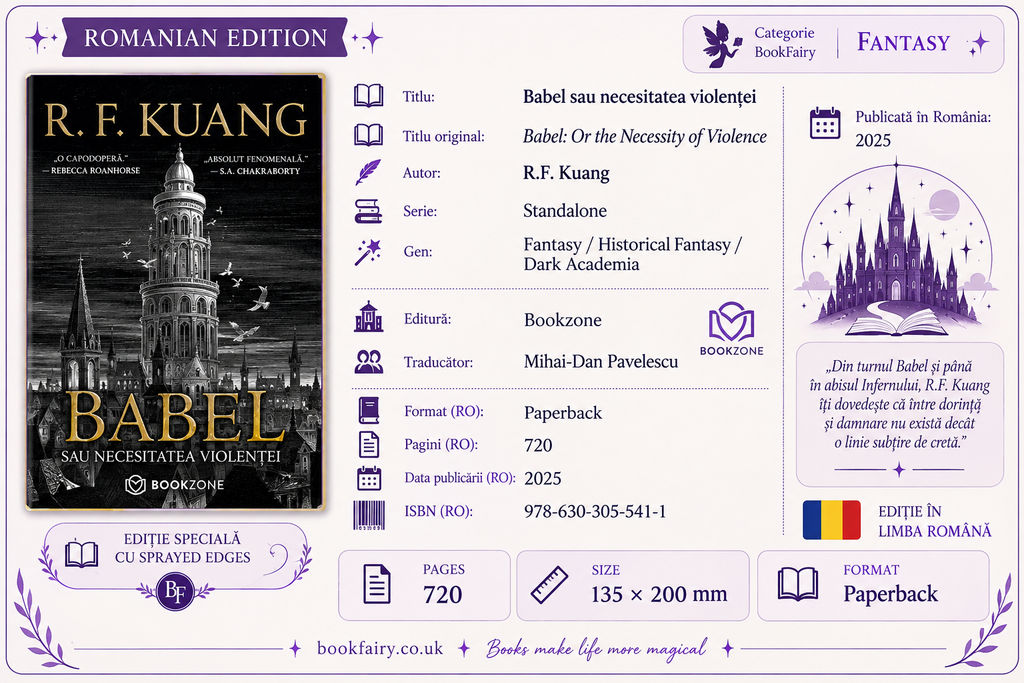
Title: Babel: Or the Necessity of Violence
Author: R.F. Kuang
Genre: Fantasy • Historical Fantasy • Dark Academia
BookFairy Category: Fantasy
Language: English
First Published: 2022
Original Publisher: HarperVoyager
Original Edition Pages: 560
Series: Standalone
🇷🇴 Romanian Edition
Romanian Title: Babel sau necesitatea violenței
Author: R.F. Kuang
Translator: Mihai-Dan Pavelescu
Publisher: Bookzone
Publication Year: 2025
Language: Romanian
Format: Paperback
Pages: 720
Dimensions: 135 × 200 mm
ISBN: 9786303055411
Edition: Special Edition with Sprayed Edges
Availability: In print
🛒 Buy the Book
If Babel: Or the Necessity of Violence sounds like your kind of read, you can support BookFairy by purchasing the book through the links below. It won’t cost you anything extra, and using these links helps support the site while allowing me to continue creating honest, independent book reviews.