 Fairytale
📝 First Impressions
Sometimes I don’t realise how much I miss a particular kind of book until I suddenly find myself holding one again.
That was exactly what happened with Ceainicul fermecat și alte basme japoneze.
I had been missing fairy tales. Not modern retellings dressed up as fantasy novels, not stories loosely inspired by folklore, but actual fairytales — those compact, strange, magical stories where animals can talk, impossible things happen without anyone demanding an explanation, cleverness can save your life, greed can destroy it, and the world seems to operate according to its own ancient rules.
Then I saw this collection recommended by Romeo Aurelian Ilie, looked it up and decided I wanted it.
And I actually managed to buy it.
That deserves mentioning because I was living in the UK, and finding a physical book printed in Romanian was not always as simple as deciding that I wanted one and ordering it. There was something particularly satisfying about finally getting my hands on a Romanian edition of a collection of Japanese fairy tales while living hundreds of miles away from Romania.
But there was another reason I was immediately drawn to it.
I am an absolute sucker for Chinese and Japanese stories.
Apparently, I always have been.
As soon as I started reading this collection, it brought back memories of a volume of Chinese stories I had read as a child from the Romanian Povești Nemuritoare series. I hadn’t been consciously thinking about that book when I bought this one, but the connection appeared almost immediately.
And suddenly I remembered the feeling.
Being a child in Romania, opening a book and discovering a world that seemed unimaginably far away.
Different names.
Different landscapes.
Different customs.
Different creatures.
And yet the stories themselves somehow still made perfect sense.
Reading Ceainicul fermecat și alte basme japoneze gave me some of that feeling again.
It was both new and wonderfully familiar.
💜 What I Loved
The thing I love about traditional fairy tales is that they don’t waste time asking permission to be magical.
A talking animal appears?
Fine.
A mysterious supernatural being enters the story?
Of course.
Someone receives an impossible gift, meets an unusual stranger or suddenly discovers that the world contains forces they never imagined?
Nobody stops the story for thirty pages to explain the mechanics.
It simply happens.
There is something incredibly refreshing about that.
I read a lot of fantasy and science fiction, and I love complex worlds, detailed lore and elaborate ideas. But sometimes I don’t want a magic system.
Sometimes I just want magic.
Traditional stories understand that distinction beautifully.
They ask the reader to accept the impossible for a few pages and see where it leads.
Ceainicul fermecat și alte basme japoneze has exactly the kind of flavour I find irresistible in Japanese fairy tales.
There is often humour beside cruelty, wisdom beside absurdity, beauty beside something unexpectedly dark. A story can feel gentle one moment and suddenly become unsettling the next.
That unpredictability is part of the attraction for me.
I also loved recognising how many elements of fairy-tale storytelling seem to cross cultural boundaries.
The scenery changes.
The creatures change.
The customs change.
The names and beliefs surrounding the supernatural change.
But people?
People remain remarkably familiar.
There are kind people and greedy people.
Clever people and foolish people.
People who listen to good advice and people who absolutely refuse to do so.
There are characters who receive kindness and repay it, and others who see somebody else’s good fortune and immediately decide that they deserve twice as much.
Basically, humanity has apparently been humanity everywhere for a very long time.
And that makes folklore fascinating.
You can read stories created thousands of kilometres apart and still recognise the same fears, desires, weaknesses and hopes underneath them.
That is one of the reasons I am so attracted to Chinese and Japanese tales.
They offer me a world very different from my own while constantly revealing small things that are completely universal.
There is also something about the economy of traditional storytelling that I appreciate more now than I probably did as a child.
A fairy tale doesn’t need four hundred pages to tell you who someone is.
A few sentences can establish everything necessary.
Someone is poor.
Someone is generous.
Someone is jealous.
Someone is foolish.
Someone wants something they should probably leave alone.
Excellent.
We can begin.
And because the stories are short, a collection like this gives you that wonderful feeling of repeatedly opening new doors.
One tale finishes.
Turn the page.
New place.
New characters.
New problem.
New piece of strangeness.
That variety was exactly what I had been missing.
I think this is also where my childhood memory of Povești Nemuritoare became important.
I grew up reading fairy tales from many different traditions through those books, and at that age I probably wasn’t thinking consciously about cultural differences or folklore studies or narrative structures.
I simply knew that I loved the stories.
The Chinese tales stood out because they felt exotic to me in the best possible sense: they opened a window onto somewhere I knew almost nothing about.
Years later, Japanese stories still give me that same little spark of curiosity.
Apparently some reading tastes change dramatically as we get older.
This one didn’t.
🤔 What Didn’t Quite Work for Me
Like most collections of traditional tales, Ceainicul fermecat și alte basme japoneze has one inevitable limitation: not every story stays with you equally.
Some immediately catch your attention.
Others are enjoyable while you’re reading them but disappear fairly quickly afterwards.
And when you read many short stories belonging to the same folkloric tradition close together, certain patterns naturally begin to repeat.
Kindness is rewarded.
Greed is punished.
Someone ignores advice and discovers why that was a terrible idea.
Someone behaves well and receives an unexpected reward.
Someone else sees the reward and thinks, Well, obviously I should get one too, at which point things usually go spectacularly wrong.
There is comfort in that repetition because it is part of fairy-tale logic, but it also means this isn’t necessarily a book I would recommend racing through as if it were a novel.
I think collections like this benefit from a little space.
Read a few stories.
Put the book down.
Come back.
Let each little world breathe before entering the next one.
There is also the simplicity of the characters themselves.
If you approach traditional fairy tales expecting the psychological complexity of a modern novel, you’ll probably be disappointed.
Characters often exist primarily through one defining characteristic or one role in the story.
The kind person.
The greedy person.
The clever person.
The foolish person.
The mysterious stranger.
The supernatural helper.
But I don’t really consider that a failure of the stories.
It’s simply part of the form.
These tales were never designed to give us a 600-page character arc.
They’re distillations.
A few people.
A problem.
A strange event.
A consequence.
Sometimes a moral.
Sometimes a joke.
Sometimes something far darker than you expected.
You have to meet them on those terms.
👥 Who Would Enjoy This Book?
Anyone who still loves fairy tales.
And I very deliberately do not mean only children.
I think one of the strangest things we do as adults is decide that certain kinds of stories have an expiry date.
Apparently, at some mysterious point, we’re supposed to stop enjoying talking animals, impossible transformations, magical objects and strange old stories because we’ve become Serious Adults™.
No, thank you.
One of the pleasures of returning to fairy tales as an adult is discovering that you’re not actually reading the same stories you read as a child.
The words may be the same.
You aren’t.
As a child, you follow the adventure.
As an adult, you notice the cruelty.
The irony.
The social rules.
The consequences.
The assumptions about good and evil.
The humour.
The things the story never explicitly says.
Sometimes you even find yourself wondering how on earth somebody decided this was suitable bedtime material for children.
And I love that.
I would particularly recommend Ceainicul fermecat și alte basme japoneze to people interested in Japanese culture, folklore and traditional storytelling, especially if most of the fairy tales they know come from European traditions.
It is also an obvious recommendation for anyone who shares my weakness for Chinese and Japanese stories.
And Romanian readers who grew up with collections such as Povești Nemuritoare may get an additional little hit of nostalgia from it.
Because sometimes what we are looking for isn’t only a good story.
Sometimes we are looking for the feeling we used to have when somebody told us one.
💭 Final Thoughts
What I expected from Ceainicul fermecat și alte basme japoneze was a pleasant collection of fairy tales.
What I got was also an unexpected trip back into my own reading childhood.
That surprised me.
I hadn’t opened the book planning to think about Povești Nemuritoare.
I hadn’t consciously connected my current fascination with Japanese and Chinese stories to the books I had loved decades earlier.
But apparently that thread has been there all along.
As a child, those Chinese stories allowed me to travel somewhere unimaginably distant without leaving Romania.
Years later, I found myself living in the UK, buying a Romanian translation of Japanese fairy tales and feeling that same curiosity all over again.
There is something rather lovely about that circularity.
Books do this sometimes.
You think you’re discovering something new and suddenly realise you’ve been following the same trail for most of your life.
I had also genuinely missed the uncomplicated pleasure of being told a story.
Not analysing a complicated world.
Not memorising twelve kingdoms, seven magic systems and the political history of an invented continent.
Just:
Here is a strange thing that happened once.
Would you like to hear about it?
Yes.
Absolutely.
Tell me.
Traditional tales have survived because that invitation never really stops working.
We might grow older, move countries, change languages, change jobs, fill our shelves with completely different books and convince ourselves our tastes have become enormously sophisticated.
And then someone mentions a magical teapot, a talking animal or an impossible journey and some little part of us immediately says:
Go on. What happened next?
That part of me is apparently alive and well.
And I’m very glad it is.
✨ The BookFairy Verdict
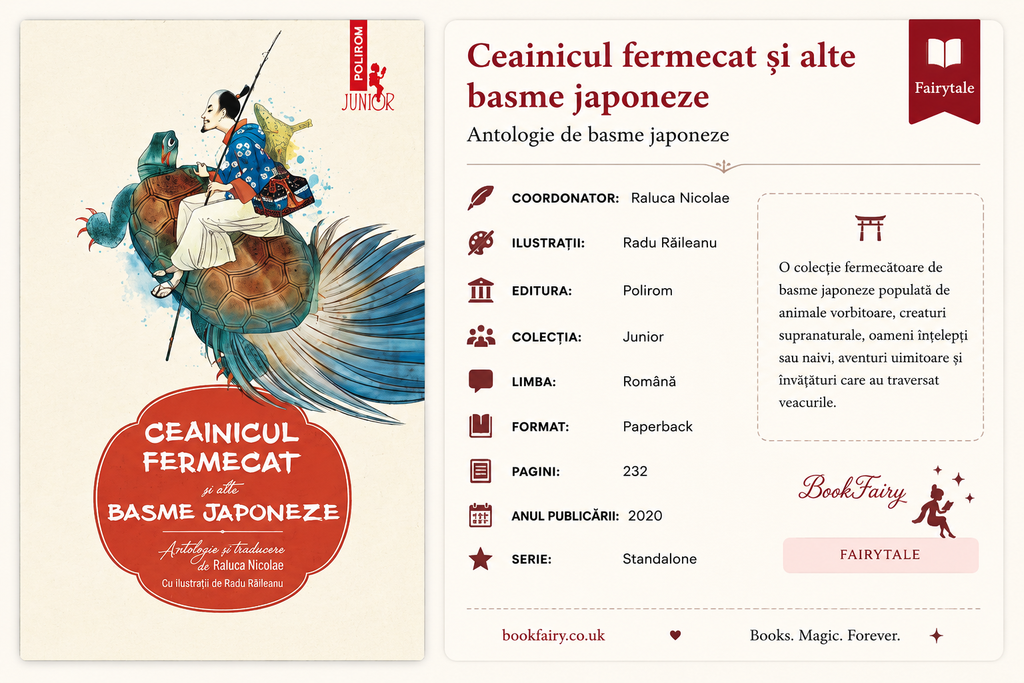
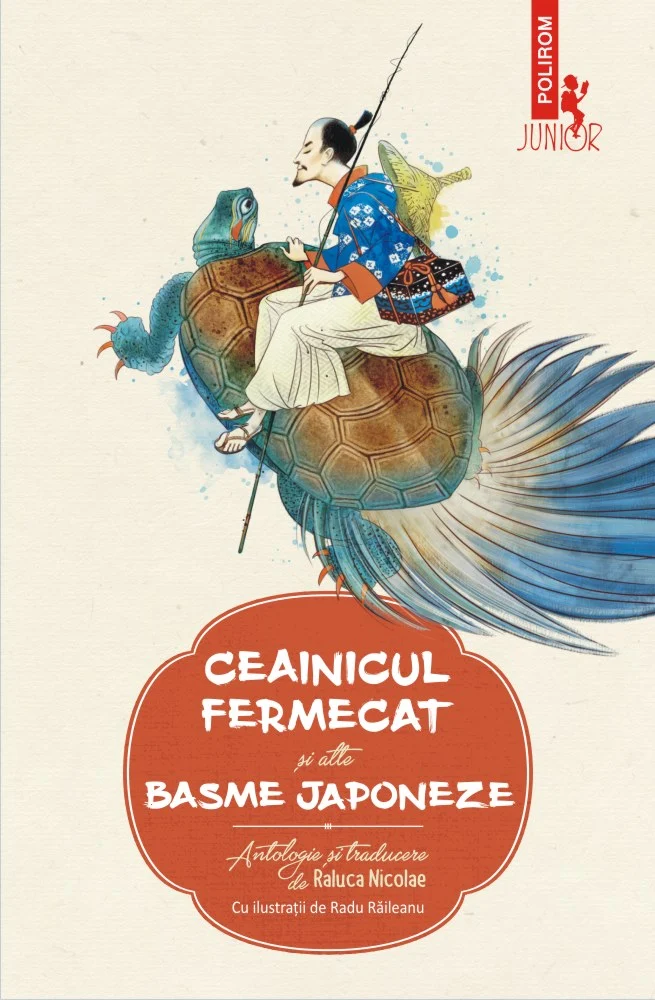
Ceainicul fermecat și alte basme japoneze
📖 Book Details
Title: Ceainicul fermecat și alte basme japoneze
Coordinator: Raluca Nicolae
Illustrations: Radu Răileanu
Genre: Japanese Fairy Tales • Folklore
BookFairy Category: Fairytale
Publisher: Polirom
Language: Romanian
Format: Paperback
Pages: 232
Publication Year: 2020
Series: Standalone