An ambitious and deeply moving science fiction novel in which an extraordinary journey through space becomes an intimate exploration of love, separation and the fragility of human connection.
 Science Fiction
 Space Opera
📝 First Impressions
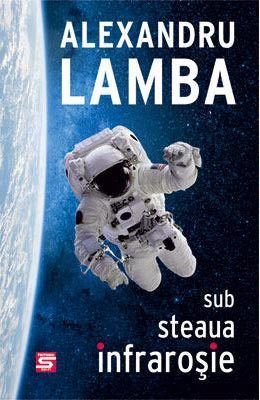
Every once in a while, I come across a book that genuinely surprises me, not because I had particularly low expectations, but because I simply wasn’t prepared for how much I would enjoy it. Sub steaua infraroșie by Alexandru Lamba was one of those wonderful discoveries. I read it in 2016, shortly after its publication, and I remember being absolutely astonished that such an accomplished piece of science fiction could be someone’s debut novel.
I am not particularly easy to impress when it comes to books, especially science fiction. I have read enough of the genre to recognise when an author brings something genuinely interesting to the table, and Lamba certainly did. His imagination, the complexity of the themes he approached and, perhaps most importantly, his ability to give an ambitious science fiction story such a deeply human dimension immediately captured my attention.
What surprised me most was how naturally everything came together. The novel explores extraordinary scientific possibilities and the challenges of interstellar travel, but it never loses sight of the people at the centre of its story. Beneath the fascinating concepts lies a remarkably intimate narrative about love, separation and the painful consequences of circumstances that neither of the protagonists can control. I finished the book convinced that I had discovered an author with enormous potential, someone whose work could comfortably stand alongside that of much more established international science fiction writers.
💜 What I Loved
The central idea of Sub steaua infraroșie remains one of the most memorable concepts I encountered in my reading that year. At its heart is a couple whose lives are turned upside down by an almost cruel reversal of circumstances. The man, who never particularly wanted to leave Earth, finds himself aboard a spacecraft travelling towards a distant star. Meanwhile, the woman he loves, who actually dreamed of undertaking such a journey, is the one forced to remain behind. Neither gets the future they imagined, and both must confront the consequences of a separation they would never have chosen.
What makes their situation so fascinating is that they share a telepathic connection, allowing them to communicate through their thoughts even when they are separated by immense distances. At first, this extraordinary ability offers a certain comfort. Although they cannot physically be together, they can still reach one another, share their experiences and maintain something of the intimacy that defined their relationship on Earth. I found that idea beautiful, particularly because it introduces an element of hope into what might otherwise have been a straightforward story about two people separated by space.
However, as the spacecraft approaches the infrared star, their mental connection gradually begins to weaken. What initially seemed capable of overcoming the physical distance between them becomes increasingly unreliable, and the possibility of losing contact altogether casts a shadow over their relationship. I remember being particularly affected by this development because the loss of communication happens gradually. It is not simply a matter of two people being separated one day and unable to speak the next. Instead, there is the growing awareness that something precious is slipping away, accompanied by the helplessness of knowing that neither of them can necessarily prevent it.
For me, this is where Lamba’s imagination truly shines. The scientific premise is fascinating in itself, but its emotional implications are what make the story so powerful. Space exploration is often presented as an extraordinary achievement, an expression of humanity’s curiosity and determination to reach beyond familiar boundaries. Here, that same ambition comes with an intensely personal cost. The further the protagonist travels towards the unknown, the more uncertain his connection with the person he loves becomes. The journey represents discovery and possibility, but also loneliness, regret and the painful realisation that progress does not come without sacrifice.
I also loved the way the novel’s emotional story is presented through something resembling a letter to a lost love. That narrative approach gives the book a wonderful intimacy and allows the reader to experience the protagonist’s thoughts rather than simply observe his circumstances. The scientific elements are never merely decorative, but neither do they overwhelm the characters. Instead, the two sides of the novel reinforce one another, turning an ambitious exploration of the cosmos into a surprisingly personal meditation on human attachment.
Another aspect I appreciated enormously was the sheer number of substantial themes Lamba managed to explore without making the story feel superficial. His writing struck me as remarkably confident for a debut author, and I admired his willingness to tackle difficult questions while maintaining a strong emotional thread throughout the narrative. When I originally reviewed the novel in 2016, I wrote that he could easily be compared with some of the major names in international science fiction. Looking back, I still recognise the enthusiasm behind those words. It was the kind of debut that made me genuinely excited about what its author might write next.
🤔 What Didn’t Quite Work for Me
It is difficult to identify a significant weakness in a novel that impressed me so completely at the time of reading. My original review was overwhelmingly enthusiastic, and nothing in the notes I preserved suggests that a particular aspect of the story disappointed me. I was fascinated by the premise, deeply moved by the relationship at its centre and genuinely impressed by the maturity of the writing.
Of course, I read the book in 2016, and I would be dishonest if I claimed to remember every detail after so many years. There are aspects of the plot that have faded from memory, including the precise circumstances of the ending. However, I do remember the central conflict and, most importantly, the emotional impression it left on me. Rather than inventing criticisms that I did not have at the time, I would prefer to acknowledge that this was simply one of those rare reading experiences in which everything that mattered to me worked beautifully.
👥 Who Would Enjoy This Book?
I would recommend Sub steaua infraroșie to science fiction readers who appreciate ambitious ideas but also want compelling human stories behind the scientific concepts. There is plenty here for anyone fascinated by space exploration, distant stars and the extraordinary possibilities of communication beyond our current understanding, yet the novel’s greatest strength lies in how naturally those elements become part of an emotionally engaging narrative.
It is also an excellent choice for readers who enjoy thoughtful stories about relationships, particularly those exploring the consequences of separation, missed opportunities and circumstances beyond our control. Although love plays an essential role in the novel, I would not describe it as a conventional romance. It is science fiction first and foremost, but science fiction that understands how powerful an emotional story can become when placed against the immense scale of the universe.
Finally, I would especially encourage readers interested in Romanian speculative fiction to discover Alexandru Lamba’s work. There is a great deal of talent within Romanian science fiction, and this novel demonstrates how an original voice can explore ambitious ideas without sacrificing literary quality or emotional depth.
💭 Final Thoughts
Almost a decade has passed since I first read Sub steaua infraroșie, and although some details have understandably become less clear, I still remember the extraordinary premise and how strongly it affected me. The image of two people whose wishes are unexpectedly reversed, separated by an interstellar journey and desperately trying to preserve their increasingly fragile telepathic connection, has remained with me all these years. I think that says something important about the strength of the story.
What I admired most was Lamba’s ability to take an idea that could easily have become a purely technical exercise in speculative science and transform it into something profoundly human. The enormous distances of space, the fascination of scientific discovery and the extraordinary possibilities of the future all become part of a story about feelings we recognise immediately: love, longing, regret and the fear of losing someone who matters to us.
I remember being particularly impressed that this was the author’s first novel. His confidence, imagination and willingness to explore complex themes made me feel that I was reading the work of someone with a remarkable future ahead of him. I rarely make comparisons with the established giants of science fiction, but in 2016 I genuinely believed Alexandru Lamba deserved that kind of recognition.
Revisiting my original Goodreads review now has reminded me of the excitement I felt when I discovered this book. It was not simply an enjoyable novel or a promising debut; it was a story that made me stop and appreciate what science fiction can accomplish when extraordinary ideas are supported by genuine emotional depth. For me, Sub steaua infraroșie remains a magnificent example of Romanian science fiction and one of the most impressive literary debuts I encountered that year.
✨ The BookFairy Verdict
Sub steaua infraroșie
📖 Book Details
- Title: Sub steaua infraroșie
- Author: Alexandru Lamba
- Original Publication: 2016
- Country: Romania 🇷🇴
- Original Language: Romanian
- Publisher: Tritonic
- Genre: Science Fiction, Hard Science Fiction, Space Opera
- Themes: Interstellar Exploration, Love, Separation, Telepathy, Human Connection, Loss
- Format: Paperback
- Pages: 172
- ISBN: 9786067491241
- Series: Standalone Novel
- Literary Debut: Yes
- English Translation: None
- Other Translations: None known