
Author Guide | BookFairy
📖 About Stan Nicholls
Stan Nicholls is a British fantasy and science fiction author best known for his internationally successful Orcs novels, a series that challenges one of the most familiar conventions of traditional fantasy: the idea that certain creatures are inherently evil and exist primarily to be defeated by heroic adventurers. By placing orcs at the centre of his stories, Nicholls offers readers an opportunity to explore a fantasy world from a perspective that is usually overlooked.
Born in 1949, Nicholls has enjoyed a long and remarkably varied career encompassing fiction, journalism, bookselling and nonfiction writing. His involvement with speculative literature extends far beyond writing novels. He worked in the specialist book trade, including managing the science fiction and fantasy bookshop Dark They Were and Golden Eyed, before becoming the first manager of the Forbidden Planet chain. His professional experience placed him at the heart of British fantasy and science fiction culture during an important period in the development of the genre’s readership.
Alongside his work in bookselling, Nicholls established himself as a journalist, contributing to publications including The Guardian, The Independent, Rolling Stone, SFX and Locus. In 1981, he became a full-time writer, eventually building a bibliography that includes fantasy and science fiction novels, books for younger readers, graphic novel adaptations, biographies and interviews with prominent figures from the world of imaginative literature.
Although his career encompasses several different genres and literary forms, Nicholls achieved his greatest international recognition through Orcs: First Blood. The trilogy follows Stryke and his warband, the Wolverines, through a world threatened by conflict, powerful magical forces and the growing influence of humanity. What distinguishes these novels from more conventional fantasy adventures is that the orcs are not presented as anonymous monsters or disposable enemies. They have their own society, relationships, loyalties and ambitions, and the reader experiences events primarily through their perspective.
The trilogy became an international bestseller, reaching audiences in numerous countries and introducing many readers to a different interpretation of one of fantasy literature’s most recognisable creatures. In 2007, Nicholls received the Le’Fantastique Lifetime Achievement Award at the Trolls & Légendes festival in Belgium, recognising his contribution to imaginative literature.
What I find particularly appealing about his work is his willingness to question assumptions that readers have encountered so often that they may no longer think about them. Fantasy has always been populated by extraordinary beings, but those beings are frequently assigned moral roles simply because of the race to which they belong. Nicholls demonstrates how much more interesting a fictional world can become when its inhabitants are allowed to escape those limitations and develop into individuals.
📚 Stan Nicholls Books and Series
Stan Nicholls has written extensively across fantasy and science fiction, creating several distinct fictional universes alongside standalone works and nonfiction projects. His bibliography reflects an author comfortable with both large-scale adventures and stories that explore familiar genre conventions from unexpected perspectives.
While the Orcs novels remain his most widely recognised achievement, his earlier and subsequent works demonstrate the breadth of his imagination and his longstanding interest in constructing elaborate speculative worlds.
⚔️ Orcs: First Blood
The Orcs: First Blood trilogy is the series that introduced Nicholls to an international audience and remains an excellent starting point for readers unfamiliar with his writing. Set in the world of Maras-Dantia, the novels follow a band of orc warriors known as the Wolverines, led by their captain, Stryke. Their adventures involve dangerous missions, conflicts between different races and the search for powerful artefacts whose significance extends far beyond the immediate circumstances of their quest.
What makes the series particularly interesting is its decision to place traditionally villainous creatures in the position usually occupied by human heroes. The orcs remain warriors, accustomed to violence and conflict, but their personalities and relationships gradually reveal a complexity that challenges their conventional portrayal. They are capable of courage and loyalty, but also cruelty, selfishness and mistakes, making them far more engaging than a uniformly heroic or villainous group.
The trilogy consists of:
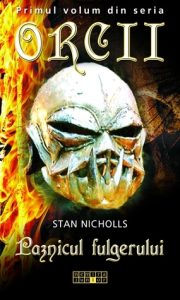
- Bodyguard of Lightning (1999) — Paznicul fulgerului
- Legion of Thunder (1999) — Legiunea tunetului
- Warriors of the Tempest (2000) — Războinicii furtunii
All three novels were translated into Romanian by Antuza Genescu and published by Nemira between 2009 and 2011. The Romanian editions are currently out of print, although second-hand copies may occasionally be available.
The original trilogy has also appeared in collected editions under the title Orcs, allowing readers to experience the complete opening story in a single volume.
⚔️ Orcs: Bad Blood
Following the international success of Orcs: First Blood, Nicholls returned to his fantasy universe with Orcs: Bad Blood, a second trilogy continuing the larger story of the orcs and the world they inhabit.
The continuation builds upon the characters, conflicts and mythology established in the original books, expanding the fictional universe while maintaining the adventurous spirit that made the first trilogy successful. For readers who become attached to Stryke and his companions, these novels offer an opportunity to explore further developments within the world of Maras-Dantia.
The trilogy consists of:
- Weapons of Magical Destruction (2008)
- Army of Shadows (2009)
- Inferno (2011)
Although the two trilogies form separate narrative sequences, I would recommend beginning with Orcs: First Blood before moving on to Orcs: Bad Blood. Discovering the characters and their world through the original books provides a stronger foundation for appreciating the continuation.
🌑 The Nightshade Chronicles
Before the publication of Orcs: First Blood, Nicholls had already established himself as a fantasy novelist through works such as The Nightshade Chronicles. Published between 1996 and 1998, this trilogy demonstrates his earlier interest in developing substantial fantasy narratives across multiple volumes.
The series consists of:
- The Book of Shadows (1996)
- The Shadow of a Sorcerer (1997)
- A Gathering of Shadows (1998)
For readers interested in exploring the development of Nicholls’s career, this trilogy provides an opportunity to discover his fantasy writing before the international success of the Orcs novels. It also demonstrates that his interest in extended storytelling and imaginative fictional worlds was already well established during the 1990s.
✨ The Quicksilver Trilogy
The Quicksilver trilogy represents another major fantasy project in Nicholls’s bibliography. Published between 2003 and 2006, the series demonstrates his continued interest in ambitious fantasy storytelling beyond the universe that made him internationally famous.
The trilogy consists of:
- Quicksilver Rising (2003)
- Quicksilver Zenith (2004)
- Quicksilver Twilight (2006)
The books have appeared under alternative titles in some markets, while the trilogy is also associated with the name Dreamtime in the United States. These variations are important when identifying editions, particularly for readers who collect books published in different countries.
📕 Standalone Novels and Other Works
Stan Nicholls’s literary career extends considerably beyond his major fantasy series. His published work includes science fiction, standalone novels, books for younger readers, graphic novel adaptations and nonfiction projects, demonstrating an impressive versatility across different forms of storytelling.
Among his notable works are Strange Invaders (1995) and Fade to Black (1997). He has also adapted works by David Gemmell into graphic novel form and written authorised biographies, reflecting his broader involvement with popular culture and imaginative literature.
Another particularly interesting publication is Wordsmiths of Wonder: Fifty Interviews with Writers of the Fantastic, which draws upon his experience as both a journalist and a participant in the speculative fiction community. Through interviews and nonfiction writing, Nicholls has explored the creative processes and careers of other authors working within fantasy and science fiction.
This diversity is one of the things that makes his bibliography worth exploring. Although readers may initially discover him through the adventures of Stryke and the Wolverines, his literary career encompasses a much wider range of interests and accomplishments.
✨ What Makes Stan Nicholls’s Stories Special?
One of the things I have always appreciated about fantasy is its freedom to imagine extraordinary worlds populated by creatures, cultures and societies unlike anything we encounter in everyday life. However, that freedom does not always result in particularly complex characters. Fantasy has developed a collection of conventions that readers recognise immediately, and certain races are often associated with specific qualities long before an individual character has done anything to deserve that reputation.
Elves, for example, are frequently presented as graceful, wise or exceptionally gifted, while orcs tend to occupy the opposite position. They are usually portrayed as brutal, destructive and inherently dangerous, appearing in large numbers whenever an author needs an army of enemies for the heroes to defeat. These conventions can be entertaining, but they also risk reducing entire fictional races to little more than predictable roles.
What I find particularly refreshing about Stan Nicholls is his willingness to challenge that assumption. Rather than treating orcs as an anonymous collection of monsters, he gives them individual identities and allows readers to experience their world through their own perspective. They have relationships, emotions, ambitions and conflicts that exist independently of the human characters who might otherwise consider them enemies.
More importantly, Nicholls does not simply reverse the traditional division between good and evil. His orcs do not suddenly become universally noble, compassionate or misunderstood. They remain capable of violence and cruelty, and their culture is certainly not presented as an ideal society. However, those characteristics no longer define every member of their race. Some individuals behave honourably, others make terrible decisions, and many possess a combination of admirable qualities and serious flaws.
That distinction matters enormously to me because I have never particularly liked the idea that a character’s moral nature should be determined entirely by their origins. Whether we are reading about humans, elves, dwarves, orcs or any other intelligent creatures, I find their stories much more compelling when their personalities and actions determine how we perceive them.
Nicholls also understands the importance of making an adventure entertaining. His Orcs novels are filled with battles, dangerous quests, magical artefacts and conflicts that keep the story moving. There is no attempt to abandon the pleasures of traditional fantasy simply because the protagonists are unconventional. Instead, those familiar elements become more interesting because we experience them from a different perspective.
I particularly enjoy stories in which relationships within a group become just as important as the dangers its members face. A band of warriors may share a common objective, but that does not mean they will always agree, behave admirably or approach every problem in the same way. Their personalities inevitably influence their decisions, and those differences can make their adventures considerably more engaging.
For me, this is where Nicholls’s approach becomes especially successful. His orcs are still recognisably orcs, but they are also individuals whose motivations and emotions deserve attention. That combination allows a familiar fantasy concept to become something unexpectedly fresh without losing the excitement and atmosphere that readers appreciate about the genre.
📖 Stan Nicholls on BookFairy
⚔️ Bodyguard of Lightning (1999)
Romanian edition: Paznicul fulgerului — Nemira, 2009
I read Bodyguard of Lightning in Romanian in 2016 and thoroughly enjoyed its refreshing approach to traditional fantasy. By giving orcs individual personalities, emotions and motivations, Stan Nicholls transforms familiar villains into complex characters with stories of their own. The exciting adventures and battles made the experience even more enjoyable.
📖 Read My Bodyguard of Lightning Review
🌟 Where to Start with Stan Nicholls
For readers discovering Stan Nicholls for the first time, I would recommend beginning with Bodyguard of Lightning, the opening volume of Orcs: First Blood. It provides an excellent introduction to his best-known fictional universe while demonstrating almost immediately what makes his approach to traditional fantasy so distinctive. Rather than following the adventures of noble human warriors fighting an army of monsters, readers are invited to experience the story through the very creatures who would normally occupy the role of villains.
The novel is particularly well suited to readers who enjoy action-packed fantasy, dangerous quests and groups of characters whose relationships are shaped by loyalty, disagreement and shared experiences. There are battles, magical elements and the kind of adventurous storytelling associated with traditional epic fantasy, but the unusual protagonists give those familiar ingredients a different flavour.
I would especially recommend it to readers who have grown tired of simplistic divisions between good and evil. Nicholls demonstrates that an orc can be brave, cruel, loyal, selfish, compassionate or deeply flawed, and that no single quality necessarily defines an entire race. This approach makes the characters more interesting without transforming them into conventional heroes who happen to look different.
Those who enjoy the first novel can continue with Legion of Thunder and Warriors of the Tempest, completing the original trilogy before exploring Orcs: Bad Blood. Reading the books in this order allows the fictional world and its characters to develop naturally, making the larger story easier to appreciate.
Readers who would prefer to discover other aspects of Nicholls’s writing can explore The Nightshade Chronicles or the Quicksilver trilogy. His standalone fiction and nonfiction projects also offer opportunities to discover the broader interests of an author whose career extends well beyond his most famous creation.
Although Orcs is the obvious starting point for me, it is certainly not the only part of his bibliography worth exploring. Nicholls has spent decades working within imaginative literature, and his range of publications reflects a writer with a genuine and longstanding connection to fantasy and science fiction.
💜 My Favourite Stan Nicholls Reading Experience
My favourite Stan Nicholls reading experience is Bodyguard of Lightning, which I discovered through its Romanian translation, Paznicul fulgerului, in 2016. I remember it as a thoroughly entertaining fantasy adventure, but what made the book particularly memorable was the pleasure of discovering orcs who were finally allowed to become individuals rather than simply the enemies of somebody else’s story.
I have encountered orcs in countless fantasy settings, and they are so often portrayed as creatures whose primary purpose is to threaten, destroy or be defeated. Their appearance alone usually tells the reader everything they are expected to know about them. What I loved about Nicholls’s approach was that he refused to accept that limitation. His orcs had different personalities, feelings, loyalties and motivations, and their relationships were shaped by the same complicated emotions that influence human behaviour.
I particularly appreciated that the author did not simply replace the familiar image of evil orcs with an equally simplistic portrayal of noble, misunderstood heroes. Some of his characters were sympathetic, others were unpleasant or cruel, and many existed somewhere between those extremes. They could demonstrate courage and loyalty while remaining capable of selfishness or brutality. That complexity made them far more interesting to me because I could respond to them as individuals rather than judge them collectively.
The adventure itself was also great fun. I enjoyed following Stryke and the Wolverines through their dangerous encounters, battles and complicated situations, particularly because the characters were not interchangeable warriors with identical personalities. Their different attitudes and relationships gave the group a sense of individuality, and I found myself increasingly interested in their experiences.
What stayed with me after finishing the book was the realisation that a relatively simple change in perspective could make such a familiar fantasy concept feel refreshing again. Orcs did not need to become completely different creatures to be interesting. They simply needed the opportunity to tell their own stories, experience their own emotions and make their own choices.
For me, that was the greatest achievement of Bodyguard of Lightning. It offered the excitement of a traditional fantasy adventure while encouraging me to look beyond familiar assumptions about who deserves to be considered a hero and who is automatically condemned to the role of villain. I had a wonderful time reading it, and that unusual perspective remains the reason I remember it so fondly.
📚 Explore Stan Nicholls’s Complete Bibliography
Stan Nicholls has built an extensive literary career encompassing fantasy and science fiction novels, interconnected series, standalone works, books for younger readers, graphic novel adaptations, biographies and nonfiction. His published work reflects decades of involvement with imaginative literature, both as a writer and as someone professionally connected to the wider speculative fiction community.
The Stan Nicholls Complete Bibliography provides a dedicated guide to his published works, organised chronologically and by series. It distinguishes original publications from alternative titles, translated editions and omnibus collections, allowing readers to explore his literary career without confusing individual books with later collected editions.
Readers interested in the Orcs universe can follow the recommended reading order, while those wishing to explore his earlier fantasy writing or nonfiction projects can discover how his work developed across different genres and formats.