
Author Guide | BookFairy
📖 About R. F. Kuang
Rebecca F. Kuang (born 29 May 1996) is an award-winning American author of fantasy, historical fantasy and contemporary literary fiction. She is best known for The Poppy War trilogy, Babel, Yellowface and Katabasis, novels that explore power, identity, violence, colonialism, ambition and the complicated relationship between knowledge and authority.
Born in Guangzhou, China, Kuang moved to the United States with her family as a child and grew up in Texas. Her experiences across different cultures, together with her academic interests in Chinese history, language and literature, have significantly influenced her writing.
Kuang studied at Georgetown University before pursuing postgraduate studies at the University of Cambridge and the University of Oxford. Her academic background is particularly visible in her fiction, where universities, languages, historical research and intellectual institutions frequently play central roles.
Her debut novel, The Poppy War, was published in 2018 and introduced readers to a dark fantasy world inspired by Chinese history and mythology. Its success established Kuang as an important new voice in speculative fiction.
She followed it with The Dragon Republic (2019) and The Burning God (2020), completing an ambitious trilogy about war, imperialism, revenge and the destructive consequences of power.
In 2022, Kuang published Babel, a standalone historical fantasy centred on translation, colonialism and an alternative nineteenth-century Oxford. The novel received major literary recognition, including the Nebula Award for Best Novel and the Locus Award for Best Fantasy Novel.
Her next novel, Yellowface (2023), marked a departure from epic fantasy. This contemporary literary satire examines publishing, cultural appropriation, racial identity, jealousy and the pursuit of literary success.
With Katabasis (2025), Kuang returned to dark academia and speculative fiction, combining academic ambition with a journey into the underworld.
Across genres, her novels share a fascination with institutions that promise opportunity while concealing systems of exploitation, inequality and control.
🐉 The Poppy War Trilogy
The Poppy War is a completed grimdark fantasy trilogy inspired by Chinese history, mythology and twentieth-century warfare.
The series follows Fang Runin, known as Rin, a young woman whose determination to escape poverty brings her into a prestigious military academy and, eventually, into a devastating conflict.
What begins with the familiar structure of a fantasy school story gradually develops into a brutal examination of war, trauma, nationalism and moral responsibility.
📚 Reading Order
- The Poppy War (2018) — Book 1
- The Dragon Republic (2019) — Book 2
- The Burning God (2020) — Book 3
The trilogy should be read in order, as the novels form one continuous narrative.
The Drowning Faith (2020)
The Drowning Faith is a shorter companion work associated with The Poppy War universe.
It is not a fourth novel in the trilogy and should be identified separately in the complete bibliography.
Themes of The Poppy War
The trilogy explores:
- The relationship between warfare and political power.
- Historical trauma and collective memory.
- Imperialism, occupation and nationalism.
- The consequences of revenge.
- Religious belief and supernatural power.
- The moral compromises demanded by survival.
- The destructive relationship between personal ambition and national destiny.
Although the books contain magic, gods and fantastical elements, their violence and political themes place them firmly within dark adult fantasy.
🏛️ Babel: Or the Necessity of Violence (2022)
Babel is a standalone historical fantasy novel set in an alternative version of nineteenth-century Britain.
Its full title is Babel: Or the Necessity of Violence: An Arcane History of the Oxford Translators’ Revolution.
The story follows Robin Swift, a young man brought from Canton to England and educated for a future at Oxford’s Royal Institute of Translation.
In Kuang’s imagined world, translation creates magical effects through the differences in meaning between words in different languages. This process, known as silver-working, supports the economic and political power of the British Empire.
The novel combines dark academia, alternative history and fantasy with an examination of colonial exploitation.
Major Themes
- Language and translation.
- Colonialism and imperialism.
- Education and institutional privilege.
- Cultural identity and belonging.
- Racism and exploitation.
- Resistance and revolution.
- The ethical limits of political violence.
What distinguishes Babel from many other dark-academia novels is that its magical system is inseparable from its political argument.
Language is not simply a subject studied by the characters: it becomes a resource, an industry and a source of power.
🦋 Babel – BookFairy Review
BookFairy has reviewed Babel, exploring its treatment of language, colonialism, historical fantasy and the complicated relationship between knowledge and power.
📖 Read the full BookFairy review: Babel by R. F. Kuang – When Language Becomes Power
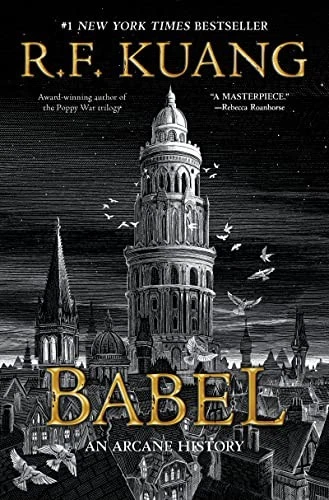
The review also discusses the experience of approaching the novel through its English edition and subsequently listening to the Romanian audiobook.
✍️ Yellowface (2023)
With Yellowface, Kuang moved away from speculative fantasy to write a contemporary literary satire.
The novel follows June Hayward, an unsuccessful novelist who witnesses the death of a more successful writer, Athena Liu.
When June takes Athena’s unpublished manuscript and presents it as her own work, she enters a world of literary deception, jealousy and increasingly dangerous lies.
The novel examines the contemporary publishing industry and the ways in which identity, representation and commercial success intersect.
Major Themes
- Cultural appropriation.
- Racism and representation.
- Literary ownership.
- Publishing-industry politics.
- Professional jealousy.
- Social media and public scandals.
- The unreliable narrator.
Unlike The Poppy War or Babel, Yellowface does not rely on a fantasy setting.
Its uncomfortable humour and sharp criticism of literary culture nevertheless share the satirical instincts present throughout Kuang’s work.
🔥 Katabasis (2025)
Katabasis is a standalone dark-academia fantasy novel that combines classical mythology, academic rivalry and supernatural adventure.
The story follows Alice Law, a graduate student whose pursuit of academic success takes an extraordinary turn when she journeys into Hell in an attempt to recover the soul of her deceased professor.
Accompanied by a fellow student, Alice must navigate an underworld governed by its own strange rules.
The novel draws on mythological traditions of descent into the realm of the dead, while exploring the pressures and obsessions of academic life.
Major Themes
- Academic ambition.
- Intellectual rivalry.
- Mentorship and exploitation.
- Grief and mortality.
- The pursuit of recognition.
- The limits of knowledge.
- The sacrifices demanded by success.
Like Babel, Katabasis places scholarship and intellectual institutions at the centre of its imaginative world.
📚 Other Fiction and Publications
Kuang has also written shorter fiction and contributed to anthologies.
Notable publications include:
- “How to Talk to Ghosts” (2018) — non-fiction essay published in Uncanny Magazine.
- “The Nine Curves River” (2020) — short story included in The Book of Dragons.
- “Against All Odds” (2020) — short story included in From a Certain Point of View: The Empire Strikes Back.
- The Best American Science Fiction and Fantasy 2023 — guest-edited anthology, with series editor John Joseph Adams.
Kuang’s work also includes Taipei Story, announced for publication in 2026.
These contributions are distinguished from her full-length novels in the complete bibliography.
📖 R. F. Kuang’s Writing Style and Themes
R. F. Kuang’s fiction combines ambitious ideas with emotionally intense storytelling.
Her novels frequently feature intelligent, determined protagonists whose pursuit of knowledge, power or recognition gradually forces them to confront the institutions that shape their lives.
Although her books span different genres, several recurring themes connect them.
Power and Institutional Control
Kuang is particularly interested in systems that claim to reward merit while reinforcing existing inequalities.
Military academies, universities, empires and publishing houses all become environments in which personal ambition collides with institutional power.
Colonialism and Historical Memory
Her fantasy novels draw extensively on history, particularly the lasting consequences of imperial expansion, warfare and cultural exploitation.
History is not merely decorative background; it shapes the conflicts, motivations and political structures of her fictional worlds.
Language and Identity
Language plays a particularly important role in Babel, but questions of identity, representation and cultural belonging appear throughout Kuang’s fiction.
Her characters often struggle with the tension between who they are and the identities imposed upon them.
Ambition and Moral Compromise
Kuang repeatedly asks what people are prepared to sacrifice to achieve their goals.
Her protagonists are not always conventionally heroic. They can be brilliant, determined, morally compromised and capable of destructive decisions.
Violence and Resistance
From military conflict in The Poppy War to revolutionary struggle in Babel, Kuang examines violence both as an instrument of oppression and as a response to oppressive systems.
Her fiction rarely offers easy answers to these questions.
🇷🇴 R. F. Kuang in Romanian Translation
R. F. Kuang’s books have been published in Romanian by Paladin and Bookzone.
The Poppy War Trilogy – Paladin
| Original title | Romanian title | Romanian year | Translator |
|---|---|---|---|
| The Poppy War | Războiul macului | 2020 | Alexandra Fusoi |
| The Dragon Republic | Republica Dragonului | 2024 | Oana Cristea |
| The Burning God | Zeul în flăcări | 2025 | Laura Ciobanu |
Publisher: Editura Paladin, part of Grupul Editorial ART.
All three novels have been translated into Romanian.
Standalone Novels – Bookzone
| Original title | Romanian title | Romanian year | Translator |
|---|---|---|---|
| Babel | Babel sau necesitatea violenței | 2025 | Mihai-Dan Pavelescu |
| Yellowface | Yellowface | 2026 | Mihai-Dan Pavelescu |
| Katabasis | Katabasis | 2025 | Anca Irina Ionescu |
Publisher: Bookzone.
The Romanian editions preserve the original titles of Yellowface and Katabasis, while Babel uses an expanded Romanian title.
Romanian Edition Notes
- The Poppy War trilogy is available as three individual Romanian novels; promotional box sets and multi-book packages do not constitute additional original works.
- Babel is an independent novel, not part of The Poppy War trilogy.
- Yellowface is contemporary literary fiction rather than fantasy.
- Katabasis is another standalone novel.
- Special editions, sprayed-edge editions and later reprints are recorded separately from the original work when relevant.
🦋 R. F. Kuang on BookFairy
📖 Babel – Book Review
Babel by R. F. Kuang – When Language Becomes Power
BookFairy’s review explores the novel’s ambitious linguistic magic system, its criticism of imperialism and the moral complexity of its characters.
The review also considers the novel’s deliberate pacing, extensive academic discussions and the way its themes sometimes become unusually explicit.
Further reviews of R. F. Kuang’s novels will be added to this section as they are published.
📚 Complete R. F. Kuang Bibliography
For a comprehensive chronological catalogue of R. F. Kuang’s literary work, including The Poppy War trilogy, Babel, Yellowface, Katabasis, Taipei Story, short fiction, editorial work and Romanian translations, explore the dedicated R. F. Kuang Complete Bibliography on BookFairy.
The bibliography includes original publication dates, series reading orders, Romanian editions and publishers, and links to existing BookFairy reviews.
💭 R. F. Kuang’s Literary Significance
R. F. Kuang has established herself as a distinctive contemporary writer by combining speculative imagination with politically engaged storytelling.
Her fiction asks difficult questions about how societies organise power, whose knowledge is valued and how individuals respond when institutions they once trusted prove fundamentally unjust.
What makes her work particularly interesting is its range.
The Poppy War explores warfare and its devastating consequences through grimdark fantasy. Babel transforms translation into a magical system that exposes the machinery of empire. Yellowface turns its attention to the modern publishing industry, while Katabasis examines intellectual ambition through a fantastical journey into the underworld.
Together, these books reveal a writer interested not only in telling compelling stories but in examining the structures, assumptions and inequalities that shape human experience.
For readers drawn to historical fantasy, dark academia, morally complex characters and ambitious fiction with substantial themes, R. F. Kuang is an author worth exploring.