
Author Guide | BookFairy
📖 About Lucian Dragoș Bogdan
Lucian Dragoș Bogdan is a Romanian author whose work encompasses science fiction, fantasy, crime fiction, mystery and romance. Born on 16 July 1975 in Alba Iulia, he has developed a remarkably varied literary career, creating imaginary universes, unconventional protagonists and stories that move between futuristic settings and recognisable Romanian cities. His bibliography includes novels, short fiction and collaborations with other writers, reflecting an interest in exploring unusual ideas across different genres.
His fascination with storytelling began during childhood, when he discovered science fiction through works such as Star Wars and the adventure novels of Jules Verne. He began creating illustrated stories and experimenting with his own fictional worlds at an early age, eventually producing a homemade magazine called Galacticus. His first published story, Triunghiul Bermudelor, appeared in 1991, marking the beginning of a literary journey that would continue through magazine contributions, short fiction and novels.
In 2004, Bogdan published his first collections, while his science fiction novel Frontiera followed in 2006. These early publications established his interest in speculative worlds and the possibilities of constructing stories around unfamiliar societies, extraordinary circumstances and questions that extend beyond everyday experience. After resuming a more active publishing career in 2013, he expanded into new genres and developed several interconnected fictional universes.
One of the most important aspects of his later career has been his collaboration with other Romanian writers, particularly Teodora Matei. Together, they created the science fiction trilogy Omul-fluture, which explores a future shaped by virtual reality, technological developments and complicated questions about human identity. Their collaborative writing also extends into fantasy, demonstrating Bogdan’s willingness to explore different kinds of storytelling rather than remaining confined to one literary category.
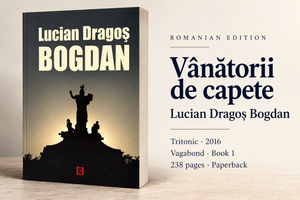
Alongside his speculative fiction, Bogdan established himself as a crime writer through the Vagabond series, beginning with Vânătorii de capete in 2016. Set in Alba Iulia, the novel introduces Dinu Căbulea, an unconventional protagonist whose decision to abandon his familiar life places him in circumstances far removed from an ordinary existence. The series subsequently expanded through additional novels and companion stories, combining criminal investigations with contemporary Romanian settings.
Bogdan’s fiction is particularly interesting because of the contrast between its settings. Some of his stories explore distant civilisations and imagined futures, while others unfold in places readers might recognise from their own lives. The genres may be different, but his work repeatedly demonstrates how an unusual premise can transform a familiar situation into something unexpected.
Today, Lucian Dragoș Bogdan is associated with several areas of Romanian genre fiction, from science fiction and fantasy to contemporary crime and mystery. His literary career offers readers a wide range of possibilities, whether they prefer elaborate speculative universes, unconventional investigations or stories developed in collaboration with other authors.
On BookFairy, you can explore his major books and series, discover the different fictional worlds he has created and read about my personal connection with Vânătorii de capete, a novel set in a city I have known since childhood.
📚 Lucian Dragoș Bogdan’s Books and Literary Worlds
Lucian Dragoș Bogdan’s bibliography covers an unusually broad selection of genres, including science fiction, fantasy, mystery, crime thrillers and romantic fiction. His novels range from stories involving distant civilisations and virtual reality to investigations unfolding within contemporary Romanian society. Several works belong to larger fictional universes, while others were developed in collaboration with fellow Romanian authors.
🚀 The Frontiera Universe
The Frontiera universe represents one of Bogdan’s major contributions to Romanian science fiction. Its central novel, Frontiera, originally published in 2006 and later revised and expanded, explores an interconnected fictional setting in which different worlds and civilisations are drawn into larger conflicts.
Rather than restricting his imagination to a single futuristic society, Bogdan uses this universe to investigate relationships between different environments, cultures and perspectives. Related fiction, including Un bilet de plecare de pe Søregaard and Cu drag, pentru Rugh, expands the setting beyond its central novel.
The project reflects his longstanding interest in ambitious speculative ideas and the possibilities offered by science fiction when an author is free to imagine worlds beyond the limitations of contemporary reality. Readers interested in interconnected settings and unfamiliar civilisations may find this aspect of his work particularly appealing.
🔎 The Vagabond Series
The Vagabond series introduces a different side of Bogdan’s writing, replacing distant fictional worlds with contemporary Romanian settings and unconventional crime investigations. Its central character, Dinu Căbulea, begins his journey in Vânătorii de capete, published in 2016, when his decision to leave behind an established existence places him among people living on the margins of society.
What makes the premise interesting is the contrast between the protagonist’s previous life and his new circumstances. Through Dinu’s experiences, the series can explore aspects of urban society that are frequently overlooked, while the criminal investigations provide mystery and suspense. The use of Alba Iulia gives the opening novel a particularly recognisable Romanian setting.
The main sequence continues with Apărarea siciliană (2017), Picătura chinezească (2018), Văduva neagră (2020) and Pactul cu diavolul (2024). The wider fictional universe also includes shorter works and Femeia din portbagaj (2019), a related novel written with Jacky Schwartzmann.
🦋 The Omul-fluture Trilogy
Written with Teodora Matei, the Omul-fluture trilogy explores the relationship between technology, human identity and society within an imagined future. Its fictional world examines the influence of virtual reality and the consequences of technological developments that increasingly affect how people understand themselves and interact with others.
The trilogy consists of Omul-fluture (2015), Maya (2016) and Sindromul Charlotte (2017). Together, the novels form a connected narrative that combines speculative technology with questions about personal choices, relationships and social change.
This collaboration is an interesting part of Bogdan’s bibliography because it demonstrates how two authors can contribute to the development of a shared fictional world. For readers who enjoy science fiction concerned with the social consequences of technological progress, the series offers a different experience from either the Frontiera universe or the contemporary investigations of Vagabond.
✨ Fantasy, Romance and Other Fiction
Beyond his principal series, Bogdan has published fantasy, romantic fiction and speculative works that demonstrate the variety of his literary interests. Among his titles are Vraciul de pe norul interior, Ultimul flux, Întâmplări din oceanele timpului, Cartea haosului, Uneori, când visez… and Parfumul Cracoviei.
His collaborations have also produced works such as Un străin în Regatul Assert, written with Teodora Matei, and Când penele roșii vor plânge. Ciudatul caz al umbrelor, written with Daniel Timariu. These projects illustrate his willingness to explore different fictional settings and approaches to storytelling alongside other writers.
Bogdan’s bibliography also includes short fiction and anthology contributions, which form an important part of his development as an author. For the complete publication chronology, individual stories, collaborative credits, translations and editions, see the separate Lucian Dragoș Bogdan bibliography.
✨ What Makes Lucian Dragoș Bogdan’s Stories Special?
One of the most appealing qualities of Lucian Dragoș Bogdan’s fiction is his willingness to build stories around unusual premises. Some authors become closely associated with a particular type of setting or narrative, but Bogdan moves between imaginative science fiction, fantasy adventures and mysteries grounded in contemporary reality. What connects these different genres is an interest in placing characters in circumstances that challenge their expectations and force them to see the world differently.
His speculative fiction demonstrates an enthusiasm for creating unfamiliar environments, exploring technological possibilities and imagining societies whose rules differ from our own. The Frontiera universe and Omul-fluture trilogy illustrate different approaches to these interests, from interconnected worlds and civilisations to the consequences of virtual reality. Both invite readers to consider possibilities beyond contemporary experience, while retaining the importance of the individuals living within those imagined environments.
His crime fiction offers an equally interesting contrast. Instead of relying upon extraordinary technology or supernatural events, the Vagabond series explores unusual choices and dangerous situations within recognisable Romanian settings. The idea of someone deliberately leaving behind an established life to enter the world of homeless people is compelling precisely because it does not require an imaginary universe. It is an extraordinary decision made within a world that readers already understand.
I also appreciate the presence of Romanian locations in his fiction. Although I love stories that take me to unfamiliar planets and imaginary kingdoms, there is a different kind of pleasure in reading about places I recognise. A familiar street or neighbourhood can make a fictional investigation feel unexpectedly personal, particularly when it is connected to memories formed long before encountering the book.
Another distinctive aspect of Bogdan’s career is his collaborative writing. Working with different authors across science fiction and fantasy allows him to participate in the creation of shared fictional worlds, while his individual novels demonstrate the breadth of his own interests. This variety makes his work appealing to readers who enjoy moving between genres rather than remaining within a single literary tradition.
For me, the most interesting common thread is the idea that an unusual perspective can transform an otherwise familiar story. Whether the setting is a distant world, a technologically transformed future or a Romanian city, Bogdan’s fiction offers opportunities to discover circumstances and experiences that might otherwise remain unexplored.
📖 Lucian Dragoș Bogdan on BookFairy
🔎 Vânătorii de capete (2016)
Vagabond — Book 1
My BookFairy review explores Vânătorii de capete, a Romanian crime thriller whose unusual premise immediately fascinated me. I particularly enjoyed its Alba Iulia setting, as recognising places connected to my childhood made the story feel unexpectedly personal.
📖 Read My Vânătorii de capete Review
📚 Where Should You Start Reading Lucian Dragoș Bogdan?
For readers discovering Lucian Dragoș Bogdan for the first time, I would recommend choosing a starting point according to the genres they enjoy most. His bibliography moves between very different kinds of fiction, so a reader attracted to contemporary mysteries may have a completely different experience from someone looking for ambitious science fiction or fantasy.
For crime fiction enthusiasts, Vânătorii de capete is an excellent introduction. As the first novel in the Vagabond series, it introduces an unconventional protagonist whose circumstances allow him to investigate mysteries from a perspective quite different from that of a traditional detective. The Alba Iulia setting also gives the story a distinctive Romanian identity, making it particularly appealing to readers interested in crime fiction set outside the usual international locations.
Readers who prefer science fiction may wish to begin with Frontiera, especially if they enjoy interconnected fictional universes and stories involving unfamiliar worlds. Alternatively, Omul-fluture, written with Teodora Matei, offers an introduction to a future shaped by virtual reality and the increasingly complicated relationship between humanity and technology.
For fantasy readers, Bogdan’s collaborative projects and standalone speculative works offer further possibilities. His bibliography is varied enough that there is no single starting point suited to everyone, but that variety is part of its appeal. It allows readers to approach his writing through the kinds of stories they already enjoy before exploring other aspects of his imagination.
💜 My Favourite Lucian Dragoș Bogdan Reading Experience
My favourite Lucian Dragoș Bogdan reading experience is Vânătorii de capete, which I read in 2016. The premise immediately caught my attention: the idea of someone suddenly abandoning everything familiar and choosing to live on the streets seemed both unusual and fascinating. It made me wonder how a person could adapt to such a dramatic change and what they might discover outside the security of their previous life.
What made the novel particularly special to me, however, was its setting. My mother comes from the area surrounding Alba Iulia, and I have known the city since childhood, especially its central neighbourhoods. Recognising places throughout the story gave me an unexpected sense of familiarity and made the reading experience more enjoyable.
Even years later, those two things remain the strongest memories I associate with the book: an intriguing idea and the pleasure of rediscovering a city connected to my own past. That combination made Vânătorii de capete a particularly memorable discovery.
📚 Complete Lucian Dragoș Bogdan Bibliography
Explore the complete bibliography of Lucian Dragoș Bogdan, including his science fiction novels, fantasy works, crime fiction, romantic fiction, short stories, anthologies and collaborations with other Romanian authors.
The bibliography follows original publication dates and presents the Vagabond, Omul-fluture and Frontiera works separately, with recommended reading orders. It also distinguishes original publications from revised editions, collected works and translations, while identifying collaborative titles and linking to existing BookFairy reviews.