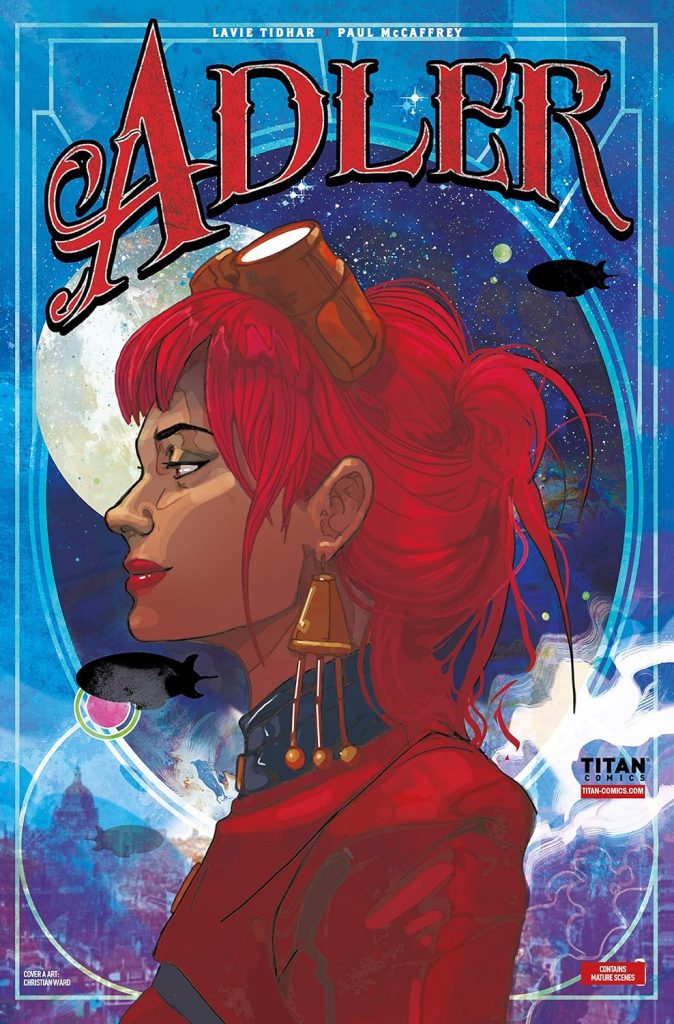
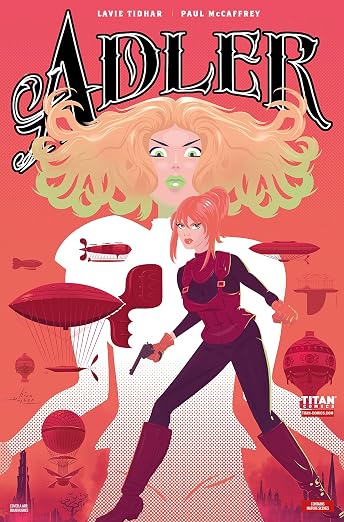
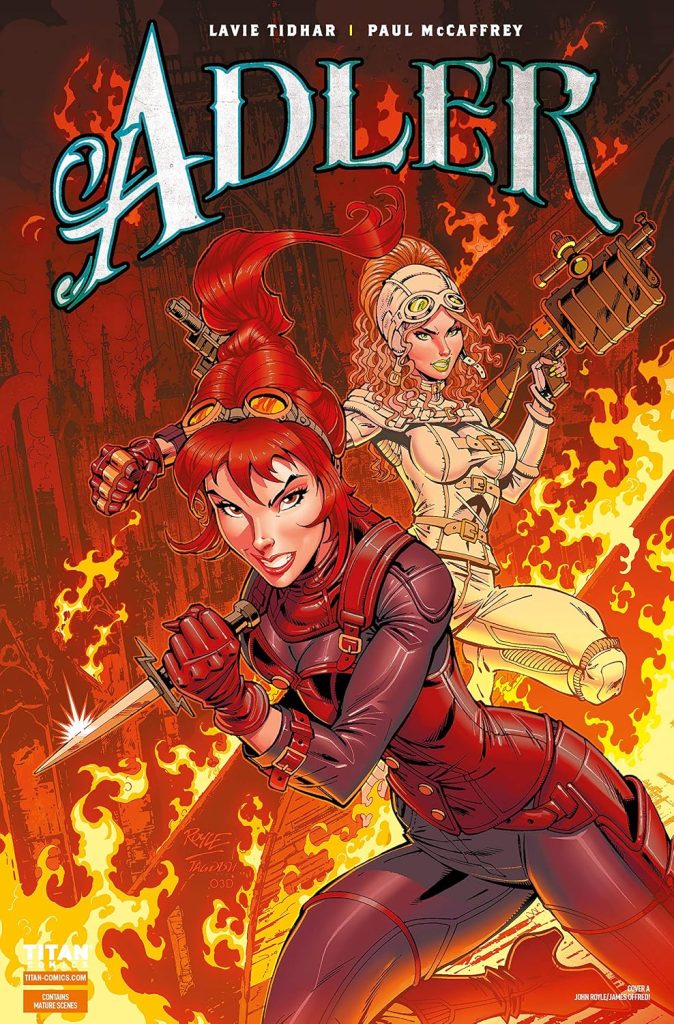
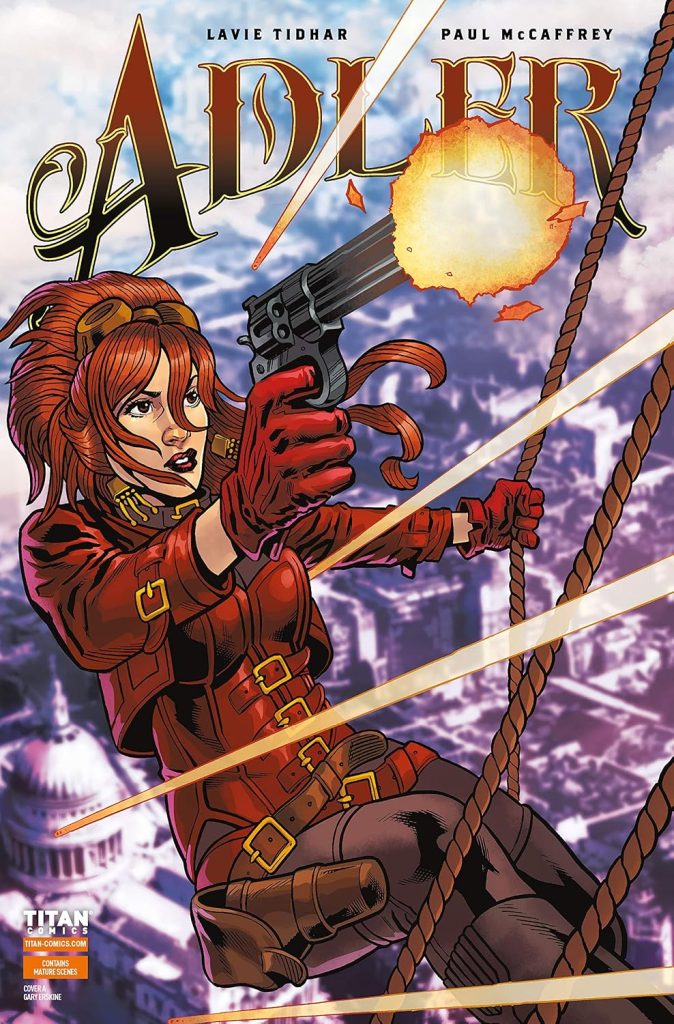
 Comic Book

📝 First Impressions
Some books catch my attention because of the author. Others because of the cover. And then there are books like Adler, where I only need to hear the premise before deciding that I absolutely have to know what on earth is going on.
Irene Adler.
Jane Eyre.
Lady Havisham.
Ayesha.
Carmilla.
Madame Curie.
All existing in the same alternative version of early twentieth-century London.
Seriously. How was I supposed to resist that?
The story begins in 1902, but this is definitely not the history we know. Jane Eyre has returned to London after being wounded during the Boer War. Lady Havisham is now a glamorous inventor. Queen Victoria is somehow still alive thanks to experimental medicine. Irene Adler has become an adventurer in her own right, while Ayesha — She-Who-Must-Be-Obeyed — is waging a brutal war against the British Empire.
And then Carmilla turns up as an assassin.
At some point you simply have to stop asking questions and enjoy yourself.
That was very much my experience with Adler.
On paper, this could have been an absolute mess. There are so many literary references, historical figures and genres being thrown together that it would have been incredibly easy for the comic to become nothing more than a long series of cameos.
Instead, Lavie Tidhar somehow makes the whole thing feel like it belongs together.
It is part Victorian literary mash-up, part alternate history, part steampunk adventure and part glorious pulp nonsense.
And I mean “nonsense” in the nicest possible way.
I had a ridiculous amount of fun with it.
💜 What I Loved
The concept is easily my favourite thing about Adler.
There are plenty of stories that borrow famous literary characters, but I loved the way this one treats Victorian and Gothic fiction almost as though it were one enormous shared universe.
Instead of preserving these characters exactly as they appeared in their original novels, Tidhar asks what else they might have become.
And that gives him a lot of room to play.
Irene Adler is the obvious centre of the story, and I particularly enjoyed seeing her completely removed from Sherlock Holmes’ shadow.
Her original appearance in Arthur Conan Doyle’s work is surprisingly small considering the enormous cultural life the character has had since, yet she became unforgettable precisely because she was one of the few people capable of outmanoeuvring Holmes.
Here, she does not exist simply because Sherlock Holmes once found her interesting.
This is her adventure.
She is clever, capable, confident and perfectly able to get herself involved in international conspiracies without waiting for a famous detective to arrive and tell everyone what to do.
I loved that.
Then there is Jane Eyre.
Jane has apparently been off fighting in the Boer War and returns wounded.
I remember thinking something along the lines of:
I’m sorry, Jane Eyre has been doing WHAT?
And that was probably the moment when Adler completely won me over.
The comic does not treat classic literature as something too sacred to touch. It takes familiar characters and gleefully sends them in directions their original creators could never have imagined.
Lady Havisham as an inventor is another perfect example.
The woman permanently associated with a decaying wedding feast in Great Expectations is now involved with experimental technology.
Why?
Because apparently Lavie Tidhar looked at Victorian literature and decided everyone needed a career change.
I approve.
Ayesha is also more interesting than I expected.
She is certainly positioned as the major threat, but her hatred of the British Empire is not presented as entirely arbitrary. There is colonial violence behind her desire for revenge, which means the story at least acknowledges that the Empire itself is hardly an uncomplicated force for good.
That gives the conflict a little more substance underneath all the explosions, assassins and secret weapons.
And then we have Carmilla.
Sheridan Le Fanu’s vampire.
As an assassin.
Of course.
By that point the comic could probably have introduced Frankenstein’s monster as somebody’s accountant and I would have accepted it without question.
Madame Curie becoming connected to the struggle over a dangerous scientific weapon adds another brilliant layer to the madness, while Queen Victoria’s continued survival thanks to experimental medicine immediately tells us that history itself has changed significantly in this universe.
I love those little alternate-history details.
They make the world feel larger than the immediate plot.
Paul McCaffrey’s artwork is also a major part of why everything works as well as it does.
This London is recognisably Victorian and Edwardian, but it has the energy of a pulp comic rather than a historical illustration. There is enough period atmosphere to anchor the story, while the action, technology and exaggerated personalities keep it visually lively.
And with this many characters appearing in such a short space, the artwork does a lot of work helping everyone remain distinctive.
Most of all, though, I simply loved how much fun Adler is willing to have with its idea.
It is clever without becoming painfully self-conscious about being clever.
That made a huge difference for me.
🤔 What Didn’t Quite Work for Me
My biggest issue with Adler is actually the result of liking the concept so much.
There isn’t enough of it.
The entire series consists of only five issues, collected into 128 pages, and there is an enormous amount happening in that relatively small space.
Characters appear quickly.
Ideas appear even faster.
Before I had properly settled into one aspect of the world, the comic was already throwing something else at me.
That keeps the story fast and entertaining, but it also means that some of the best ideas never get as much development as I would have liked.
I wanted more of Irene and Jane together.
More Lady Havisham.
Definitely more Carmilla.
More time exploring Ayesha’s motivations.
And honestly, more time simply wandering around this completely bizarre version of London and discovering what had happened to everyone else from nineteenth-century literature.
There are also moments when the sheer number of references becomes slightly overwhelming.
Most of them work because they are genuinely integrated into the story, but occasionally a character appears and you can almost feel the comic nudging you and saying, “Recognise this one?”
That is always a danger with literary mash-ups.
If you know the reference, it is fun.
If you don’t, the character may simply feel like somebody who arrived very suddenly and then disappeared again.
I also think the pacing could have benefited from slowing down occasionally.
The pulp-adventure speed is part of the charm, so I would never have wanted the story to become slow, but there are several ideas here that deserved more breathing space.
And that is ultimately what keeps Adler at four BookFairies for me rather than five.
I enjoyed it enormously.
But I could also see how much more it might have done with another five issues.
👥 Who Would Enjoy This Book?
Adler is an easy recommendation for readers who enjoy classic literature but don’t mind watching someone completely dismantle it and rebuild it into something new.
If the idea of Jane Eyre returning from the Boer War horrifies you on principle, you may want to stay far away from this one.
If your reaction is:
Jane Eyre went to war?! Tell me everything.
Then welcome.
You are probably exactly the audience.
Sherlock Holmes readers will obviously get something extra from seeing Irene Adler take centre stage, but you do not need to be an expert on Conan Doyle to follow the story.
The same applies to the other literary references.
Knowing Jane Eyre, Great Expectations, She and Carmilla makes many of the jokes and character choices more entertaining, but I don’t think you need to have read every original work before picking this up.
I would especially recommend it to readers who enjoy alternate history, steampunk, Gothic fiction, pulp adventures and literary mash-ups.
It should also appeal to anyone who likes stories built around strong female ensembles — particularly stories interested in taking women who originally occupied very different roles in nineteenth-century fiction and allowing them to become the centre of the action.
And if your favourite kind of crossover is the one that makes you repeatedly think, who on earth are they going to introduce next?, Adler is very much that kind of comic.
💭 Final Thoughts
I had a genuinely great time with Adler.
It is weird, energetic, occasionally completely ridiculous and absolutely committed to its own premise.
And that commitment is probably what made it work for me.
There is nothing timid about putting Irene Adler, Jane Eyre, Lady Havisham, Ayesha, Carmilla and Madame Curie into the same adventure.
The comic knows perfectly well how outrageous that sounds.
It just doesn’t care.
Neither did I.
I loved seeing Irene finally allowed to exist outside Sherlock Holmes’ story. I loved discovering what completely unexpected life Tidhar had invented for each familiar character. I loved the alternative-history details and the slightly mad science running underneath everything.
And I loved never being entirely sure who might appear next.
My frustration is simply that the series ends after five issues.
This feels like a world that could easily have supported several volumes. There are hundreds of characters Tidhar could have pulled out of Victorian and Gothic literature, and after seeing what he did with this group, I genuinely would have liked to see how far he could push the idea.
Instead, the collected edition contains the entire thing.
Five issues.
That’s it.
So Adler is not one of those comics I finished thinking it had gone on too long.
Quite the opposite.
I finished it wishing there were more.
For me, that makes it a very strong four out of five: clever, beautifully illustrated and ridiculously entertaining, even if the scale of the concept ultimately feels bigger than the space the series was given.
✨ The BookFairy Verdict
Adler
📖 Book Details
Title: Adler
Writer: Lavie Tidhar
Artist: Paul McCaffrey
Publisher: Titan Books Ltd
Format: Collected Comic Book Edition
Series: Adler
Series Status: Complete
Issues: 5
Genre: Comic Book / Alternate History / Steampunk / Adventure
Pages: 128
ISBN: 9781782760719
Language: English
Dimensions: 258 × 170 mm
📚 Reading Order
The Adler series is complete and consists of five issues:
#1 — Adler #1
#2 — Adler #2
#3 — Adler #3
#4 — Adler #4
#5 — Adler #5
The collected Titan edition contains all five issues, so the 128-page volume is the complete series.
🛒 Buy the Book
If Adler sounds like your kind of read, you can support BookFairy by purchasing the book through the links below. It won’t cost you anything extra, and using these links helps support the site while allowing me to continue creating honest, independent book reviews.
📚 Waterstones
📦 Amazon UK
📗 Adler: The Complete Collection — Paperback
📘 Adler: The Complete Collection — Kindle Edition
📱 Adler Vol. 1 — Kindle Edition
📱 Adler Vol. 2 — Kindle Edition
📱 Adler Vol. 3 — Kindle Edition
📱 Adler Vol. 4 — Kindle Edition
📱 Adler Vol. 5 — Kindle Edition