 Mystery
 Thriller


📝 First Impressions
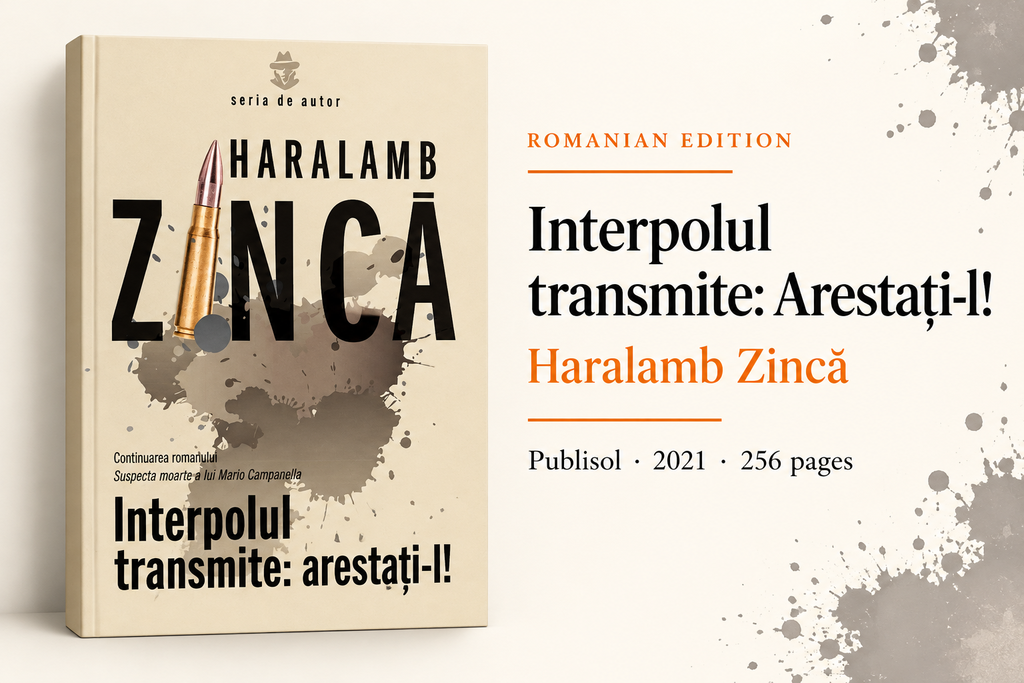
After enjoying Suspecta moarte a lui Mario Campanella, I was curious to see where Haralamb Zincă would take the story next. The first novel had offered an engaging detective investigation set against the uncertainty of Romania immediately after the December 1989 Revolution, and I had particularly appreciated the way the author incorporated that turbulent historical period into his fiction. Naturally, I approached Interpolul transmite: Arestați-l! with certain expectations. I wanted another interesting mystery, another opportunity to explore the complicated world Zincă had introduced, and, above all, a continuation that would justify returning to these characters and their circumstances. Although I ultimately enjoyed the book, I found that it did not quite reach the same level as its predecessor.
One of the things I appreciate about Haralamb Zincă is his ability to write detective fiction that feels connected to the society in which his stories take place. His novels are not simply about solving crimes; they also reflect political structures, institutional relationships, and the complicated ways in which people operate within systems of authority. This becomes particularly interesting when those systems are undergoing substantial changes, as they were in Romania following the collapse of communism. Having lived through that period myself, I find this historical background fascinating, even when the fictional investigation remains the central focus of the story. It gives Zincă’s crime fiction a distinctive Romanian identity, something I value when returning to authors whose work is closely connected to our country’s history.
As a continuation, Interpolul transmite: Arestați-l! inevitably invites comparison with the first book. That is one of the difficulties of reading consecutive novels: whether consciously or not, you carry your impressions of the earlier story into the next one. In my case, Suspecta moarte a lui Mario Campanella had established a fairly high standard, particularly in terms of atmosphere and the way its mystery developed. This second instalment remained an enjoyable reading experience, but I found the intrigue slightly less compelling. It was not a dramatic decline in quality, nor did I consider the novel disappointing. I simply felt that the first book had offered a stronger combination of suspense, investigation, and historical atmosphere.
💜 What I Loved
What I continued to appreciate was Haralamb Zincă’s approach to detective fiction. His stories belong to a tradition in which investigations are closely connected to questions of identity, authority, secrecy, and the complicated relationships between individuals and institutions. These are elements I generally enjoy in a crime novel, particularly when they are presented within a recognisable historical and political environment. Rather than relying entirely on dramatic confrontations or spectacular action, this kind of fiction invites the reader to pay attention to information, motives, and the circumstances surrounding the investigation. There is something satisfying about following a mystery in which understanding the people involved can be just as important as understanding the crime itself.
I also appreciated the opportunity to return to the world established in Suspecta moarte a lui Mario Campanella. One of the pleasures of reading a continuation is the familiarity that comes with it. The reader already understands something of the author’s fictional environment and can approach the new story with an established sense of its background. In this case, the connection with the previous novel was particularly welcome because I had enjoyed that book. I was interested in discovering how Zincă would develop his detective fiction further, and although the result was not quite as strong as I had hoped, I still found the experience worthwhile. There is a difference between a sequel that fails to satisfy and one that simply does not match the qualities of its predecessor, and I would place this novel firmly in the second category.
Another aspect I appreciate about Zincă’s writing is the connection between crime fiction and Romania’s political history. The years following the Revolution were marked by enormous changes, but those changes did not happen neatly or immediately. Institutions had to be reorganised, established relationships were challenged, and the transition from one political system to another created considerable uncertainty. This is the broader context associated with these novels, and it remains one of the most interesting aspects of reading them today. I cannot say that the historical atmosphere impressed me as strongly in this second book as it did in the first, but I still value the way Zincă’s fiction engages with a period that remains important to Romania’s recent history.
Most importantly, I enjoyed reading the novel. That may sound like a simple observation, but I think it matters. Sometimes a sequel receives a less enthusiastic response simply because the first instalment created stronger expectations, and it becomes easy to focus entirely on what the continuation failed to achieve. I do not want to do that here, because Interpolul transmite: Arestați-l! was still a pleasant reading experience. I was happy to return to Haralamb Zincă’s detective fiction, and I appreciated the familiar elements of mystery and investigation. The fact that I preferred the first book does not erase the enjoyment I found in the second.
🤔 What Didn’t Quite Work for Me
My main reservation concerns the intrigue, which I found slightly weaker than in Suspecta moarte a lui Mario Campanella. The first novel had managed to capture my attention particularly well, combining an interesting murder investigation with an atmosphere of political uncertainty that gave the story an additional dimension. In comparison, this continuation did not have quite the same impact on me. I still enjoyed following the mystery, but I was not as impressed by its development, and the overall reading experience felt somewhat less compelling. It was not a question of disliking the story or finding the investigation uninteresting; rather, the earlier novel had established expectations that this second instalment did not entirely fulfil.
I think comparisons between books in a series are sometimes unavoidable, especially when the stories are closely connected. Once an author has demonstrated how effectively certain elements can work together, it is natural to hope for something equally satisfying in the continuation. However, I do not believe every sequel needs to be more complicated, more dramatic, or more ambitious than the book that came before it. A continuation can succeed perfectly well by offering another enjoyable story within an established fictional world. My difficulty here was simply that the intrigue felt a little less effective, making the novel enjoyable without leaving quite the same impression as its predecessor.
That distinction is important because I would not describe Interpolul transmite: Arestați-l! as a bad detective novel. Nor do I think the difference between the two books is so enormous that readers who enjoyed the first should automatically avoid the second. It is a more modest disappointment: the kind you experience when you finish a perfectly readable novel and realise that, although you had a good time with it, you preferred the previous instalment. I did not encounter anything that made me regret continuing the story. I simply found that this second book lacked some of the strength that had made Suspecta moarte a lui Mario Campanella particularly enjoyable for me.
👥 Who Would Enjoy This Book?
I would recommend Interpolul transmite: Arestați-l! primarily to readers who have already enjoyed Suspecta moarte a lui Mario Campanella and would like to continue exploring Haralamb Zincă’s detective fiction. Because the two novels are connected, I think it makes sense to approach them in their intended order rather than beginning with the continuation. Reading the first book provides the necessary introduction to this fictional world and allows the second to be appreciated within its broader context. Even if, like me, you ultimately prefer the earlier novel, there is still something enjoyable about returning to an author’s storytelling after a positive first experience.
The novel may also appeal to readers interested in Romanian crime and espionage fiction, particularly those who enjoy mysteries involving institutions, authority, and political circumstances. Haralamb Zincă is an important name in the history of Romanian genre literature, and his work offers an interesting perspective on how detective stories can reflect the society in which they were written. Readers who appreciate traditional investigations and the gradual development of a mystery may find his approach appealing, especially if they are interested in discovering Romanian authors beyond the more internationally familiar names.
I would also suggest this book to readers who do not expect every instalment of a series to surpass the previous one. Sometimes we become so focused on finding the next extraordinary book that we forget there is considerable pleasure in a story that is simply enjoyable. Interpolul transmite: Arestați-l! may not have impressed me as much as its predecessor, but I still consider it a worthwhile continuation for someone interested in Zincă’s fiction. If you enjoyed the first novel and want to spend more time with this particular kind of detective story, I think there is enough here to justify giving the second book a chance.
💭 Final Thoughts
My experience with Interpolul transmite: Arestați-l! was ultimately a positive one, even though I enjoyed it less than Suspecta moarte a lui Mario Campanella. The first novel had impressed me with its combination of an engaging investigation and a particularly convincing portrayal of Romania immediately after the Revolution. That historical atmosphere had created a strong personal connection for me, partly because I remember something of those years from my own childhood. Approaching the continuation, I naturally hoped for a similarly satisfying experience, and while I was pleased to return to Haralamb Zincă’s detective fiction, I found the intrigue slightly less compelling. It was an enjoyable book, but it did not leave quite the same impression as the previous one.
I do not think this makes the novel unsuccessful. There are plenty of books that I enjoy without considering them especially remarkable, and I have never believed that every reading experience needs to be extraordinary to be worthwhile. Sometimes I simply want an interesting mystery, an opportunity to return to a familiar author’s work, and a story that holds my attention for a few hours. Zincă provided that experience here, even if the result was not as memorable as I had hoped. I appreciated the continuation and did not regret reading it, but I would still recommend the first book more enthusiastically.
What I find particularly interesting about reading these novels together is the opportunity to explore a Romanian author’s detective fiction against the background of a period of profound political change. Even when the central mystery is not equally strong in both books, that broader context gives the reading experience an additional dimension. I enjoy discovering or revisiting Romanian writers whose fiction reflects important moments in our history, and Haralamb Zincă certainly belongs among the authors worth exploring. His work reminds me that crime fiction can offer more than an investigation: it can also preserve something of the anxieties, attitudes, and uncertainties of the society in which it was created.
In the end, Interpolul transmite: Arestați-l! was a pleasant continuation, but not one that managed to surpass its predecessor. I liked it, and I am glad I read both novels, yet Suspecta moarte a lui Mario Campanella remains my favourite of the two. Its intrigue was stronger, and the overall experience was more satisfying. That does not mean the second book has nothing to offer; it simply means that, for me, the first set a standard that the continuation did not quite reach. A decent Romanian detective novel, enjoyable in its own right, and a worthwhile addition to my exploration of Haralamb Zincă’s work.
✨ The BookFairy Verdict
Interpolul transmite: Arestați-l!
📖 Book Details
- Title: Interpolul transmite: Arestați-l!
- Romanian Title: Interpolul transmite: Arestați-l!
- Author: Haralamb Zincă
- Series: Mario Campanella — Book 2
- Genre: Mystery, Thriller, Crime Fiction
- Publisher (EN): No English edition confirmed
- Publisher (RO): Publisol
- First Published: 1993
- Published (RO): 2021 (Publisol edition)
- Pages (EN): Not applicable
- Pages (RO): 256
- Format Experienced: Paperback
- Edition Owned: Romanian edition, Publisol, 2021
📚 Reading Order
Mario Campanella — Two-Book Sequence
- Suspecta moarte a lui Mario Campanella (1991) — Book 1
- Interpolul transmite: Arestați-l! (1993) — Book 2