 Mystery
 Thriller

📝 First Impressions
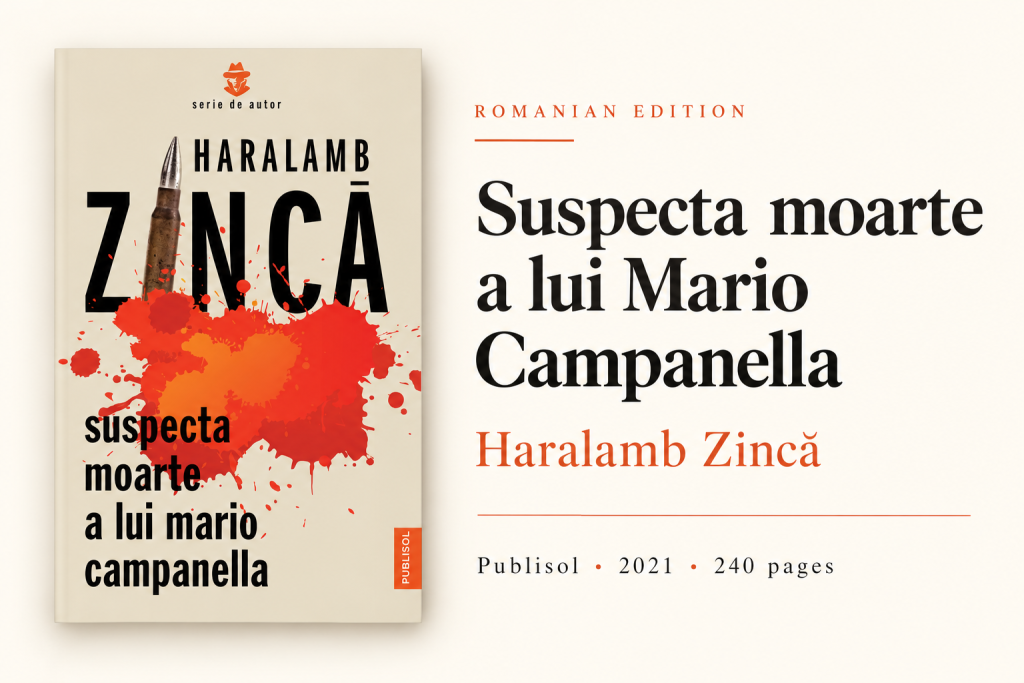
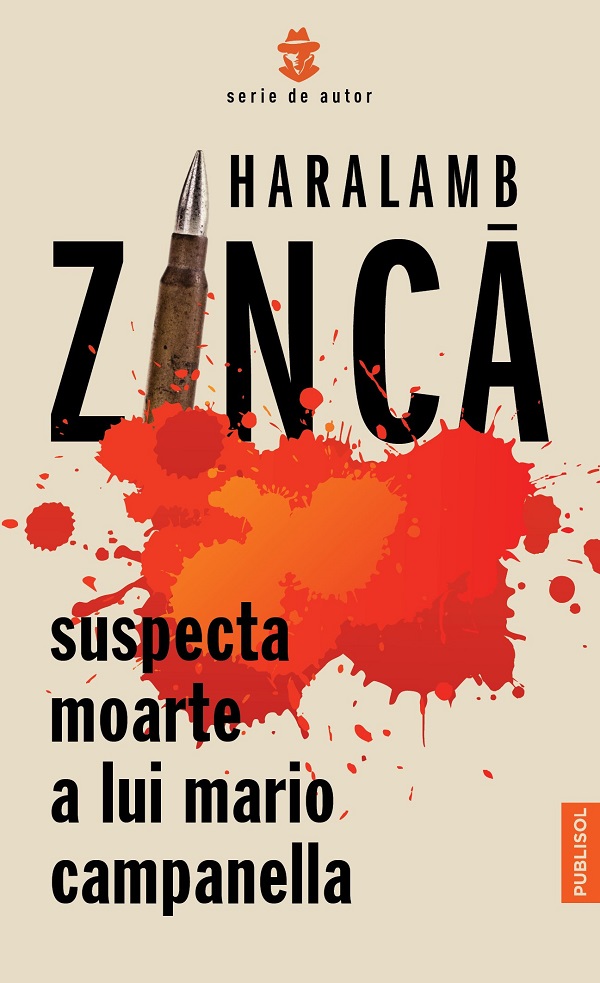
There is something particularly interesting about reading a novel set during a period of history you have actually lived through. Even when you were only a child at the time, certain memories remain with you: the general atmosphere, the uncertainty surrounding everyday life, the way adults spoke about political events, and the strange feeling that everything was changing while nobody really knew what would happen next. That was one of the things that immediately drew me into Suspecta moarte a lui Mario Campanella by Haralamb Zincă, a detective novel set during the first months following the Romanian Revolution of December 1989. I was ten years old when the Revolution happened, and although my understanding of those events was naturally limited by my age, I still remember the atmosphere of those years. Reading a crime story set against that background brought back something of the confusion and uncertainty that accompanied Romania’s transition away from communism.
The novel follows Lieutenant Major Mircea Dabu, who is assigned what initially appears to be a relatively straightforward murder investigation. A man has been killed by his drinking companions, and the suspects are quickly identified, suggesting that the case might be resolved without too many complications. However, the situation changes dramatically when one of the suspects claims to be working for a colonel connected to the newly reorganised security services and insists that he has a secret mission to carry out in Paris. The murder victim is allegedly a terrorist, the supposed colonel cannot be found, one of the suspects dies from nicotine poisoning, and the dead man turns out to have more than one identity. What begins as an ordinary criminal investigation gradually develops into a mystery involving questionable loyalties, suspicious circumstances, and the possibility of connections to intelligence operations.
I enjoy detective fiction that begins with a seemingly simple crime and slowly reveals a much more complicated situation, so the premise immediately appealed to me. Zincă introduces enough uncertainty to make the investigation interesting without losing sight of the central mystery, and Mircea Dabu is a character I enjoyed following as he attempts to make sense of the increasingly contradictory information. Yet what made the novel stand out for me was the historical setting, which feels inseparable from the investigation itself. Romania is going through an enormous political transformation, its institutions are being reorganised, and the boundaries between the old regime and the emerging political order remain unclear. In such circumstances, questions about identity, authority, and trust become particularly relevant, giving the story an atmosphere that I found both convincing and personally familiar.
💜 What I Loved
The aspect I appreciated most was Haralamb Zincă’s portrayal of Romania immediately after the Revolution, particularly the confusion surrounding institutions that had previously operated within a rigid communist system. The old regime had collapsed, but the people, structures, and relationships that supported it could not simply disappear overnight, and the country was left trying to establish what its new political reality would look like. The police were undergoing changes, the former Securitate was being reorganised, and there was considerable uncertainty about who retained influence and who could legitimately claim authority. Zincă uses this unstable environment to strengthen the mystery, creating a situation in which even apparently straightforward statements deserve to be questioned. A suspect claiming to work for a security official might be telling the truth, inventing a story to protect himself, or exploiting the general confusion for reasons that are not immediately apparent.
I particularly enjoyed the constant atmosphere of suspicion, because it felt appropriate for the historical moment rather than artificially introduced to make the plot more dramatic. Throughout the investigation, there is a sense that important information is being withheld and that the truth is considerably more complicated than the official explanations suggest. The uncertainty surrounding the suspects, the conflicting claims about secret missions, and the questions raised by the victim’s multiple identities all contribute to an engaging mystery. What makes these elements especially effective is that the political background provides a believable reason for so much confusion. In a society where institutions are changing and established hierarchies are being challenged, it becomes difficult to determine who is genuinely acting on official orders and who is merely pretending to have powerful connections.
Another element I enjoyed was Mircea Dabu and the investigation he is trying to conduct. He begins with what appears to be an ordinary murder case, only to discover that the circumstances surrounding the crime are far less straightforward than anyone initially expected. I liked following the development of the investigation, particularly as new information complicated what had previously seemed relatively simple. Zincă understands how to maintain a reader’s curiosity, allowing the mystery to expand while keeping the original crime at its centre. I appreciate detective novels that encourage me to consider different possibilities and question the information presented, and this one provided exactly that kind of reading experience.
However, the most personal aspect of the novel was the familiarity of its atmosphere. Having lived through the Revolution and the years that followed, I recognised something of the Romania Zincă was describing, even though I experienced those events from a child’s perspective. I remember the uncertainty, the rumours, the discussions about political changes, and the feeling that the country was entering an entirely new period without anyone being completely certain what that would mean. The novel brought back that broader atmosphere in a way I found remarkably convincing. For readers unfamiliar with Romanian history, these details might simply make the setting more interesting, but for me they created an additional connection to the story. I was not only following a fictional investigation; I was also revisiting a period that forms part of my own memories, and I think that made the experience considerably more engaging.
🤔 What Didn’t Quite Work for Me
I cannot honestly identify a particular aspect of Suspecta moarte a lui Mario Campanella that disappointed me. The investigation was interesting, the protagonist worked well for me, and the historical atmosphere was convincing enough to become one of the most memorable elements of the entire reading experience. I enjoyed the development of the mystery and appreciated how naturally Zincă incorporated the political uncertainty of post-Revolution Romania into his story. At the same time, I think there is an important distinction between enjoying a novel and considering it genuinely exceptional. This was a very good detective story, but it did not offer that extraordinary idea, unexpected originality, or particularly brilliant narrative element that would have made it stand out as something truly remarkable within the genre.
That does not mean I believe the book needed a more complicated plot or a succession of increasingly dramatic twists. I do not think every detective novel needs to reinvent crime fiction or astonish its readers at every opportunity, and there is considerable pleasure in a well-told mystery that achieves exactly what it sets out to do. Zincă delivers an engaging investigation, an interesting central character, and a historical setting that gives the story a distinctive personality. Those are substantial qualities, and I appreciated them throughout the novel. It simply remained, for me, a thoroughly enjoyable crime story rather than an unforgettable literary experience, and I see nothing wrong with making that distinction.
👥 Who Would Enjoy This Book?
I would recommend Suspecta moarte a lui Mario Campanella to readers who appreciate traditional detective fiction, particularly stories in which an apparently simple crime gradually reveals a much more complicated situation. If you enjoy investigations involving suspicious identities, contradictory information, possible intelligence connections, and characters whose motives are not immediately clear, Zincă’s novel offers an interesting mystery to follow. It should also appeal to readers who prefer crime fiction grounded in a recognisable political or social environment rather than stories that exist almost entirely within the investigation itself. The historical circumstances are important to the plot, but they do not replace the central detective story, which remains engaging throughout.
I think the novel might be particularly interesting for Romanian readers who remember the years immediately following the Revolution, as well as younger readers curious about that period of our history. There is something fascinating about seeing a familiar historical environment reflected through fiction, especially when the author captures the uncertainty and contradictions of the time so convincingly. For international readers, the book offers an opportunity to encounter a turbulent chapter of Romanian history through the accessible structure of a crime investigation. It is also a worthwhile choice for anyone interested in discovering Romanian detective and espionage literature and the ways in which established authors adapted their work to the enormous political changes that followed the collapse of communism.
💭 Final Thoughts
What stayed with me most after finishing Suspecta moarte a lui Mario Campanella was not necessarily the murder investigation itself, although I enjoyed it, but the atmosphere of Romania immediately after the Revolution. Haralamb Zincă succeeds in recreating a society caught between two political systems, where the old structures have officially lost their authority but their influence and connections have not necessarily disappeared. The uncertainty surrounding the police, the former security services, and the people claiming to act on behalf of powerful institutions creates a convincing environment for a mystery built around questionable identities and conflicting information. I liked Mircea Dabu, appreciated the way the investigation developed, and found the combination of detective fiction and political instability particularly effective.
Perhaps my appreciation of the historical setting is partly influenced by my own memories, because I lived through those years and still remember something of their atmosphere. I was a child when the Revolution took place, but that does not mean the events surrounding it left no impression on me. Reading Zincă’s novel reminded me of how uncertain that period felt and how difficult it could be to distinguish genuine change from the survival of familiar structures under different names. That recognition gave the story an additional dimension, allowing me to connect with its setting in a way that went beyond the fictional events themselves. It is one of the reasons I found the book memorable, even though I would not describe its central mystery as particularly groundbreaking.
Ultimately, I consider Suspecta moarte a lui Mario Campanella a very good Romanian detective novel that combines an engaging investigation with a remarkably convincing historical atmosphere. It is neither a masterpiece nor a book that completely transforms the genre, but it does not need to be either of those things to deserve appreciation. I enjoyed the story, liked its protagonist, and found its portrayal of post-Revolution Romania particularly compelling. Sometimes a good crime novel is simply a good crime novel, and that is more than enough. In this case, the additional pleasure of recognising a period from my own childhood made the experience all the more worthwhile.
✨ The BookFairy Verdict
Suspecta moarte a lui Mario Campanella
📖 Book Details
- Title: Suspecta moarte a lui Mario Campanella
- Romanian Title: Suspecta moarte a lui Mario Campanella
- Author: Haralamb Zincă
- Series: Mario Campanella — Book 1
- Genre: Mystery, Thriller, Crime Fiction
- Publisher (EN): No English edition available
- Publisher (RO): Publisol
- First Published: 1991
- Published (RO): 2021 (Publisol edition)
- Pages (EN): Not applicable
- Pages (RO): 240
- Format Experienced: Paperback
- Edition Owned: Romanian edition, Publisol, 2021
📚 Reading Order
- Suspecta moarte a lui Mario Campanella (1991) — Book 1
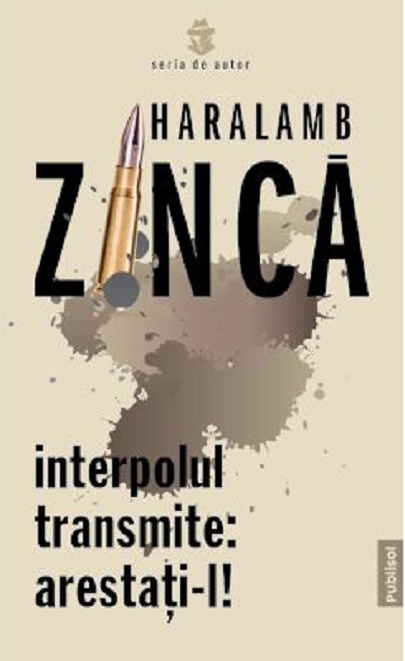
- Interpolul transmite: Arestați-l! — Book 2