A refreshing fantasy adventure that challenges traditional ideas of good and evil, giving orcs their own personalities, emotions, loyalties and destinies.
 Fantasy
 Adventure
 Magic
📝 First Impressions
Fantasy has a long tradition of presenting certain creatures as inherently evil. Orcs, in particular, have spent countless stories serving as the terrifying enemies that heroes must defeat. They appear on battlefields, threaten kingdoms, destroy villages and generally make life miserable for everyone unfortunate enough to cross their path. We rarely stop to wonder what their lives might look like when they are not busy being someone else’s monsters.
That is precisely what makes Bodyguard of Lightning by Stan Nicholls such an entertaining and refreshing experience. Instead of telling another familiar story about brave warriors fighting hordes of evil orcs, Nicholls turns the entire perspective around and allows the orcs themselves to take centre stage. They are no longer merely obstacles standing between traditional fantasy heroes and their destinies. This time, they have their own story to tell.
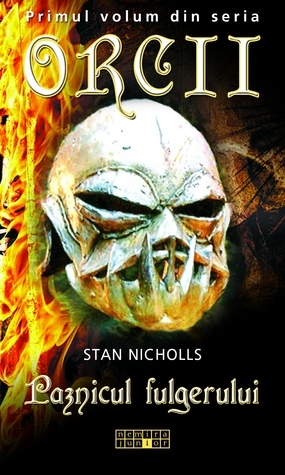
I read the Romanian edition, Paznicul fulgerului, published by Nemira, in 2016, and I remember thoroughly enjoying the experience. The book offered exactly the kind of fantasy adventure I appreciate: plenty of action, an interesting fictional world and characters who gradually become far more complicated than their initial appearances might suggest. Most importantly, I loved the decision to challenge the familiar assumption that belonging to a particular race automatically determines whether someone is good or evil.
What impressed me was that Nicholls did not simply replace one stereotype with another. He did not decide that orcs should suddenly become noble, misunderstood creatures incapable of cruelty. Instead, he gave them different personalities, motivations and emotions, allowing them to be individuals rather than members of a uniformly villainous race. That approach immediately made the story more interesting to me, because it opened the door to relationships, disagreements, loyalties and moral choices that traditional fantasy often reserves for its human characters.
💜 What I Loved
The greatest pleasure I found in Bodyguard of Lightning was discovering a fantasy world in which orcs were finally allowed to be more than the villains in somebody else’s adventure. I have always found it interesting how easily certain fantasy races become associated with particular moral qualities. Elves are frequently portrayed as beautiful and wise, while orcs tend to be brutal, destructive and almost universally evil. Individual characters might occasionally challenge those expectations, but the general division often remains remarkably simple. Stan Nicholls takes that familiar convention and asks us to look at it from an entirely different perspective.
What I particularly appreciated was that his orcs are not all alike. They have individual personalities, feelings, loyalties and conflicts. Some are more sympathetic than others, some behave honourably, and some make questionable or outright cruel decisions. They are capable of friendship, anger, affection, resentment and courage, and their relationships are shaped by the same complicated emotions that influence people in the real world. In other words, they are not automatically good or bad simply because they are orcs. They are individuals, and their actions matter far more than the race to which they belong.
This was, for me, the most refreshing aspect of the entire novel. Nicholls does not ask readers to forget that orcs can be violent or brutal, nor does he attempt to disguise the harshness of their existence. They remain warriors, accustomed to danger and conflict, and the story certainly does not lack aggression or bloodshed. However, violence is no longer their only defining characteristic. Once we begin to understand their motivations and the relationships within their group, they become far more interesting than the anonymous enemies we encounter in so many other fantasy adventures.
I also enjoyed following the orc warband known as the Wolverines, led by Stryke. Their adventures bring together battles, dangerous encounters and a quest involving powerful artefacts, all set against the tensions of a world in which different races struggle for survival and control. The premise offers plenty of opportunities for action, but the relationships within the group are just as important to the experience. These warriors do not always agree with one another, and their differences contribute to the sense that we are following a collection of distinct personalities rather than an interchangeable group of fighters.
Another element I appreciated was the way the story challenges the usual distinction between heroes and monsters. When a fantasy novel is told primarily from a human perspective, it is easy to accept that the creatures opposing humanity must represent evil. But when we begin to see events through the eyes of those creatures, the situation becomes much less straightforward. We discover that they also have reasons for fighting, things they want to protect and circumstances that influence their decisions. Their enemies may consider them monsters, but that does not mean they see themselves in the same way.
I find this kind of reversal particularly satisfying because it encourages readers to question assumptions they might otherwise accept without thinking. It is surprisingly easy to become comfortable with the familiar conventions of a genre, especially when we have encountered them repeatedly over many years. Sometimes, all it takes is a change in perspective to make an established fantasy world feel exciting again. That is exactly what happened for me with this book.
And, of course, I loved the adventure itself. Bodyguard of Lightning is not simply a philosophical exercise about prejudice and moral complexity disguised as fantasy. It is an entertaining story filled with danger, action and conflict, and I thoroughly enjoyed that aspect of it. The battles and challenges provide the excitement I expect from an adventurous fantasy novel, while the unusual protagonists give those familiar elements a distinctive flavour.
What makes the combination work so well is that the action and the characters support one another. I was interested in what would happen next, but I was also interested in the orcs themselves. The more I saw of their personalities and relationships, the more enjoyable their adventures became. For me, that is an important distinction. Spectacular battles can be entertaining, but they become considerably more engaging when I care about the people — or, in this case, the orcs — involved.
Ultimately, I appreciated that Nicholls allowed his protagonists to possess the same complexity traditionally granted to human fantasy characters. They could be brave without being perfect, loyal without always agreeing and sympathetic without being entirely innocent. It gave the story a welcome sense of individuality and made the orcs far more memorable than they would have been if the author had simply turned them into conventional heroes with different physical appearances.
🤔 What Didn’t Quite Work for Me
Looking back at my reading experience, I remember Bodyguard of Lightning as a thoroughly enjoyable fantasy adventure, although not quite one of those rare books that left me completely overwhelmed. I appreciated its unusual perspective, entertaining action and the individuality given to its orc characters, but my overall impression was that of a very good, satisfying read rather than an absolute favourite.
The novel embraces many familiar elements of adventure fantasy, including dangerous missions, battles and the pursuit of powerful objects. Those conventions are not inherently a weakness, particularly when they are handled with enthusiasm and energy, but the basic structure of the adventure is more traditional than its choice of protagonists might initially suggest. What made the book distinctive for me was less the nature of the quest itself and more the fact that I was experiencing it through characters who would normally have been portrayed as its enemies.
I should also acknowledge that I read the novel in 2016, and after so many years I no longer remember every development or minor character in sufficient detail to offer a scene-by-scene criticism. I would rather be honest about that than attribute specific weaknesses to a book I remember enjoying so much. My lasting impression is overwhelmingly positive, even if the reading experience did not quite reach the level of the exceptional novels I reserve my greatest enthusiasm for.
None of this significantly diminished my enjoyment. I had a wonderful time discovering the world Nicholls created and following the adventures of his unusual protagonists. More importantly, the central idea remained interesting enough that I still remember exactly why the book appealed to me.
👥 Who Would Enjoy This Book?
I would recommend Bodyguard of Lightning to fantasy readers who enjoy adventurous stories filled with battles, dangerous quests and characters whose loyalties are tested by difficult circumstances. There is plenty of action to keep the story moving, and the world provides an entertaining setting for a group of protagonists who are rather different from the usual noble knights and heroic adventurers.
The book should particularly appeal to readers who enjoy seeing familiar fantasy conventions challenged. If you have ever wondered what an adventure might look like from the perspective of the creatures traditionally presented as its villains, Stan Nicholls offers a fascinating answer. His orcs are not simply humans wearing monstrous faces, but neither are they the mindless embodiments of evil we so often encounter elsewhere. Their differences, emotions and relationships make them engaging characters in their own right.
I also think the novel would appeal to readers interested in morally complicated characters. Not every orc behaves admirably, and not every conflict can be reduced to an obvious struggle between good and evil. That ambiguity gives the story an additional layer of interest without preventing it from remaining an accessible and entertaining fantasy adventure.
Readers who appreciate military groups, strong bonds between companions and the complicated dynamics of people forced to face danger together may also find plenty to enjoy. The Wolverines provide an opportunity to explore loyalty and disagreement within a group whose members must depend on one another, even when their personalities and opinions clash.
Finally, I would recommend it to anyone who enjoys traditional fantasy but occasionally wishes that authors would approach familiar creatures from a less predictable angle. You do not necessarily need a completely revolutionary plot to create something refreshing. Sometimes, allowing the supposed monsters to tell their side of the story is enough to make a familiar genre feel wonderfully different.
💭 Final Thoughts
When I think about Bodyguard of Lightning, the first thing that comes to mind is not a particular battle or dramatic confrontation, but the pleasure of encountering orcs who were finally treated as individuals. That was what made the novel memorable for me when I read it in 2016, and it remains the aspect I appreciate most when looking back on the experience.
I have always enjoyed fantasy worlds populated by different races, creatures and cultures, but I find them far more interesting when those differences do not automatically determine a character’s morality. Real people are complicated, and I see no reason why fictional orcs, elves, dwarves or other intelligent beings should be denied the same complexity. Some individuals are kind, others are cruel, and many are a mixture of admirable qualities and serious flaws. Giving fantasy characters that individuality makes their worlds feel richer and their conflicts more meaningful.
Stan Nicholls understands the appeal of approaching a familiar story from the other side. By allowing the orcs to become the protagonists, he encourages readers to reconsider creatures they might previously have dismissed without a second thought. They are still warriors, and the story does not pretend otherwise, but they are also capable of loyalty, emotion, disagreement and personal choices. They have their own motivations and destinies, rather than existing solely to serve the adventures of someone else.
I also remember how much fun I had reading the book. The action, the battles and the dangerous quest provided the excitement I wanted from an adventurous fantasy novel, while the characters gave the experience its particular charm. It was an enjoyable combination of familiar genre pleasures and a perspective that made those elements feel fresh.
For me, Bodyguard of Lightning is a very entertaining beginning to the Orcs: First Blood trilogy and an excellent reminder that fantasy becomes more interesting when its characters are allowed to escape the roles traditionally assigned to them. I loved discovering a world in which orcs could be good, bad, brave, selfish, loyal, cruel or compassionate, just like anyone else. They were no longer simply the monsters waiting at the end of somebody else’s sword. They finally had a story of their own, and I thoroughly enjoyed reading it.
✨ The BookFairy Verdict
Bodyguard of Lightning
📖 Book Details
- Original Title: Bodyguard of Lightning
- Romanian Title: Paznicul fulgerului
- Author: Stan Nicholls
- Original Publication: 1999
- Country: United Kingdom 🇬🇧
- Original Language: English
- Genre: Fantasy, Adventure, Magic
- Series: Orcs: First Blood (Orcii)
- Series Order: Book 1 of 3
- Original Publisher: Victor Gollancz
- Romanian Publisher: Nemira
- Romanian Collection: Nemira Junior
- Romanian Publication Date: 5 February 2009
- Romanian Translator: Antuza Genescu
- Romanian Format: Paperback
- Romanian Pages: 432
- Romanian ISBN: 9789731433196
- Format Experienced: Romanian paperback
- Romanian Edition Availability: Out of print
📚 Reading Order — Orcs: First Blood
| # | Original Title | Romanian Title | Romanian Edition |
|---|---|---|---|
| 1 | Bodyguard of Lightning (1999) | Paznicul fulgerului | Nemira, 2009 |
| 2 | Legion of Thunder (1999) | Legiunea tunetului | Nemira, 2010 |
| 3 | Warriors of the Tempest (2000) | Războinicii furtunii | Nemira, 2011 |
All three volumes were translated into Romanian by Antuza Genescu and published by Nemira. All three editions are currently out of print.
The third Romanian volume also includes the accompanying short story The Taking.
The trilogy forms the original Orcs: First Blood storyline. Stan Nicholls subsequently expanded the universe with Orcs: Bad Blood.
🇷🇴 Romanian Edition
Title: Paznicul fulgerului
Author: Stan Nicholls
Translator: Antuza Genescu
Publisher: Nemira
Collection: Nemira Junior
Publication Year: 2009
Language: Romanian
Format: Paperback
Pages: 432
ISBN: 9789731433196
Availability: Out of print
🛒 Buy the Book
If Bodyguard of Lightning sounds like your kind of read, you can support BookFairy by purchasing the Orcs omnibus edition through the affiliate links below. It won’t cost you anything extra, and using these links helps support the site while allowing me to continue creating honest, independent book reviews.
The omnibus includes all three novels in the original trilogy: Bodyguard of Lightning, Legion of Thunder and Warriors of the Tempest.
📚 Waterstones
📦 Amazon UK
📱 Kobo
– Ebook