
Author Guide | BookFairy
📖 About Michael Crichton
Michael Crichton was an American novelist, screenwriter, film director and physician best known for creating Jurassic Park, one of the most influential science-fiction thrillers of the twentieth century. His novels combined scientific research, technological speculation and suspense, establishing him as one of the defining voices of the modern techno-thriller.
Born John Michael Crichton on 23 October 1942 in Chicago, Illinois, he grew up with an interest in writing and the sciences. He studied anthropology at Harvard College before attending Harvard Medical School, graduating in 1969.
His medical education became an important influence on his writing. Unlike many science-fiction authors who concentrated primarily on distant futures or imaginary civilisations, Crichton frequently explored scientific developments that appeared possible within the contemporary world.
He began publishing fiction while studying medicine, initially using pseudonyms such as John Lange and Jeffery Hudson. These early novels explored crime, espionage and suspense, allowing him to develop the fast-paced storytelling that would later characterise his most successful books.
His breakthrough came with The Andromeda Strain (1969), a novel about scientists investigating a deadly extraterrestrial microorganism. Its combination of technical explanations, documentary-style presentation and mounting tension established the distinctive approach that would become associated with his name.
Throughout his career, Crichton explored subjects ranging from genetic engineering and artificial intelligence to medicine, aviation, archaeology, evolutionary biology and corporate power.
His stories often begin with an extraordinary scientific discovery or technological achievement. However, the excitement surrounding these developments gradually gives way to questions about responsibility, ethics and the limits of human control.
Crichton was particularly interested in the dangers of overconfidence. His characters frequently believe that advanced technology, careful planning and scientific expertise will allow them to manage complicated situations, only to discover that reality is far less predictable.
His creative achievements extended beyond literature. In 1973, he wrote and directed Westworld, a science-fiction film exploring the dangers of a futuristic amusement park populated by lifelike robots.
He also created the medical television drama ER, which premiered in 1994 and became one of the most successful television series of its era.
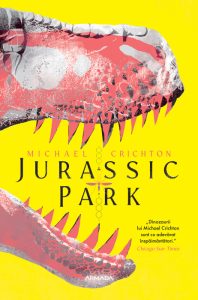
In 1990, Crichton published Jurassic Park, the novel that would become his most recognisable literary achievement. Its premise, involving the genetic recreation of dinosaurs for a commercial theme park, captured the imagination of readers around the world.
Steven Spielberg’s 1993 film adaptation transformed the story into an international cinematic phenomenon, introducing Crichton’s fictional world to an even larger audience.
Crichton died on 4 November 2008, but his work continued to reach readers through adaptations, new editions and posthumous publications.
Today, his novels remain influential examples of science-based suspense, exploring the complicated relationship between technological progress, human ambition and the unpredictable natural world.
On BookFairy, you can explore Michael Crichton’s major works, discover his recurring themes and read my review of Jurassic Park.
📚 Michael Crichton’s Books and Literary Worlds
Michael Crichton’s bibliography spans science fiction, medical thrillers, historical adventures, crime fiction and nonfiction. Although most of his novels are standalone works, several share recurring themes involving scientific experimentation, technological development and the unintended consequences of human decisions.
🦖 Jurassic Park
Jurassic Park (1990) is Crichton’s most famous novel and the beginning of his best-known fictional series.
The story imagines a remote island where scientists have used genetic engineering to recreate dinosaurs and establish an extraordinary theme park.
What initially appears to be a remarkable scientific achievement gradually becomes a terrifying demonstration of the dangers of attempting to control complex biological systems.
The novel explores genetic engineering, chaos theory, corporate ambition and the ethical responsibilities of scientific discovery.
Its sequel, The Lost World (1995), returns to the world of genetically recreated dinosaurs, expanding the story’s interest in evolution, animal behaviour and ecological relationships.
Together, the two novels form the original Jurassic Park series and remain among Crichton’s most recognisable works.
🦠 Scientific and Medical Thrillers
Crichton’s medical background strongly influenced novels such as The Andromeda Strain (1969) and The Terminal Man (1972).
In The Andromeda Strain, a team of scientists investigates a mysterious microorganism brought to Earth by a returning space probe.
The story combines laboratory procedures, medical research and the growing possibility of a biological catastrophe.
The Terminal Man explores experimental neurological treatment and the consequences of attempting to alter human behaviour through medical technology.
These novels demonstrate Crichton’s ability to transform complicated scientific concepts into suspenseful stories while raising questions about the responsibilities of researchers and medical institutions.
🌊 Science Fiction and Technological Suspense
Several of Crichton’s novels explore extraordinary discoveries and technological developments that challenge conventional understanding.
Sphere (1987) follows a group of specialists investigating a mysterious object discovered deep beneath the Pacific Ocean. The novel combines underwater exploration with psychological suspense and questions about human consciousness.
Prey (2002) examines nanotechnology, artificial intelligence and the unpredictable behaviour of autonomous systems.
Next (2006) returns to genetic engineering and biotechnology, exploring the legal and ethical consequences of scientific developments involving human and animal genetic material.
These stories share a fascination with the possibilities of scientific progress, alongside a persistent concern about humanity’s ability to anticipate its consequences.
🦍 Adventure and Historical Fiction
Crichton also wrote novels combining scientific research with adventure, exploration and historical settings.
Congo (1980) follows an expedition into the African rainforest, combining primatology, technological research and the search for a legendary lost city.
Timeline (1999) brings together medieval history, archaeology and speculative physics, placing modern researchers in a dangerous historical environment.
The Great Train Robbery (1975) reconstructs an elaborate criminal operation in Victorian England, while Eaters of the Dead (1976) draws on historical accounts and elements of the Beowulf legend.
These novels reveal Crichton’s versatility, demonstrating his ability to build suspense around subjects extending well beyond contemporary scientific laboratories.
✈️ Corporate and Contemporary Thrillers
Crichton’s interest in complicated systems also extended to corporations, industries and modern institutions.
Airframe (1996) examines aviation safety, technical investigations and the influence of corporate and media pressure.
Disclosure (1994) explores workplace power, sexual harassment allegations and corporate politics, while Rising Sun (1992) combines crime fiction with corporate intrigue.
These novels demonstrate how Crichton applied the structure of the techno-thriller to contemporary social and institutional conflicts.
His bibliography also includes early crime novels published under the name John Lange, nonfiction works and several books released after his death.
For a complete publication chronology, pseudonymous works, posthumous titles and Romanian editions, see the separate Michael Crichton bibliography.
✨ What Makes Michael Crichton’s Stories Special?
One of Michael Crichton’s most distinctive qualities was his ability to make complicated scientific ideas accessible through suspenseful storytelling.
His novels often begin with a remarkable discovery or technological innovation that appears to offer extraordinary possibilities.
However, these developments rarely remain as predictable or controllable as their creators expect.
In Jurassic Park, genetic engineering makes it possible to recreate prehistoric animals, but the people responsible for the project fail to appreciate the complexity of the living creatures they have brought into existence.
In The Andromeda Strain, sophisticated scientific procedures become humanity’s principal defence against a biological threat that existing knowledge cannot adequately explain.
In Sphere, scientific investigation leads researchers towards questions that challenge their understanding of reality itself.
Crichton frequently explored the limitations of human knowledge, particularly when commercial ambition or institutional confidence encouraged people to underestimate uncertainty.
His novels also stand out for their extensive technical explanations.
Scientific terminology, research procedures, specialist reports and detailed descriptions of technological systems often play an important role in the narrative.
These elements can create an impressive sense of realism, even when the underlying premise belongs firmly to speculative fiction.
However, the same attention to detail can occasionally interrupt the storytelling, especially for readers who prefer a stronger emphasis on characters and emotional development.
Another recurring theme is the relationship between humanity and the natural world.
Crichton’s stories repeatedly challenge the assumption that technological superiority gives human beings complete authority over biological or environmental systems.
His fiction raises questions about scientific responsibility, corporate ethics and the consequences of treating complex living systems as problems that can always be solved through technology.
Although his novels are often remembered for their dramatic premises and cinematic action, their underlying concerns are frequently more philosophical.
They invite readers to consider not only what humanity is capable of creating, but whether every possible scientific achievement should be pursued.
📖 Michael Crichton on BookFairy
🦖 Jurassic Park (1990)
My BookFairy review explores Jurassic Park, Michael Crichton’s famous science-fiction thriller about genetically engineered dinosaurs and the disastrous consequences of attempting to control prehistoric life.
The central idea is fascinating, combining scientific ambition, corporate greed and the unpredictable behaviour of living creatures.
However, my reading experience was more complicated than I expected.
Although I appreciated the premise and the ethical questions surrounding the park, I found the novel excessively long and technical in places.
The extensive scientific explanations and repeated descriptions of dinosaur species sometimes interrupted the story rather than making it more engaging.
Among the characters, Ellie Sattler was someone I genuinely liked, while Donald Gennaro’s characterisation left me with mixed feelings.
What affected me most was the situation of the dinosaurs themselves.
Rather than viewing them simply as dangerous monsters, I felt sadness for creatures brought back into existence for human entertainment, without any consideration of their welfare or place in the natural world.
Ultimately, Jurassic Park offered an extraordinary concept and several worthwhile questions, but the reading experience did not fully live up to its premise for me.
📖 Read My Jurassic Park Review
📚 Where Should You Start Reading Michael Crichton?
For readers discovering Michael Crichton for the first time, Jurassic Park is an obvious starting point.
It introduces many of his most recognisable themes, including genetic engineering, technological overconfidence, corporate ambition and the unpredictable behaviour of complex systems.
Readers who enjoy the first novel can continue with The Lost World, its direct sequel.
For those interested in medical science and biological suspense, The Andromeda Strain offers an excellent introduction to Crichton’s earlier work.
Its laboratory setting, scientific investigation and documentary-style presentation demonstrate the approach that helped establish his reputation.
Readers who prefer psychological science fiction may enjoy Sphere, with its mysterious underwater discovery and questions about fear, perception and consciousness.
For adventure fiction, Congo combines exploration, animal intelligence and technological research.
Those interested in historical settings can begin with The Great Train Robbery or Timeline, depending on whether they prefer historical crime fiction or speculative adventure.
For readers interested in Crichton’s development as a writer, exploring his major novels in original publication order provides an interesting perspective on how his scientific interests and storytelling evolved.
His early pseudonymous novels can also be explored separately, offering a glimpse into the crime and adventure fiction he wrote before becoming internationally famous.
💜 My Favourite Michael Crichton Reading Experience
My experience with Michael Crichton’s Jurassic Park was not quite what I expected from such a famous and influential novel.
The idea of recreating dinosaurs through genetic engineering is extraordinary, and the story raises fascinating questions about scientific ambition and humanity’s relationship with nature.
However, I struggled with the novel’s length and the amount of technical information.
I enjoy science fiction, but I also want scientific explanations to support the story rather than overwhelm it. In Jurassic Park, the detailed discussions and descriptions sometimes made the reading experience feel unnecessarily slow.
Ellie Sattler was one of the characters I particularly appreciated, while Donald Gennaro left me uncertain about how I felt towards him.
The strongest emotional response I had, however, was not fear of the dinosaurs.
It was sadness for them.
These animals had been brought into existence through human experimentation, placed in an artificial environment and treated as attractions in a commercial enterprise.
Their existence was the result of human ambition, yet they were the ones forced to suffer the consequences when everything went wrong.
That aspect of the story stayed with me more than the technical explanations or the action sequences.
Although Jurassic Park did not become a personal favourite, I appreciated the questions it raised about responsibility, scientific ethics and the consequences of interfering with nature.
It was an interesting introduction to Crichton’s approach to science-based suspense, even if the novel itself did not entirely work for me.
📚 Complete Michael Crichton Bibliography
Explore the complete bibliography of Michael Crichton, including his science-fiction novels, techno-thrillers, medical suspense, historical adventures, crime novels published under pseudonyms and nonfiction works.
The bibliography includes original publication dates, the Jurassic Park reading order, works published as John Lange and Jeffery Hudson, posthumous publications, collected editions, Romanian translations and links to BookFairy reviews.
It also distinguishes books written by Crichton from authorised continuations and collaborations completed or published after his death.