
Author Guide | BookFairy
📖 About Terry Pratchett
Sir Terry Pratchett (28 April 1948 – 12 March 2015) was a British fantasy author, satirist and one of the most distinctive voices in modern speculative fiction. He is best known for creating Discworld, an extraordinary comic-fantasy universe in which witches, wizards, gods, trolls, dwarfs, policemen and Death himself reflect the absurdities of the human world.
Born in Beaconsfield, Buckinghamshire, Pratchett developed an early fascination with science fiction and fantasy. He began his professional career as a journalist before working as a press officer for the Central Electricity Generating Board. His first novel, The Carpet People, appeared in 1971, followed by the science-fiction novels The Dark Side of the Sun (1976) and Strata (1981).
His literary breakthrough came with The Colour of Magic in 1983. This was the beginning of Discworld, which eventually grew into 41 novels, alongside companion books, maps, illustrated works and adaptations.
Pratchett’s humour was never simply about jokes. Beneath the wordplay, eccentric characters and imaginative situations, his fiction explored prejudice, religious fanaticism, political power, war, technology, identity, mortality and the importance of treating people with dignity.
His books frequently challenge the conventions of traditional fantasy. Heroes can be deeply imperfect, villains can be terrifyingly ordinary, and the characters with the greatest wisdom are not always the ones who appear most powerful.
He received numerous literary honours, including the Carnegie Medal for The Amazing Maurice and His Educated Rodents, and was knighted in 2009 for services to literature.
Although Pratchett died in 2015, his fictional worlds remain enduringly popular. His combination of warmth, intelligence, satire and humanity continues to attract readers across generations.
🌍 Discworld – Terry Pratchett’s Most Famous Creation
Discworld is a flat world carried on the backs of four enormous elephants, which stand upon the shell of Great A’Tuin, a gigantic turtle travelling through space.
The setting may sound wonderfully ridiculous, but its stories are often perceptive examinations of human behaviour.
Unlike a conventional fantasy saga, Discworld is not one continuous storyline. The novels form several interconnected character sequences, each exploring different parts of the same world.
🧙 Rincewind and the Wizards
These novels follow the often reluctant adventures of Rincewind, a wizard whose greatest talent is surviving catastrophes.
Important titles include:
- The Colour of Magic (1983)
- The Light Fantastic (1986)
- Sourcery (1988)
- Eric (1990)
- Interesting Times (1994)
- The Last Continent (1998)
- The Last Hero (2001)
- Unseen Academicals (2009)
💀 Death
One of Pratchett’s most memorable characters, Death is not simply a supernatural figure but an unexpectedly thoughtful observer of human existence.
His principal sequence includes:
- Mort (1987)
- Reaper Man (1991)
- Soul Music (1994)
- Hogfather (1996)
- Thief of Time (2001)
🧹 The Witches
Granny Weatherwax and Nanny Ogg are among Pratchett’s most formidable creations. Their stories explore responsibility, power, folklore and the dangerous consequences of believing too strongly in stories.
The main Witches sequence includes:
- Equal Rites (1987)
- Wyrd Sisters (1988)
- Witches Abroad (1991)
- Lords and Ladies (1992)
- Maskerade (1995)
- Carpe Jugulum (1998)
🛡️ The City Watch
Set largely in Ankh-Morpork, this sequence follows Samuel Vimes and the increasingly diverse members of the city’s police force.
It combines fantasy, detective fiction and social satire.
- Guards! Guards! (1989)
- Men at Arms (1993)
- Feet of Clay (1996)
- Jingo (1997)
- The Fifth Elephant (1999)
- Night Watch (2002)
- Thud! (2005)
- Snuff (2011)
📬 Moist von Lipwig
A former con artist finds himself responsible for institutions that Ankh-Morpork desperately needs.
- Going Postal (2004)
- Making Money (2007)
- Raising Steam (2013)
🧚 Tiffany Aching
The Tiffany Aching books introduce a young witch learning about duty, courage, community and the responsibilities of magic.
- The Wee Free Men (2003)
- A Hat Full of Sky (2004)
- Wintersmith (2006)
- I Shall Wear Midnight (2010)
- The Shepherd’s Crown (2015)
“The Shepherd’s Crown was published posthumously in 2015 and is the final Discworld novel.”
📚 Standalone and Other Discworld Novels
Several novels are not confined to a single recurring-character sequence:
- Pyramids (1989)
- Moving Pictures (1990)
- Small Gods (1992)
- The Truth (2000)
- The Amazing Maurice and His Educated Rodents (2001)
- Monstrous Regiment (2003)
Although some of these books feature familiar Discworld characters, each can be enjoyed as a comparatively self-contained story.
🚀 Beyond Discworld
Pratchett wrote extensively outside his best-known fictional universe.
The Bromeliad Trilogy / The Nome Trilogy
This children’s fantasy trilogy follows the Nomes, tiny beings whose understanding of the world is challenged by extraordinary discoveries.
- Truckers (1989)
- Diggers (1990)
- Wings (1990)
The trilogy combines humour, adventure and science-fiction ideas while exploring belief, leadership, change and the courage required to question an inherited worldview.
The Johnny Maxwell Trilogy
Three novels follow Johnny Maxwell, an ordinary boy who encounters situations that challenge the boundaries between everyday life and the extraordinary.
- Only You Can Save Mankind (1992)
- Johnny and the Dead (1993)
- Johnny and the Bomb (1996)
The books explore war, history, responsibility and the relationship between young people and the adult world.
The Long Earth Series
Written with science-fiction author Stephen Baxter, this five-book sequence explores the discovery of apparently endless parallel Earths.
- The Long Earth (2012)
- The Long War (2013)
- The Long Mars (2014)
- The Long Utopia (2015)
- The Long Cosmos (2016)
The collaboration combines Pratchett’s interest in human behaviour with Baxter’s large-scale science-fiction ideas.
Other Notable Novels
- The Carpet People (1971; substantially revised in 1992)
- The Dark Side of the Sun (1976)
- Strata (1981)
- Good Omens (1990, with Neil Gaiman)
- Nation (2008)
- Dodger (2012)
Good Omens is a comic fantasy about the approaching Apocalypse, while Nation and Dodger demonstrate Pratchett’s range beyond Discworld.
✍️ Terry Pratchett’s Writing Style and Themes
Terry Pratchett’s stories are immediately recognisable for their wit, inventiveness and unusual balance between humour and serious ideas.
Recurring themes include:
- Power and responsibility: What makes someone fit to lead, and what happens when institutions stop serving people?
- Death and humanity: What does it mean to live well, and why does compassion matter?
- Belief and religion: How do stories, traditions and convictions shape societies?
- Prejudice and social change: How do communities respond when their assumptions are challenged?
- Technology and progress: Does innovation necessarily make the world better?
- Ordinary courage: Why can doing the right thing be more important than becoming a conventional hero?
His most powerful moments are often those in which comedy suddenly reveals something deeply true about human nature.
🇷🇴 Terry Pratchett in Romanian Translation
Terry Pratchett’s work has appeared in Romanian through several publishing houses. These include RAO, Corint Junior, Arthur, Paladin, Tritonic and Nemira.
Discworld – RAO
RAO published a selection of Discworld novels in Romanian, including:
| Original title | Romanian title |
|---|---|
| Wyrd Sisters | Stranii surate |
| Pyramids | Piramide |
| Guards! Guards! | Gărzi! Gărzi! |
| Eric | Eric |
| Moving Pictures | Imagini mișcătoare |
| Reaper Man | Domnul cu coasa |
| Witches Abroad | Prin cele străinătăți |
| Men at Arms | Bărbați sub arme |
These are Romanian editions of existing Discworld works, not additional novels in the series.
The Bromeliad Trilogy – Corint Junior
All three volumes have appeared in Romanian:
| Original title | Romanian title | Year |
|---|---|---|
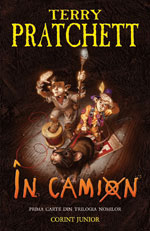
| Truckers | În camion | 2007 |
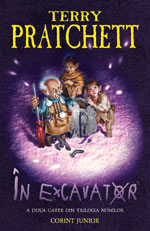
| Diggers | În excavator | 2007 |
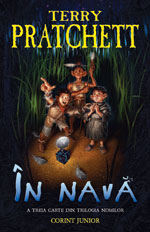
| Wings | În navă | 2007 |
The Romanian editions were published by Corint Junior and translated by Dan Doboș.
Other Romanian Editions
| Original title | Romanian title | Publisher |
|---|---|---|
| The Amazing Maurice and His Educated Rodents | Formidabilul Maurice și oastea rozătoarelor savante | Arthur |
| The Amazing Maurice and His Educated Rodents | Năstrușnicul motan Maurice | Arthur/ART Group, later film tie-in edition |
| Nation | Națiunea | Arthur |
| Good Omens (with Neil Gaiman) | Semne bune | Tritonic; later Paladin |
| The Long Earth (with Stephen Baxter) | Pământul lung | Nemira |
Formidabilul Maurice și oastea rozătoarelor savante and Năstrușnicul motan Maurice are editions of the same original novel, rather than separate works.
Similarly, the Tritonic and Paladin editions of Semne bune represent the same collaboration between Terry Pratchett and Neil Gaiman.
Romanian publication history is documented in greater detail in the complete bibliography, where original translations, later editions and reprints are distinguished.
🦋 Terry Pratchett on BookFairy
BookFairy currently features reviews of all three novels in The Bromeliad Trilogy.
📚 The Bromeliad Trilogy – BookFairy Reviews
1. Truckers by Terry Pratchett – Book Review
The opening novel introduces the Nomes and their unexpectedly complicated world.
2. Diggers by Terry Pratchett – Book Review
The second volume continues their struggle to adapt, survive and find somewhere to belong.
3. Wings by Terry Pratchett – Book Review
The trilogy reaches its conclusion as the Nomes confront larger questions about their origins and future.
These reviews reflect BookFairy’s reading experience and can be explored individually.
📚 Complete Terry Pratchett Bibliography
For a comprehensive chronological catalogue of Terry Pratchett’s work, including all 41 Discworld novels, independent novels, children’s fiction, short stories, collections, non-fiction, illustrated publications, collaborations and Romanian translations, explore the dedicated Terry Pratchett Complete Bibliography on BookFairy.
The bibliography distinguishes first publications from revised editions, omnibus collections, later reprints and alternative Romanian titles. It also provides publication and reading orders for the major series, alongside links to existing BookFairy reviews.
💭 Terry Pratchett’s Literary Legacy
Few fantasy authors have used imaginary worlds so effectively to examine reality.
Pratchett understood that fantasy could be funny without being superficial, critical without becoming cruel and deeply philosophical without losing its sense of wonder.
His characters are remembered not merely because they are entertaining, but because they represent recognisable human strengths and weaknesses.
From the reluctant heroism of Rincewind to the quiet dignity of Death, from Granny Weatherwax’s uncompromising sense of responsibility to Samuel Vimes’s determination to uphold justice, Pratchett created stories that remain relevant far beyond their fantastic settings.
His greatest literary achievement may be the way he encouraged readers to question the world while continuing to care about the people who inhabit it.
For readers who enjoy imaginative fantasy, intelligent humour and stories with genuine emotional and philosophical depth, Terry Pratchett remains an essential author.