
Arthur C. Clarke
Author Guide | BookFairy
📖 About Arthur C. Clarke
Arthur C. Clarke (1917–2008) was a British science-fiction writer, futurist and inventor, widely regarded as one of the most influential figures in the history of science fiction.
Born in Minehead, Somerset, England, Clarke developed an early fascination with astronomy, space exploration and science. His writing combined scientific knowledge with an extraordinary imagination, exploring humanity’s place in the universe, the possibilities of technological progress and the mysteries that might await us beyond Earth.
He is best known for 2001: A Space Odyssey, Childhood’s End, Rendezvous with Rama and The Fountains of Paradise. His stories frequently examine encounters with advanced civilisations, the evolution of human consciousness and the relationship between science and humanity’s future.
Beyond fiction, Clarke became an influential voice in scientific and technological discussions. His 1945 article on extraterrestrial relay stations anticipated the use of geostationary satellites for global communications.
Clarke spent much of his later life in Sri Lanka, where he continued writing and pursuing his interests in science, technology and underwater exploration.
His literary legacy extends across novels, short stories, essays and scientific writing, inspiring generations of readers, scientists and science-fiction authors.
✍️ Arthur C. Clarke’s Literary World
What makes Arthur C. Clarke particularly remarkable is the relationship between scientific possibility and philosophical imagination in his writing.
His stories frequently begin with extraordinary mysteries:
- An enormous alien spacecraft enters the Solar System.
- Humanity discovers evidence that an unknown intelligence has influenced its development.
- An apparently perfect civilisation encounters the limits of its own knowledge.
- New technology creates possibilities that previous generations considered impossible.
- Scientific discoveries force humanity to reconsider its place in the universe.
Clarke was fascinated by the idea that the cosmos might contain phenomena far beyond humanity’s present understanding.
His fiction often examines the consequences of discoveries rather than focusing exclusively on the discoveries themselves.
Throughout his work, several important themes emerge.
🌌 Humanity’s Place in the Universe
Clarke’s stories frequently challenge humanity’s assumption that it occupies a privileged position in the cosmos.
The discovery of extraterrestrial intelligence becomes an opportunity to reconsider human history, civilisation and the meaning of progress.
🔬 Science and Technological Progress
Scientific developments are central to Clarke’s fiction.
Space travel, artificial intelligence, satellite communications, planetary exploration and advanced engineering frequently shape his narratives.
Rather than presenting technology as inherently beneficial or dangerous, Clarke explores how its consequences depend on the societies that develop and use it.
👽 First Contact and Alien Intelligence
Few writers have explored extraterrestrial intelligence with Clarke’s combination of wonder and restraint.
His aliens are not always recognisable beings with human motivations.
Sometimes their presence is revealed through enormous structures, mysterious technologies or evidence of activities that humanity cannot fully comprehend.
🧠 Evolution and Transformation
Clarke repeatedly returns to questions about the future of human intelligence.
What might humanity become?
Could technological or biological change transform human consciousness?
And would future generations still recognise themselves as human?
These questions give many of his novels a philosophical dimension that extends beyond conventional space adventure.
🌠 Space Odyssey Series
The Space Odyssey series is among Arthur C. Clarke’s most celebrated achievements.
Beginning with 2001: A Space Odyssey, the novels explore artificial intelligence, human evolution and the influence of a mysterious extraterrestrial intelligence.
The first novel emerged from Clarke’s collaboration with filmmaker Stanley Kubrick.
Although the novel and film appeared in 1968, they developed alongside one another and contain important differences.
📚 Space Odyssey Reading Order
- 2001: A Space Odyssey (1968)
- 2010: Odyssey Two (1982)
- 2061: Odyssey Three (1987)
- 3001: The Final Odyssey (1997)
2001: A Space Odyssey (1968)
The first novel follows humanity’s encounters with mysterious objects associated with an intelligence far more advanced than our own.
Its exploration of artificial intelligence, evolution and cosmic mystery has made it one of the defining works of modern science fiction.
The character of HAL 9000 remains particularly significant in discussions about artificial intelligence and the relationship between humans and intelligent machines.
2010: Odyssey Two (1982)
The second novel returns to the mysteries introduced in 2001.
A new mission investigates events connected to the earlier expedition, bringing renewed attention to questions raised by humanity’s encounter with advanced extraterrestrial technology.
2061: Odyssey Three (1987)
The third novel continues Clarke’s exploration of humanity’s expanding presence in the Solar System.
New expeditions and scientific discoveries reveal further consequences of the events that transformed humanity’s understanding of the universe.
3001: The Final Odyssey (1997)
The final volume takes readers into a distant human future.
Clarke examines the evolution of civilisation, technological development and the unresolved mysteries that have shaped the entire series.
🛸 Rama Series
The Rama series begins with one of the most celebrated first-contact novels in science fiction.
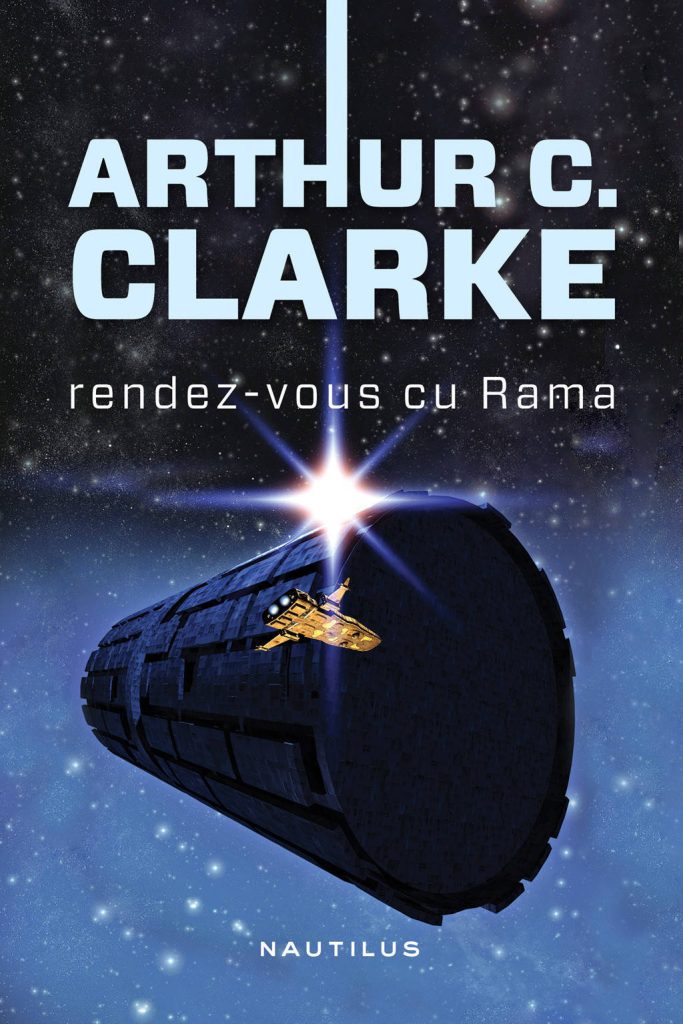
Rendezvous with Rama (1973)
When astronomers detect a vast cylindrical object entering the Solar System, a spacecraft is sent to investigate.
What initially appears to be an asteroid turns out to be an extraordinary artificial structure.
As the explorers enter the object, they encounter an environment that challenges their understanding of technology, intelligence and the universe.
Rendezvous with Rama is particularly notable for its sense of scale and mystery.
Rather than providing easy answers, Clarke allows readers to experience the wonder and uncertainty of encountering something genuinely alien.
The novel received both the Hugo Award and the Nebula Award.
Romanian title: Rendez-vous cu Rama
🦋 Rendezvous with Rama — BookFairy Review
📕 [Insert the cover of Rendezvous with Rama here and link the image to the existing BookFairy review.]
📖 Read My Review of Rendezvous with Rama on BookFairy
📚 Rama Reading Order
- Rendezvous with Rama (1973) — Arthur C. Clarke
- Rama II (1989) — Arthur C. Clarke and Gentry Lee
- The Garden of Rama (1991) — Arthur C. Clarke and Gentry Lee
- Rama Revealed (1993) — Arthur C. Clarke and Gentry Lee
The original novel is a complete reading experience in its own right.
The three sequels, written in collaboration with Gentry Lee, expand the fictional universe and develop its mysteries through a longer narrative.
The Rama Series in Romanian
All four principal novels have appeared in Romanian.
Their titles are:
- Rendez-vous cu Rama
- Rama II
- Grădina din Rama
- Război pe Rama
Editura Lucman published Romanian editions of all four volumes in 2002.
The first novel was also published by Editura Nemira.
The Romanian title Război pe Rama corresponds to the English novel Rama Revealed.
Gentry Lee later wrote additional novels set in the wider Rama universe, but those works are not part of the four-book Clarke and Lee sequence presented above.
⏳ A Time Odyssey Trilogy
Co-written with Stephen Baxter
The A Time Odyssey trilogy combines Arthur C. Clarke’s interest in advanced intelligence and human civilisation with Stephen Baxter’s expansive approach to science fiction.
The novels explore disruptions to time, extraordinary interventions in human history and threats extending beyond familiar ideas of space and time.
📚 A Time Odyssey Reading Order
- Time’s Eye (2004)
- Sunstorm (2005)
- Firstborn (2007)
Although the trilogy contains thematic connections to the ideas explored in Space Odyssey, it should be treated as a distinct series.
All three books are collaborations between Arthur C. Clarke and Stephen Baxter.
📚 Arthur C. Clarke’s Major Standalone Novels
Clarke’s literary legacy extends far beyond his principal series.
Many of his most influential works are standalone novels.
Childhood’s End (1953)
Childhood’s End examines humanity’s encounter with immensely powerful extraterrestrial visitors.
Although the newcomers initially appear to offer humanity the possibility of a peaceful and prosperous future, their presence raises profound questions about freedom, evolution and the destiny of the human species.
The novel is one of Clarke’s most important explorations of transcendence and humanity’s place in the cosmos.
Romanian title: Sfârșitul copilăriei
Romanian publisher: Nemira.
The City and the Stars (1956)
Set in an extraordinarily distant future, The City and the Stars follows a young inhabitant of a seemingly perfect city who begins questioning the foundations of his civilisation.
The novel explores isolation, memory, technological dependence and the human desire for discovery.
It is a substantial reworking of Clarke’s earlier Against the Fall of Night, rather than an ordinary sequel.
Romanian title: Orașul și stelele
Romanian publisher: Paladin, including a hardcover edition published in 2018.
The Deep Range (1957)
This novel turns Clarke’s scientific imagination toward Earth’s oceans.
Set in a future where humanity has developed sophisticated underwater industries, the story explores marine environments, technological progress and the ethical relationship between humans and other living creatures.
A Fall of Moondust (1961)
A disaster on the Moon becomes the basis for a story combining engineering challenges, suspense and scientific problem-solving.
The novel reflects Clarke’s interest in how human ingenuity might overcome extreme environmental conditions.
Imperial Earth (1975)
Set in a future Solar System, Imperial Earth explores interplanetary society, technological development, identity and the relationships between distant human communities.
The Fountains of Paradise (1979)
One of Clarke’s most important technological novels, The Fountains of Paradise explores the construction of a space elevator.
The enormous engineering project promises to transform humanity’s access to space.
The novel combines scientific speculation with questions about ambition, cultural history and technological progress.
Romanian title: Fântânile Paradisului
Romanian publisher: Paladin, with verified editions from 2014 and 2022.
The 2022 edition belongs to the Paladin SCI-FI Masters collection.
The Songs of Distant Earth (1986)
Set against the background of humanity’s efforts to survive beyond Earth, this novel explores interstellar travel, relationships and the emotional consequences of separation across enormous distances.
Its reflective approach makes it one of Clarke’s particularly memorable works.
The Ghost from the Grand Banks (1990)
The Ghost from the Grand Banks combines Arthur C. Clarke’s fascination with technological innovation, underwater exploration and one of the most famous maritime disasters in history.
Set in the near future, the novel follows ambitious attempts to recover the wreck of the RMS Titanic from the depths of the Atlantic Ocean.
As advanced engineering projects confront the enormous challenges of the ocean, Clarke explores humanity’s relationship with history, technological progress and the desire to achieve seemingly impossible goals.
The novel reflects his lifelong interest in underwater exploration and the extraordinary possibilities of scientific discovery.
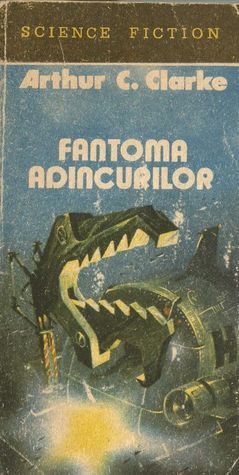
Romanian title: Fantoma adâncurilor
Romanian publisher: Valdo, 1992.
Romanian translators: Beatrice Kiseleff and Mihail Grămescu.
🦋 The Ghost from the Grand Banks — BookFairy Review
📕 [Insert the cover of Fantoma adâncurilor here and link the image to the existing BookFairy review.]
📖 Read My Review of The Ghost from the Grand Banks on BookFairy
The Hammer of God (1993)
The Hammer of God focuses on the threat posed by an asteroid approaching Earth.
The novel examines planetary defence, scientific responsibility and humanity’s attempts to prevent catastrophe.
The Last Theorem (2008)
Co-written with Frederik Pohl
Published in 2008, The Last Theorem was Clarke’s final novel.
The story combines mathematics, global politics, scientific ambition and extraterrestrial threats.
Its publication brought together two major figures of science fiction in a collaborative work.
Romanian title: Ultima teoremă
Romanian publisher: Nemira, with editions from 2010 and 2013.
Romanian translator: Roxana Brînceanu.
📖 Short Stories and Collections
Arthur C. Clarke was also a prolific writer of short fiction.
His shorter works frequently introduce extraordinary ideas with remarkable economy.
Among his best-known stories are:
- Rescue Party (1946)
- A Walk in the Dark (1950)
- The Sentinel (1951)
- The Nine Billion Names of God (1953)
- The Star (1955)
- The Wind from the Sun (1964)
Important collections include:
- Expedition to Earth (1953)
- Reach for Tomorrow (1956)
- Tales from the White Hart (1957)
- The Other Side of the Sky (1958)
- Tales of Ten Worlds (1962)
- The Nine Billion Names of God (1967)
- The Collected Stories of Arthur C. Clarke (2000)
These collections provide an opportunity to explore ideas that Clarke developed outside his longer novels.
Some stories appeared in several collections, so the complete bibliography will distinguish original publications from later reprints.
🔬 Arthur C. Clarke’s Non-Fiction
Arthur C. Clarke was not simply a novelist interested in science.
He was actively involved in scientific communication, technological forecasting and the promotion of space exploration.
His non-fiction publications cover astronomy, telecommunications, engineering and the future of civilisation.
Important works include:
- Interplanetary Flight (1950)
- The Exploration of Space (1951)
- The Exploration of the Moon (1954)
- Profiles of the Future (1962)
- The Promise of Space (1968)
- Ascent to Orbit (1984)
- How the World Was One (1992)
His writing helped make complex scientific ideas accessible to general readers.
Clarke’s interest in future technologies also demonstrates an important distinction between prediction and possibility: even when a particular invention had not yet become practical, he encouraged readers to consider the scientific principles that might eventually make it achievable.
🛰️ Arthur C. Clarke and Satellite Communications
In 1945, Clarke published an article titled Extra-Terrestrial Relays — Can Rocket Stations Give World-wide Radio Coverage?
In it, he described how satellites positioned in geostationary orbit could serve as communication relays.
Clarke did not invent the concept of geostationary orbit, but his proposal helped demonstrate its practical significance for global communications.
The idea became one of his most important contributions outside literature.
His combination of scientific analysis and imaginative thinking illustrates why he remains such an influential figure in discussions about technological innovation.
🇷🇴 Arthur C. Clarke in Romanian Translation
Arthur C. Clarke has a substantial publishing history in Romania.
His works have appeared through several publishers, including Nemira, Lucman, Paladin and Valdo.
Romanian readers have had access to major novels, complete series and works published in different editions over several decades.
🌠 Space Odyssey — Romanian Editions
Editura Nemira published the four novels of the Space Odyssey series.
| Original Title | Romanian Title | Publisher |
|---|---|---|
| 2001: A Space Odyssey | 2001: Odiseea spațială | Nemira |
| 2010: Odyssey Two | 2010: A doua odisee | Nemira |
| 2061: Odyssey Three | 2061: A treia odisee | Nemira |
| 3001: The Final Odyssey | 3001: Odiseea finală | Nemira |
The series has appeared in Romanian in different editions and formats.
The complete bibliography will identify the original Romanian publication history and distinguish later reprints.
🛸 Rama — Romanian Editions
The four principal Rama novels were published in Romanian by Editura Lucman.
| Original Title | Romanian Title | Publisher | Year |
|---|---|---|---|
| Rendezvous with Rama | Rendez-vous cu Rama | Lucman | 2002 |
| Rama II | Rama II | Lucman | 2002 |
| The Garden of Rama | Grădina din Rama | Lucman | 2002 |
| Rama Revealed | Război pe Rama | Lucman | 2002 |
Rendez-vous cu Rama also appeared through Editura Nemira.
The three sequels were co-written with Gentry Lee.
📚 Other Verified Romanian Editions
| Original Title | Romanian Title | Publisher | Verified Edition |
|---|---|---|---|
| Childhood’s End | Sfârșitul copilăriei | Nemira | Romanian edition confirmed |
| The City and the Stars | Orașul și stelele | Paladin | 2018 |
| The Fountains of Paradise | Fântânile Paradisului | Paladin | 2014; 2022 |
| The Ghost from the Grand Banks | Fantoma adâncurilor | Valdo | 1992 |
| The Last Theorem | Ultima teoremă | Nemira | 2010; 2013 |
📕 Paladin and the Arthur C. Clarke Collection
Editura Paladin, part of the ART publishing group, has published important works by Arthur C. Clarke in hardcover editions.
Among these are:
- Orașul și stelele — 2018.
- Fântânile Paradisului — editions from 2014 and 2022.
The two novels have also been offered together in an Arthur C. Clarke book package.
The 2022 edition of Fântânile Paradisului forms part of the Paladin SCI-FI Masters collection.
📖 Earlier Romanian Publishers
Clarke’s Romanian publishing history extends beyond recent editions.
Editura Lucman published the four principal Rama novels in 2002.
Editura Valdo published Fantoma adâncurilor in 1992.
These older editions are especially important for readers researching the history of science fiction publishing in Romania.
Additional historical editions and anthology appearances will be documented in the complete bibliography once their bibliographical details have been verified.
A Note for Collectors
When building a collection of Arthur C. Clarke’s works in Romanian, it is important to distinguish between:
- Original translations.
- Revised translations.
- Reprints by the same publisher.
- Editions issued by different publishing houses.
- Omnibus volumes and promotional book packages.
A new cover or format does not necessarily represent a new translation.
For this reason, the BookFairy bibliography will list each original work once while documenting relevant Romanian editions separately.
📚 Where to Start Reading Arthur C. Clarke
Arthur C. Clarke’s bibliography is extensive, but readers do not need to approach it chronologically.
His standalone novels provide excellent introductions to different aspects of his writing.
For Readers Interested in First Contact
Start with Rendezvous with Rama.
Its enormous alien structure, scientific exploration and sense of mystery make it one of Clarke’s most accessible introductions to extraterrestrial intelligence.
For Readers Interested in Artificial Intelligence
Start with 2001: A Space Odyssey.
The novel explores the relationship between humanity, intelligent machines and mysterious forces operating beyond human understanding.
For Readers Who Enjoy Philosophical Science Fiction
Start with Childhood’s End.
Its treatment of humanity’s future and transformation offers an introduction to Clarke’s more philosophical concerns.
For Readers Interested in Distant Futures
Start with The City and the Stars.
The novel explores civilisation, memory, curiosity and the desire to move beyond apparently perfect surroundings.
For Readers Interested in Engineering and Space Exploration
Start with The Fountains of Paradise.
Its central technological concept offers a compelling example of Clarke’s ability to turn scientific speculation into fiction.
For Readers Interested in the Ocean and Technological Mysteries
Start with The Ghost from the Grand Banks.
Its unusual premise combines the history of the Titanic with futuristic engineering and Clarke’s fascination with underwater exploration.
🦋 Arthur C. Clarke on BookFairy
Arthur C. Clarke occupies a special place in the history of science fiction.
His stories invite readers to imagine a universe far larger, older and stranger than human experience.
More importantly, they ask what humanity might become if curiosity, scientific discovery and technological progress continue to transform civilisation.
From the mysteries of Rendezvous with Rama to the philosophical questions of Childhood’s End and the technological imagination of The Fountains of Paradise, Clarke’s work continues to inspire readers interested in both science and speculative fiction.
This author guide is part of BookFairy’s growing collection of literary resources, connecting author biographies, complete bibliographies, reading recommendations, Romanian translations and personal book reviews.
📖 Arthur C. Clarke Book Reviews on BookFairy
The following Arthur C. Clarke novels have been reviewed on BookFairy:
- Rendezvous with Rama / Rendez-vous cu Rama — BookFairy Review
- The Ghost from the Grand Banks / Fantoma adâncurilor — BookFairy Review
Both reviews are featured alongside their respective novels above.
As more of Clarke’s works are reviewed, additional links will be added to this guide.
📚 Complete Arthur C. Clarke Bibliography
For a comprehensive chronological catalogue of Arthur C. Clarke’s novels, novellas, short stories, collections, non-fiction publications, collaborations and Romanian translations, explore the dedicated Arthur C. Clarke Complete Bibliography on BookFairy.
The bibliography distinguishes original works from revised versions, omnibus editions and later reprints, and includes publication dates, series reading orders and verified Romanian editions.
📖 Further Reading & Sources
- The Arthur C. Clarke Foundation — Biography
- King’s College London — Arthur C. Clarke
- Penguin Random House — Arthur C. Clarke
- Penguin Random House — Rama Series
- Penguin Random House — A Time Odyssey
- The Encyclopedia of Science Fiction — Arthur C. Clarke
- Nemira — Arthur C. Clarke
- Paladin — Arthur C. Clarke
- Editura ART — Arthur C. Clarke