 Science Fiction
 Military Science Fiction
 Space Opera

📝 First Impressions
What happens when a soldier is created rather than born? When someone enters the world already possessing the physical abilities of an adult, but without the memories, experiences and personal history that usually shape a human identity?
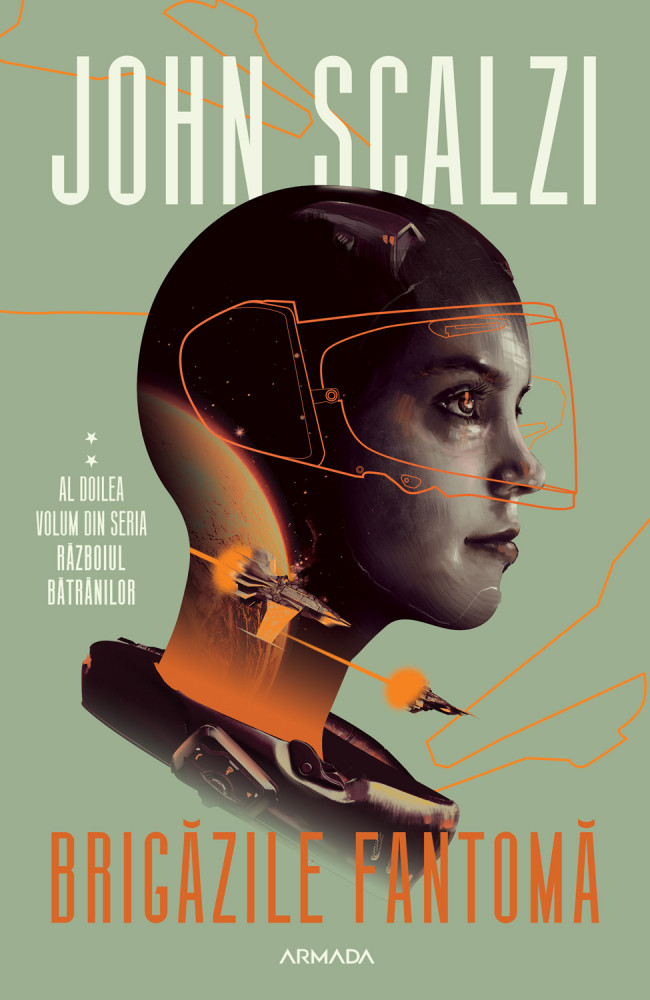
These are some of the fascinating questions explored in The Ghost Brigades, the second novel in John Scalzi’s Old Man’s War series.
Originally published in 2006, the novel returns to a universe where humanity’s expansion across the stars is anything but peaceful. Alien civilisations compete for territory, military conflict is an unavoidable part of colonial expansion, and the Colonial Defense Forces employ extraordinary technology to keep humanity alive.
After Old Man’s War, I was interested in discovering where Scalzi would take the series next. The first novel had made a stronger impression on me, and naturally, I hoped its sequel would prove equally satisfying.
Instead of continuing to follow John Perry as the central character, The Ghost Brigades shifts its attention towards the Colonial Defense Forces’ Special Forces: genetically engineered soldiers created specifically to undertake missions that ordinary troops might not survive.
Their existence immediately raises some uncomfortable questions.
Can someone created exclusively for warfare genuinely possess freedom of choice? What does individuality mean when your body has been designed by someone else? And if your memories originated with another person, where does their identity end and yours begin?
I found the concept behind these soldiers genuinely interesting. It expands the scientific possibilities of Scalzi’s fictional universe while introducing ethical dilemmas that go beyond the usual concerns of military science fiction.
Nevertheless, although the premise appealed to me, the novel as a whole didn’t quite measure up to its predecessor.
The Ghost Brigades remains an interesting continuation of the series, but for me, Old Man’s War was the stronger book.
💜 What I Loved
The fascinating concept of the Ghost Brigades
The idea behind the Ghost Brigades was easily one of the most interesting aspects of this novel.
Unlike ordinary human soldiers, these members of the Colonial Defense Forces are genetically engineered using the DNA of deceased individuals. Their bodies are created and developed for military service, giving them extraordinary physical capabilities.
They are designed to be stronger, faster and better adapted to dangerous situations than conventional human beings.
But it is not merely their physical construction that makes them fascinating.
These soldiers begin their existence without the ordinary childhood memories, family relationships and personal experiences through which most people develop their personalities.
They are effectively created for a purpose before they have any meaningful opportunity to discover who they are.
I found that idea intriguing.
Science fiction frequently imagines advances in genetic engineering, but the consequences become much more interesting when the technology is applied to human identity.
Creating an improved body is one thing. Creating a person whose entire existence has been planned around military usefulness is something else entirely.
It raises the question of whether these soldiers are genuinely individuals or simply highly sophisticated military resources.
And perhaps even more importantly, what happens when one of them begins to question the purpose for which they were created?
Jared Dirac and the question of identity
One of the central figures in the story is Jared Dirac, a Special Forces soldier created using the DNA of Charles Boutin, a scientist who has betrayed the Colonial Defense Forces.
Boutin possesses highly sensitive military information, and his cooperation with hostile alien species represents an enormous threat to humanity.
The military hopes that Jared, created from Boutin’s genetic material, might provide a way to recover the scientist’s memories and uncover the reasons behind his betrayal.
However, the process does not unfold as expected.
Jared initially develops as a soldier within the Ghost Brigades, but the possibility of Boutin’s memories resurfacing creates a particularly disturbing situation.
What would it mean to discover that fragments of another person’s life exist within your own mind?
Would those memories define who you are? Would they impose someone else’s choices upon you? Or could you still develop an identity entirely your own?
The premise introduces an interesting variation on the familiar science fiction question of what makes us human.
Our bodies certainly contribute to our identities, but so do our memories, relationships and decisions.
Jared’s circumstances challenge the idea that genetic material alone determines the person someone will become.
Even two individuals who share the same DNA need not share the same identity, loyalties or moral convictions.
This is where the novel’s speculative elements become particularly thought-provoking.
The ethical implications of engineered soldiers
The Ghost Brigades also raise broader questions about the responsibilities of the society that creates them.
These soldiers are designed for dangerous military operations. Their enhanced bodies and unusual development make them valuable assets to the Colonial Defense Forces.
Yet they are still human beings.
They can learn, develop relationships and make decisions. Their origins may be artificial, but that does not automatically make their existence less meaningful.
The distinction between creating a useful military resource and creating a conscious individual is enormously important.
If a person is manufactured specifically for combat, does that mean they have an obligation to fight?
Can consent be meaningful when someone has been shaped from the beginning to fulfil a predetermined purpose?
And how much freedom can exist within a military institution that regards obedience as essential?
These questions give the novel more substance than its military setting might initially suggest.
Scalzi uses futuristic technology to explore problems that are fundamentally human: autonomy, responsibility and the right to determine one’s own life.
The Ghost Brigades may have been created for war, but the possibilities of their existence extend beyond the battlefield.
Expanding the universe of Old Man’s War
Another strength of the novel is the way it develops the universe introduced in Old Man’s War.
The first book establishes the dangers of humanity’s expansion into space and the extraordinary measures taken by the Colonial Defense Forces to protect human colonies.
The Ghost Brigades approaches the same setting from a different perspective.
Rather than concentrating on the experience of an ordinary recruit entering an unfamiliar military system, the story examines an elite group whose members are created to function within that system from the beginning.
This shift allows Scalzi to explore parts of his fictional universe that had previously remained in the background.
The technology, military organisation and political tensions are all connected to the larger struggle for humanity’s survival.
The conflict involving Charles Boutin also reveals how dangerous the balance of power has become.
Humanity’s enemies are not merely isolated alien species encountered during individual battles. Alliances, intelligence and technological secrets can influence the future of entire civilisations.
The resulting story gives the Old Man’s War universe a broader political and military context.
Although I preferred the first novel overall, I can appreciate the decision to explore a different aspect of the same universe instead of simply repeating its original premise.
🤔 What Didn’t Quite Work for Me
A sequel that didn’t quite match the first book
My main reservation about The Ghost Brigades is straightforward: I found it weaker than Old Man’s War.
The first novel left a stronger overall impression, and this continuation did not quite reach the same level for me.
That does not mean the second book lacks interesting ideas. On the contrary, the concept of genetically engineered soldiers created from the DNA of deceased people is one of its most distinctive features.
But an intriguing premise and a satisfying reading experience are not necessarily the same thing.
As a sequel, The Ghost Brigades inevitably invites comparison with the novel that introduced this universe.
Old Man’s War had already established the setting, its unusual military technology and the larger conflict surrounding humanity’s expansion into space.
The second instalment therefore had the opportunity to build upon an existing foundation.
It certainly expands that foundation, particularly through the Ghost Brigades and Jared Dirac’s unusual circumstances.
Nevertheless, the overall experience was less compelling for me.
I appreciated the ideas without feeling that the novel surpassed what Scalzi had achieved in the first book.
An interesting premise, but a less satisfying overall experience
One of the challenges of reading a sequel is that expectations rarely begin from zero.
When the first instalment has made a strong impression, the continuation carries the additional burden of delivering something equally memorable.
That comparison is not always entirely fair, particularly when an author deliberately chooses to explore different characters and themes.
Still, it is difficult to separate a sequel from the expectations created by its predecessor.
The Ghost Brigades explores fascinating questions about manufactured life, inherited memories and personal autonomy. These themes provide plenty of material for readers who enjoy speculative fiction with a philosophical dimension.
Yet, taken as a complete novel, it did not have the same impact on me as Old Man’s War.
I would not describe it as a disappointing concept. The central premise is one of the reasons the book remains worth discussing.
Rather, this was a case where I found the ideas more compelling than my overall experience of the story.
It is a perfectly worthwhile continuation, just not one I enjoyed as much as the book that came before it.
👥 Who Would Enjoy This Book?
The Ghost Brigades is a natural choice for readers who enjoyed Old Man’s War and want to explore more of John Scalzi’s universe.
Although the novel introduces a different central character and a largely self-contained conflict, I would recommend beginning with the first book.
Having that background makes the military organisation, advanced technology and political tensions considerably easier to appreciate.
Fans of military science fiction will find a familiar combination of futuristic warfare, interstellar politics and genetically enhanced soldiers.
However, the novel is not exclusively concerned with battles and military operations.
Readers interested in genetic engineering, artificial memory and the nature of consciousness may find its central premise especially appealing.
Jared Dirac’s unusual existence creates opportunities to consider how much of our identity depends upon biology, memory and personal choice.
There is also plenty here for readers who enjoy stories about morally complicated institutions.
The Colonial Defense Forces are responsible for protecting humanity, but their methods raise difficult questions about the treatment of individuals created to serve their military objectives.
For readers who appreciate science fiction that combines action with ethical dilemmas, The Ghost Brigades offers an interesting mixture.
And if you enjoy space opera featuring competing alien civilisations, political alliances and threats to humanity’s survival, the wider conflict provides another reason to continue the series.
💭 Final Thoughts
The Ghost Brigades takes the universe of Old Man’s War in an interesting direction, moving away from John Perry’s original perspective to explore the genetically engineered soldiers of the Colonial Defense Forces.
The concept behind these soldiers was what interested me most.
Creating human beings from the DNA of deceased individuals specifically for military service is a fascinating premise, particularly when the story begins questioning the relationship between memory, identity and free will.
Jared Dirac’s circumstances provide a way to examine those ideas through someone whose existence challenges conventional definitions of individuality.
The novel also expands the political and military landscape of Scalzi’s universe, showing how complicated humanity’s position has become among hostile alien civilisations.
There is plenty of material here for readers who enjoy imaginative science fiction.
Nevertheless, I found this second instalment less satisfying than Old Man’s War.
The first book made a stronger impression on me, while The Ghost Brigades, despite its intriguing central concept, felt like a step down.
That does not make it an unsuccessful sequel or an uninteresting novel. It simply means that the overall reading experience did not reach the same level for me.
I appreciate Scalzi’s willingness to explore different corners of his fictional universe and introduce questions that go beyond military strategy and survival.
The ideas behind the Ghost Brigades are worth considering, even if I connected more strongly with the previous book.
Ultimately, The Ghost Brigades is an imaginative and thought-provoking continuation of the Old Man’s War series, but one that I enjoyed less than its predecessor.
✨ The BookFairy Verdict
The Ghost Brigades
📖 Book Details
| Detail | Information |
|---|---|
| Title | The Ghost Brigades |
| Romanian Title | Brigăzile fantomă |
| Author | John Scalzi |
| Series | Old Man’s War #2 |
| Genre | Science Fiction, Military Science Fiction, Space Opera |
| Publisher (EN) | Tor Books |
| Publisher (RO) | Nemira |
| Published (EN) | 2006 |
| Published (RO) | 2016 (first Romanian edition) |
| Pages (EN) | Varies by edition |
| Pages (RO) | 352 (2023 Armada edition) |
| Format Experienced | Paperback |
| Edition Owned | 2016 |
📚 Reading Order – Old Man’s War Series
- Old Man’s War (2005) – Războiul bătrânilor
- The Ghost Brigades (2006) – Brigăzile fantomă
- The Last Colony (2007) – Ultima colonie
- Zoe’s Tale (2008) – Povestea lui Zoe
- The Human Division (2013)
- The End of All Things (2015)

🛒 Buy the Book
If The Ghost Brigades sounds like your kind of read, you can support BookFairy by purchasing the book through the links below. It won’t cost you anything extra, and using these links helps support the site while allowing me to continue creating honest, independent book reviews.