
 Science Fiction
 Military Science Fiction

📝 First Impressions
War is often described in terms of victories, defeats, strategy and sacrifice. But what happens when the soldiers fighting that war become strangers to the very civilisation they are supposed to protect?
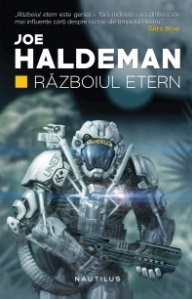
First published in 1974, The Forever War went on to win three of science fiction’s most prestigious literary awards: the Nebula Award for Best Novel in 1975, followed by the Hugo Award and the Locus Award in 1976. These achievements helped establish Joe Haldeman’s novel as one of the defining works of military science fiction.
That is one of the most fascinating questions at the heart of The Forever War, Joe Haldeman’s celebrated military science fiction novel. First published in 1974, the book combines interstellar warfare, relativistic space travel and the devastating human consequences of a conflict that seems to stretch beyond anyone’s understanding.
The story follows William Mandella, a young man recruited into humanity’s war against an alien species known as the Taurans. What begins as military training and a dangerous assignment gradually becomes something much more unsettling. Because of the effects of relativistic travel, Mandella experiences time differently from the people who remain on Earth. While he spends relatively short periods travelling and fighting, decades or even centuries can pass back home.
Every return brings a different world. Technology advances, society changes, and familiar ways of living disappear. The soldiers may survive their battles, but the lives they once knew are slipping further and further away.
I found this premise particularly compelling. The scientific concepts were interesting in themselves, but their consequences for Mandella made the story considerably more meaningful.
Although I enjoyed several aspects of the novel, particularly its treatment of time and its emotional undertones, I wasn’t equally convinced by everything. Some of the military confrontations left me wanting more, even as the larger ideas continued to hold my attention.
Ultimately, The Forever War was a thought-provoking reading experience, with concepts that stayed with me beyond the battles themselves.
💜 What I Loved
The fascinating consequences of interstellar travel
One of my favourite aspects of the novel was the way Haldeman explored relativistic space travel.
Science fiction often presents journeys between stars as extraordinary adventures, opportunities to discover distant worlds or encounter unfamiliar civilisations. Here, however, travelling through space comes with an enormous personal cost.
Mandella and his fellow soldiers experience relatively little time during their journeys, while the years continue accumulating on Earth. When they finally return, the difference can be staggering.
I loved the idea that someone could leave their planet, spend what feels like a manageable period away, and return to discover that the world has moved forward by generations.
It gives space exploration a completely different dimension. Distance is no longer the only obstacle separating people. Time itself becomes a barrier that cannot simply be crossed on the journey home.
What makes the concept especially interesting is how inevitably Mandella loses his connection with the society he once knew.
Every departure takes him further away from his own time. The people, customs, beliefs and relationships that once made Earth familiar become increasingly distant. Eventually, returning home no longer guarantees that he will feel at home.
I found that entirely understandable. How could someone maintain a sense of belonging when the world changes so dramatically between visits?
In a way, Mandella is travelling not only across space but also into the future, without having the opportunity to experience the gradual changes that brought humanity there.
And unlike a conventional time traveller, he cannot simply return to the past.
Seeing the battlefield through different eyes
Another detail I found surprisingly interesting was the technology used by the human soldiers to detect and visualise their enemies.
It reminded me of the Predator films, particularly the distinctive way the Predator perceives its surroundings through technology.
What made the association enjoyable was the shift in perspective. Instead of watching the Predator use advanced equipment to track its targets, I could imagine experiencing that technology-enhanced vision from the viewpoint of the person using it.
It gave certain aspects of the military technology an unexpectedly cinematic quality.
I enjoy science fiction that encourages me to imagine how unfamiliar technology might change something as basic as seeing the world around us. Here, it added another layer to the experience of combat and made the futuristic setting more interesting.
William Mandella and the loneliness of survival
Although the scientific ideas initially caught my attention, I also became attached to William Mandella.
He isn’t simply an interchangeable soldier moving from one battle to another. As the story progresses, the consequences of his experiences become increasingly personal.
He survives dangerous assignments, but survival doesn’t mean returning to the life he left behind.
Every journey widens the distance between him and the people of Earth. Even when he is physically home, the world he knew is disappearing into history.
I found myself feeling sorry for him.
There is something particularly cruel about surviving a war while gradually losing everything that once gave your life a sense of continuity. Mandella is still himself, but the society around him keeps changing.
His struggle becomes more than a matter of staying alive. It is also about finding somewhere, and someone, to whom he can still belong.
Mandella and Marygay
The relationship between Mandella and Marygay Potter added an emotional dimension that I appreciated.
In a story dominated by military assignments, technological developments and enormous jumps through time, their connection provides something recognisably human.
They understand experiences that people outside the war cannot easily share. Their relationship becomes especially important as the familiar world around them disappears.
I became invested in what happened to them, and their separation genuinely saddened me.
After everything Mandella had already endured, losing Marygay felt particularly painful. He had seen Earth change repeatedly and had become increasingly disconnected from ordinary human life. The possibility of losing someone who understood him made that isolation even harder to accept.
Their story illustrates something important about the novel: war does not destroy lives only through death and injury. It can also separate people, erase their sense of belonging and take away the future they imagined sharing.
A satisfying and hopeful ending
I was pleased with the ending, especially because Mandella and Marygay eventually find their way back to each other.
After so much separation and uncertainty, their reunion offers a welcome contrast to the emotional exhaustion of the war.
I also appreciated the final announcement of their child’s birth. After a story in which time repeatedly takes familiar things away from its characters, the possibility of beginning a family gives their experiences a sense of renewal.
For me, that conclusion worked.
Their reunion doesn’t erase the suffering they have endured, but it allows them to look towards something beyond survival.
In a novel concerned with the enormous distance between people, both physical and temporal, their relationship suggests that genuine human connection can still endure.
It was a satisfying way to finish such a bleak and unsettling journey.
🤔 What Didn’t Quite Work for Me
The battles sometimes felt rushed
My main disappointment concerned the way some of the military confrontations were presented.
As the novel progressed, I felt that certain battles happened too quickly. Rather than being fully developed events, they sometimes seemed to exist primarily to move Mandella towards another departure, another interstellar journey and another return to a dramatically changed Earth.
I understand why the repeated journeys matter. They are essential to the novel’s exploration of time, alienation and the absurdity of a seemingly endless war.
Nevertheless, I would have preferred some of the confrontations to receive more attention.
The preparations, military technology and consequences of combat could be fascinating, but the fighting itself did not always provide the same level of engagement.
At times, I felt that the story was rushing towards the next major passage of time.
This created an unusual imbalance. The consequences of the battles often interested me more than the battles themselves.
Perhaps that is partly the point. Haldeman isn’t writing a straightforward adventure in which each confrontation represents an exciting step towards victory. His war is confusing, wasteful and increasingly difficult to justify.
Still, recognising that intention did not completely remove my frustration as a reader.
I wanted the actual confrontations to carry more weight rather than occasionally feeling like transitions between the novel’s more compelling ideas.
An interesting concept doesn’t automatically make every scene engaging
The Forever War has an undeniably powerful premise, but I found the execution somewhat uneven.
I was deeply interested in the effects of time dilation, the changes taking place on Earth and Mandella’s growing emotional isolation. Those elements made me eager to discover what would happen next.
The military action, however, did not always sustain that same interest.
For a novel built around an interstellar conflict, I expected some of those encounters to feel more substantial.
This doesn’t mean I wanted the book to become an action-heavy space adventure. Its philosophical and emotional dimensions are precisely what make it distinctive.
I simply wished the balance between the fighting and its consequences had worked a little better for me.
👥 Who Would Enjoy This Book?
I would particularly recommend The Forever War to readers who enjoy science fiction that explores ideas beyond futuristic weapons and spectacular space battles.
Fans of military science fiction will find plenty to appreciate in its depiction of soldiers operating within an enormous and often bewildering conflict.
However, readers looking primarily for detailed combat sequences and continuous action should be aware that the novel’s real interests lie elsewhere.
This is also an excellent choice for anyone fascinated by relativistic travel, time dilation and the consequences of moving between the stars.
The idea that a relatively short personal journey could separate someone from centuries of human history is one of the book’s greatest strengths.
Readers interested in anti-war fiction may also appreciate the way Haldeman questions the purpose and human cost of prolonged military conflict.
And although romance is not the central focus, the relationship between Mandella and Marygay gives the novel a welcome emotional foundation.
Above all, I think this book will appeal to readers who enjoy science fiction that asks uncomfortable questions about humanity, belonging and the meaning of home.
💭 Final Thoughts
The Forever War is an important science fiction novel, and I can understand why it has maintained its reputation over the decades.
Haldeman takes the familiar premise of an interstellar war and uses it to explore something far more troubling: what happens to people when conflict separates them not only from their loved ones but also from their own place in history?
The treatment of relativistic travel was the aspect I found most fascinating. Mandella’s repeated journeys turn the passage of time into something almost as threatening as the enemy itself.
I also appreciated the emotional side of his story, particularly his relationship with Marygay and their eventual reunion.
At the same time, I wasn’t entirely satisfied with the pacing of the military encounters. Some felt too hurried, as though their primary function was to send the characters towards another enormous leap forward in time.
That prevented the novel from becoming a truly outstanding reading experience for me.
Nevertheless, its strongest ideas are memorable, and Mandella’s increasingly unfamiliar relationship with Earth gives the story a distinctive emotional weight.
I finished the book appreciating its imagination, its anti-war perspective and the humanity beneath its futuristic setting, even if the execution didn’t always meet my expectations.
For me, The Forever War is a worthwhile modern science fiction classic: imperfect in places, but fascinating in the way it transforms an interstellar conflict into a story about time, loss, love and the search for somewhere to belong.
✨ The BookFairy Verdict
The Forever War
📖 Book Details
| Detail | Information |
|---|---|
| Title | The Forever War |
| Romanian Title | Războiul etern |
| Author | Joe Haldeman |
| Series | The Forever War #1 |
| Genre | Science Fiction, Military Science Fiction, Space Opera |
| Publisher (EN) | St. Martin’s Press (original edition) |
| Publisher (RO) | Nemira – Nautilus |
| Published (EN) | 1974 |
| Published (RO) | 2015 |
| Pages (EN) | 236 (original edition) |
| Pages (RO) | 252 (2015 edition) |
| Format Experienced | Paperback |
| Edition Owned | Romanian paperback, Nemira – Nautilus |
📚 Reading Order – The Forever War Series
- The Forever War (1974) – The original novel introducing William Mandella and humanity’s interstellar war against the Taurans.
- A Separate War (1999) – A companion novella exploring Marygay Potter’s perspective.
- Forever Free (1999) – The direct novel sequel, continuing the story of Mandella and Marygay.
Forever Peace (1997) is a thematic companion novel, not a direct continuation of Mandella’s story.
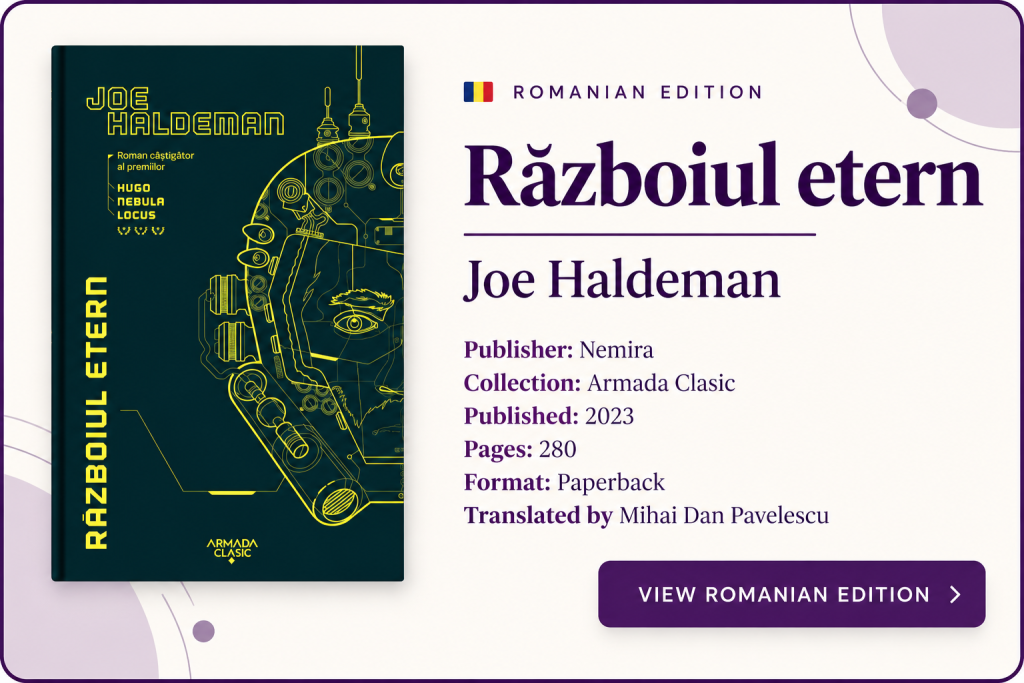
🛒 Buy the Book
If The Forever War sounds like your kind of read, you can support BookFairy by purchasing the book through the links below. It won’t cost you anything extra, and using these links helps support the site while allowing me to continue creating honest, independent book reviews.