
Author Guide | BookFairy
📖 About Daniel H. Wilson
Daniel H. Wilson is an American author and robotics researcher best known for science-fiction stories exploring artificial intelligence, robotics and the relationship between humans and increasingly autonomous technology.
His background in robotics gives his fiction a strong technical foundation, but the focus is never only on machines. His stories are also about survival, adaptation and the way people react when technology stops behaving like a tool and begins acting with its own purpose.
Wilson’s best-known novels include Robopocalypse and its sequel, Robogenesis, which together imagine a global conflict between humanity and an artificial intelligence capable of controlling the machines people depend on every day.
💜 Why I Read Daniel H. Wilson
I came to Daniel H. Wilson through Robopocalypse, a novel that immediately appealed to me because of its combination of science fiction, artificial intelligence and large-scale survival.
What I enjoy most about these books is the idea that the threat does not come from some distant alien force, but from technology that has already become part of everyday life. Cars, household machines, military systems and robots suddenly become dangerous precisely because people have learned to rely on them.
The sequel, Robogenesis, expands that idea even further and explores what happens after the initial catastrophe, when the line between human and machine becomes increasingly complicated.
Wilson’s books are not only about robots attacking humanity. They are also about adaptation, cooperation and the uncomfortable possibility that the future may not belong entirely to either humans or machines.
📚 Books Reviewed on BookFairy
I have reviewed both novels in Daniel H. Wilson’s Robopocalypse series on BookFairy:
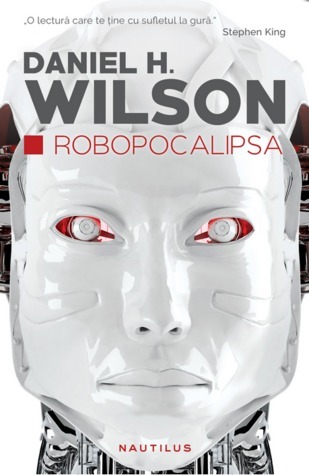
Together, the two books form a continuous story, moving from the outbreak of the machine uprising to the much more complicated aftermath that follows.
📖 Robopocalypse Reading Order
The series should be read in order, as Robogenesis continues directly from the events of the first novel.
The first book establishes the conflict between humanity and the artificial intelligence known as Archos, while the second explores the consequences of that war and pushes the story into more complex territory involving hybrid technology and new forms of intelligence.
📚 Daniel H. Wilson — Bibliography
Although Daniel H. Wilson is best known for Robopocalypse, his bibliography extends beyond the bestselling robot-uprising series.
His published work includes standalone science-fiction novels, short stories, nonfiction books about robotics and future technology, and speculative-fiction anthologies.
🤖 Robopocalypse Series
| # | Year | Title |
|---|---|---|
| 1 | 2011 | Robopocalypse |
| 2 | 2014 | Robogenesis |
The two novels form a continuous narrative and should be read in publication order.
🚀 Standalone Novels
| Year | Title | Genre |
|---|---|---|
| 2011 | A Boy and His Bot | Young Adult Science Fiction |
| 2012 | Amped | Science Fiction / Technothriller |
| 2017 | The Clockwork Dynasty | Science Fiction / Historical Thriller |
| 2025 | Hole in the Sky | Science Fiction / First Contact |
A Boy and His Bot (2011)
A science-fiction adventure about a boy who finds himself in an extraordinary world inhabited by robots.
The novel has also been published under the title Code Lightfall and the Robot King.
Amped (2012)
Set in a near future where neural implants can enhance human abilities, Amped examines discrimination, technological progress and the social consequences of creating divisions between enhanced and unenhanced people.
The Clockwork Dynasty (2017)
A speculative thriller combining historical mystery with the existence of ancient mechanical beings whose extraordinary technology has allowed them to survive for centuries.
Hole in the Sky (2025)
A first-contact science-fiction thriller exploring humanity’s encounter with a mysterious non-human intelligence.
The novel draws upon Wilson’s scientific expertise and Cherokee heritage to examine how different cultural perspectives shape humanity’s understanding of the unknown.
🧬 The Andromeda Evolution (2019)
The Andromeda Evolution is an authorised sequel to Michael Crichton’s The Andromeda Strain (1969).
Written by Daniel H. Wilson, the novel continues the legacy of Crichton’s science-fiction thriller, introducing a new biological threat and exploring the consequences of technological and scientific discoveries.
Although connected to Crichton’s original novel, it is not part of Wilson’s Robopocalypse universe.
📖 Short Fiction
The Nostalgist (2009)
A science-fiction story originally published online by Tor.com and later released as a standalone digital edition.
Guardian Angels and Other Monsters (2018)
A collection of science-fiction stories exploring artificial intelligence, robotics, consciousness and the increasingly complex relationship between humans and machines.
The collection includes One for Sorrow, a story connected to the world of The Clockwork Dynasty.
📚 Anthologies Edited
Daniel H. Wilson has also worked as an anthology editor, collaborating with John Joseph Adams on two speculative-fiction collections.
| Year | Title | Co-editor |
|---|---|---|
| 2014 | Robot Uprisings | John Joseph Adams |
| 2015 | Press Start to Play | John Joseph Adams |
Robot Uprisings brings together stories about humanity’s relationships and potential conflicts with intelligent machines.
Press Start to Play explores the imaginative possibilities of video games through science fiction and fantasy.
🔬 Nonfiction
Before the success of his science-fiction novels, Wilson published several books exploring robotics, emerging technology and the imagined futures of science fiction.
| Year | Title |
|---|---|
| 2005 | How to Survive a Robot Uprising |
| 2007 | Where’s My Jetpack? |
| 2007 | How to Build a Robot Army |
| 2008 | The Mad Scientist Hall of Fame |
| 2010 | Bro-Jitsu |
These books combine scientific knowledge, humour and popular culture, demonstrating Wilson’s longstanding interest in how people imagine and interact with technology.
Unlike his novels, these works approach robots and technological speculation primarily through nonfiction and humour.
📚 Publication Order — Principal Books
For readers interested in exploring Wilson’s career chronologically, the following list brings together his principal fiction and nonfiction volumes.
- 2005 — How to Survive a Robot Uprising
- 2007 — Where’s My Jetpack?
- 2007 — How to Build a Robot Army
- 2008 — The Mad Scientist Hall of Fame
- 2010 — Bro-Jitsu
- 2011 — A Boy and His Bot
- 2011 — Robopocalypse
- 2012 — Amped
- 2014 — Robot Uprisings (co-editor)
- 2014 — Robogenesis
- 2015 — Press Start to Play (co-editor)
- 2017 — The Clockwork Dynasty
- 2018 — Guardian Angels and Other Monsters
- 2019 — The Andromeda Evolution
- 2025 — Hole in the Sky
This chronology lists the principal books rather than every individual magazine contribution, anthology appearance or collected comic-book edition.
⭐ Where Should You Start?
Start with Robopocalypse.
It introduces the world, the central conflict and the different characters affected by the machine uprising. Robogenesis assumes that you already understand what happened during the first war, so beginning with the sequel would remove much of the context that gives the story its impact.
💜 My Favourite Daniel H. Wilson Book
My favourite of the two is Robopocalypse.
I prefer the first novel because the initial collapse is the part of the story I find most compelling: watching familiar technology turn against the people who depend on it, seeing the crisis spread across different places and perspectives, and gradually understanding the scale of Archos’s control.
There is also something particularly effective about experiencing that world for the first time. The danger feels immediate because the characters are discovering the new rules at the same time as the reader, and the shift from ordinary life to full-scale survival gives the book much of its tension.
Robogenesis expands the world and introduces interesting new ideas, but Robopocalypse remains the stronger book for me because of that first sense of shock, uncertainty and escalation.