 Science Fiction
📝 First Impressions
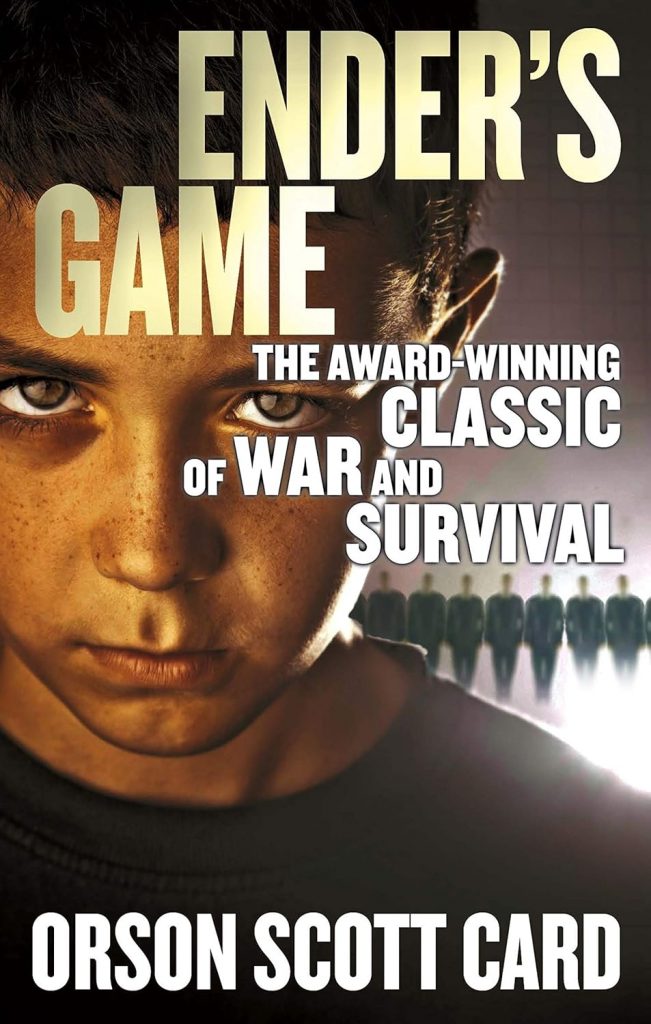
Ender’s Game by Orson Scott Card is one of those rare science fiction novels that has stayed with me for years. This wasn’t my first time reading it—in fact, I’ve revisited it several times over the years, and every reread has revealed something new. It’s the kind of story that changes depending on your own life experience. What first felt like an exciting tale about a gifted child gradually became a much deeper exploration of leadership, isolation, responsibility, and the impossible choices that shape us.
I’ve also watched the film adaptation, and while I enjoyed seeing Ender’s world brought to life on screen, returning to the novel reminded me just how much of its emotional and psychological depth exists within Orson Scott Card’s writing. The book allows you to spend time inside Ender’s mind in a way that no adaptation can fully capture.
Even decades after its original publication, Ender’s Game by Orson Scott Card feels remarkably modern. Its questions about war, ethics, education, manipulation, and the burden placed on exceptional children remain just as relevant today as they were when the novel first appeared. That timeless quality is one of the reasons I continue coming back to it.
💜 What I Loved
One of the greatest strengths of Ender’s Game by Orson Scott Card is the way it blends an exciting science fiction adventure with surprisingly deep psychological storytelling. At first glance, the novel appears to be about brilliant children training for an interstellar war, but beneath that premise lies a thoughtful exploration of leadership, empathy, sacrifice, and the cost of victory.
The Battle School remains one of the most memorable settings I’ve encountered in science fiction. Every challenge feels carefully designed, and watching Ender adapt to increasingly impossible situations is genuinely fascinating. Rather than relying on action alone, Orson Scott Card builds tension through strategy, problem-solving, and intelligence. The battles are exciting not because of explosions, but because every decision matters.
Ender himself is one of the reasons I keep returning to Ender’s Game by Orson Scott Card. He’s exceptionally gifted, yet he never feels unrealistic or invincible. Despite his intelligence, he remains a lonely child placed under extraordinary pressure by adults who constantly manipulate him in the name of humanity’s survival. His internal conflict gives the novel an emotional depth that elevates it far beyond a typical military science fiction story.
I also appreciated how morally complex the story becomes. There are very few clear heroes or villains, and the novel repeatedly asks difficult questions without offering easy answers. Is it acceptable to sacrifice one person for the greater good? Can empathy exist alongside warfare? Does understanding your enemy make it easier—or harder—to fight them? These themes become more meaningful every time I revisit the book, which is one of the reasons Ender’s Game by Orson Scott Card rewards rereading so well.
Another aspect I admire is Orson Scott Card’s pacing. Despite dealing with philosophy, ethics, military strategy, and politics, the novel never feels slow. Every chapter pushes Ender’s journey forward while gradually revealing more about the world and the enormous expectations placed upon him. Even though I’ve read the novel several times, I still found myself completely engaged.
Finally, I love how timeless Ender’s Game by Orson Scott Card feels. Although it was originally published in the 1980s, its discussions about leadership, education, manipulation, artificial intelligence, prejudice, and the consequences of war remain remarkably relevant today. Few science fiction novels manage to entertain while also encouraging readers to question their own assumptions, and that’s what continues to make this book stand out decades after its publication.
🤔 What Didn’t Quite Work for Me
As much as I admire Ender’s Game by Orson Scott Card, there are a few aspects that have never completely worked for me, even after multiple rereads.
The biggest one is the pacing during certain sections of the Battle School. While the strategic exercises are brilliantly conceived, some of the training sequences can feel repetitive. I understand why they’re necessary—they demonstrate Ender’s growth and the relentless pressure placed upon him—but occasionally I found myself wanting the story to spend more time exploring the wider universe beyond the station.
Another element that may divide readers is the supporting cast. Several characters are memorable, particularly Graff, Valentine, and Peter, but many of Ender’s fellow students blend together. Their primary purpose is often to challenge or support Ender’s development rather than exist as fully realised individuals in their own right. It isn’t a major flaw, but it’s something I noticed again during this reread.
I also think Ender’s Game by Orson Scott Card asks readers to accept that children are capable of handling responsibilities that would overwhelm most adults. Within the context of the novel, the premise is convincing enough, yet it still requires a certain suspension of disbelief. Readers looking for a more realistic portrayal of childhood may find this difficult to embrace.
Finally, although the novel explores morality with remarkable depth, some of its emotional moments pass by surprisingly quickly. There were times when I wished Orson Scott Card had allowed certain scenes a little more space to breathe, giving both Ender and the reader additional time to process the consequences of what had happened before moving on to the next challenge.
That said, none of these points diminish my appreciation for Ender’s Game by Orson Scott Card. If anything, they highlight how ambitious the novel is. It attempts to balance military science fiction, psychological drama, philosophical questions, and coming-of-age storytelling within a relatively concise book—a balance that, for the most part, it achieves remarkably well.
👥 Who Would Enjoy This Book?
Ender’s Game by Orson Scott Card is an excellent choice for readers who enjoy science fiction that goes beyond futuristic technology and space battles. While the novel certainly delivers exciting military strategy and imaginative world-building, its real strength lies in the questions it asks about leadership, empathy, morality, and the consequences of our choices.
I would especially recommend Ender’s Game by Orson Scott Card to readers who enjoy character-driven science fiction. If you appreciate stories where intellectual challenges are just as important as physical action, this novel offers a refreshing change from more traditional space operas.
Fans of books such as Dune, The Forever War, Red Rising, Skyward, or The Hunger Games will likely find plenty to enjoy here. Although each approaches conflict differently, they all explore how extraordinary circumstances shape young protagonists and force them to confront difficult moral decisions.
Despite featuring children as its main characters, Ender’s Game by Orson Scott Card is not a middle-grade novel. Its themes are surprisingly mature, making it just as rewarding for adult readers as it is for younger audiences. In fact, many of the ethical questions become even more thought-provoking with age, which is one of the reasons I believe this book rewards rereading.
If you’re new to science fiction and are looking for a novel that balances accessibility with meaningful ideas, Ender’s Game by Orson Scott Card is an excellent place to start. And if you’re already a longtime fan of the genre, it’s easy to understand why this novel continues to be regarded as one of the modern classics of science fiction literature.
💭 Final Thoughts
There are very few science fiction novels that I return to again and again, but Ender’s Game by Orson Scott Card has earned that place on my bookshelf. Every time I revisit it, I discover something I hadn’t fully appreciated before. As a teenager, I was captivated by the clever battle simulations and Ender’s extraordinary intelligence. Reading it again as an adult, I found myself focusing much more on the emotional weight of his journey, the ethical dilemmas woven throughout the story, and the enormous cost of asking a child to carry the fate of humanity on his shoulders.
One of the reasons Ender’s Game by Orson Scott Card has remained a classic for so many decades is its remarkable balance between entertainment and substance. It delivers exciting tactical challenges and memorable science fiction concepts while never losing sight of the people behind the conflict. The novel constantly reminds us that intelligence alone is not enough—true leadership also requires compassion, understanding, and the willingness to question the price of victory.
Although I’ve also seen the film adaptation, the novel remains the definitive experience for me. The film captures many of the key moments, but it cannot fully recreate Ender’s internal struggles or the gradual psychological development that makes the book so compelling. If you’ve only watched the movie, I would strongly encourage you to read Ender’s Game by Orson Scott Card as well—you’ll discover a far richer and more emotionally nuanced story.
Whether you’re picking up Ender’s Game by Orson Scott Card for the first time or returning to it years later, it’s a novel that continues to reward thoughtful readers. Its themes of empathy, responsibility, and the consequences of our decisions feel just as relevant today as they did when it was first published. Few books manage to remain both deeply entertaining and intellectually engaging across multiple generations, and that’s exactly why this novel continues to deserve its place among the greatest works of modern science fiction.
✨ The BookFairy Verdict
Ender's Game
📖 Book Details
Title: Ender’s Game
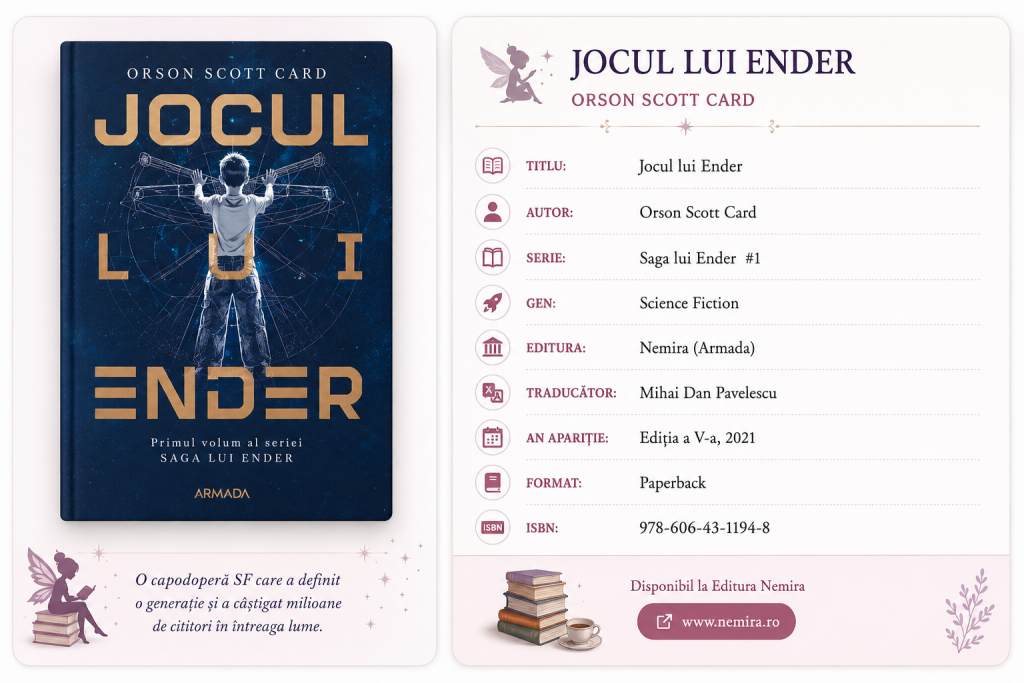
Romanian Title: Jocul lui Ender (Editura Nemira)
Author: Orson Scott Card
Series: Ender’s Saga (#1)
Genre: Science Fiction
Publisher (English): Tor Books
Publisher (Romanian): Nemira (Armada)
First Published: January 1985
Format Experienced: Audiobook (Romanian)
Edition Owned: Hardback (Romanian)
Pages: 324 (English first edition)
🛒 Buy the Book
If Ender’s Game sounds like your kind of book, you can support BookFairy by purchasing the book through the links below. It won’t cost you anything extra, and using these links helps support the site while allowing me to continue creating honest, independent book reviews.
📚 Waterstones
📕 Hardcover
📗 Paperback
📦 Amazon UK
📕 Hardcover
📗 Paperback
📘 Kindle Edition
📱 Kobo
📘 eBook
🎧 Audiobook